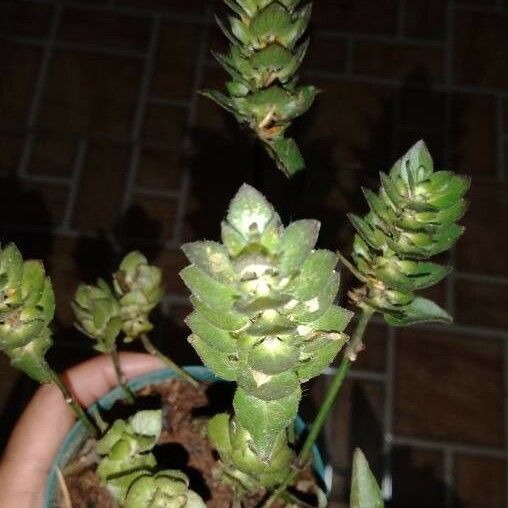
Plant Overview
Known as the "Green-shrimp plant" or "Browne's Blechum," this humble tropical herb is a master of disguise. Often mistaken for a common weed in lawns and roadsides throughout the Caribbean and Central America, it is actually a resilient groundcover with a rich history in folk medicine. Its unassuming green spikes serve as a vital nursery for some of the world’s most beautiful tropical butterflies.
🔍 How to Identify
- 🌿 The "Pyramid" Spikes: The most distinct feature is the terminal spikes made of overlapping green, leaf-like bracts that form a four-sided square or "pyramid" shape.
- 🌸 Hidden Blooms: Small, trumpet-shaped flowers in pale lavender, mauve, or white peek out shyly from between the green bracts.
- 📐 Square Stems: Like many members of its family, its stems are noticeably square to the touch and tend to creep along the ground, rooting at the joints (nodes).
🏡 In Your Garden
- 🌱 Opportunistic Growth: This plant thrives in moist, disturbed soil. If you find it in your garden, it’s likely because the area stays damp and shaded—it loves "waste places" where other plants might struggle.
- 🦋 Butterfly Magnet: If you are trying to attract wildlife, don’t pull this "weed!" It is a primary host plant for the Malachite butterfly and the White Peacock butterfly, providing essential food for their caterpillars.
⚠️ Safety & Toxicity
- ✅ Generally Safe: Blechum pyramidatum is not known to be toxic to touch and is generally safe around pets and children.
- 🍵 Medicinal Use Caution: While it is used in traditional Caribbean medicine to create "cooling" teas for fevers or digestive issues, you should never ingest wild plants without expert pharmacological knowledge, as misidentification can be dangerous.
✨ Fun Fact
In traditional folk practices, the leaves of this plant are often crushed and used as a poultice to treat "Mal de Ojo" (the Evil Eye) or to soothe itchy skin rashes and fungal infections!

Detailed Care Instructions
To grow Blechum Pyramidatum plant, follow these steps:
- Choose the right location: Blechum Pyramidatum plants thrive in bright, indirect sunlight. Select a spot that receives moderate to bright light throughout the day.
- Optimal temperature: These plants prefer warm temperatures of around 65-80°F (18-27°C). Protect them from drafts and cold temperatures, as they are sensitive to low temperatures.
- Soil requirements: Use well-draining soil that is rich in organic matter. A mix of regular potting soil and perlite or sand works well for this plant.
- Watering: Keep the soil moist but not waterlogged. Water the plant when the top inch of soil feels dry to the touch. Avoid overwatering, as it can lead to root rot.
- Humidity: Blechum Pyramidatum plants prefer high humidity. You can increase humidity by placing the pot on a tray filled with pebbles and water or by using a room humidifier.
- Fertilization: Feed the plant every two weeks during the growing season (spring and summer) using a balanced, water-soluble fertilizer. Follow the instructions on the fertilizer packaging for proper dosage.
- Pruning: Prune your Blechum Pyramidatum plant regularly to maintain a compact shape and encourage bushy growth. Trim back any leggy or overgrown branches to promote new growth.
- Propagation: You can propagate Blechum Pyramidatum plants through stem cuttings. Take a cutting from a healthy stem, remove the lower leaves, and place it in a glass of water until roots develop. Then, transfer it to a pot with well-draining soil.
- Pests and diseases: Keep an eye out for common houseplant pests like spider mites or aphids. If you notice an infestation, treat it with an appropriate insecticide or try a natural remedy like insecticidal soap.
- Repotting: Repot your Blechum Pyramidatum plant every 1-2 years or when it becomes root-bound. Choose a slightly larger pot with fresh, well-draining soil.
Remember to regularly inspect your plant for any signs of stress or pests and provide it with the required care. With proper attention and care, your Blechum Pyramidatum plant will thrive and grow.
To ensure proper growth and health of this plant, it is important to follow proper watering techniques. It is recommended to water the plant deeply and thoroughly, but not too frequently. Allow the top inch of soil to dry out before watering again.
When watering, ensure that the water is distributed evenly around the entire plant and not just in one spot. Avoid getting water on the foliage as this can lead to fungal diseases.
This plant prefers to be kept moist but not soggy. Over-watering can lead to root rot, so it is important to check the soil moisture level regularly before watering.
In drier climates, misting the plant with water can help increase humidity levels, but this should not replace proper watering.
During the winter months, reduce watering frequency as the plant's growth slows down.
To fertilize this plant, apply a balanced fertilizer with equal amounts of nitrogen, phosphorus, and potassium once every two weeks during the growing season. Dilute the fertilizer to half strength and pour it directly into the soil around the base of the plant, avoiding contact with the foliage. Water the plant thoroughly after fertilizing. During the dormant season, reduce fertilizer applications to once a month and use a low-nitrogen fertilizer.
Blechum pyramidatum is a species of plant that is best grown in well-draining and nutrient-rich soil. The soil should have a neutral to slightly acidic pH level, ideally between 6.0 and 7.5. A mix of organic compost, sand, and perlite can be used to create an ideal soil composition for this plant. Additionally, the soil should be kept consistently moist, but not waterlogged, and the plant should be located in a spot that receives bright, indirect sunlight. Careful attention to soil quality and conditions will help ensure healthy growth and flowering of Blechum pyramidatum.
Blechum Pyramidatum is a beautiful flowering perennial plant that can be propagated easily through stem cuttings. Here are the steps to propagate Blechum Pyramidatum:
- Select a healthy stem from the mother plant that is at least 4-6 inches long.
- Cut the stem just below a leaf node using a clean, sharp knife or pruning shears.
- Remove all the leaves from the bottom 2 inches of the stem, leaving only a few leaves on the top.
- Dip the cut end of the stem into rooting hormone powder to promote root growth.
- Fill a pot with well-draining soil and make a small hole in the center of the soil with a pencil or your finger.
- Insert the cutting into the soil, making sure at least 2 inches of the stem is buried in the soil.
- Water the soil thoroughly and cover the pot with a clear plastic bag.
- Place the pot in a warm, bright location but avoid direct sunlight.
- In a few weeks, the cutting should start developing roots.
- Once the roots are well-established in the soil, remove the plastic bag and continue to water the plant regularly.
- You can transplant the new Blechum Pyramidatum plant to a larger pot or plant it directly in the ground outdoors.
By following these simple steps, you can successfully propagate Blechum Pyramidatum and enjoy its beautiful blooms in your garden.








