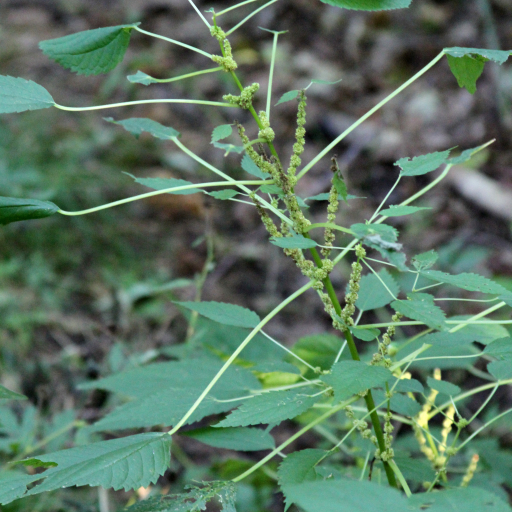
Plant Overview
Often called the "Bog Hemp" or "False Nettle," this plant is the gentle, polite cousin of the infamous stinging nettle. While it mimics the look of its prickly relatives almost perfectly, it completely lacks the painful stinging hairs, making it a "friendly" addition to damp landscapes. Native to North America, it thrives in the shadows where other plants might struggle with "wet feet."
🔍 How to Identify
- 🍃 The Leaves: Broad, oval, and sharply serrated (toothed) edges. They grow in pairs directly opposite each other along the stem, featuring three prominent veins branching from the base.
- 🌾 The Flowers: Tiny, greenish-white blossoms clustered on stiff, upright spikes that emerge from where the leaves meet the stem. These "cylindrical" spikes give the plant its botanical name.
- 🦯 The Stem: A sturdy, upright stem that can reach up to three feet tall. Crucially, it is smooth or slightly hairy, but never possesses the needle-like injectors found on true nettles.
🏡 In Your Garden
- 💧 The Moisture Specialist: This is a "hydrophyte," meaning it thrives in saturated soils. It is the perfect candidate for a rain garden, the edge of a pond, or those soggy, shaded spots in your yard where grass refuses to grow.
- 🦋 A Butterfly Nursery: If you find the leaves being munched on, don't reach for the pesticide! False Nettle is a primary host plant for several beautiful butterflies, including the Red Admiral, the Question Mark, and the Eastern Comma.
⚠️ Safety & Toxicity
- ✅ Touch-Safe: You can brush against this plant or pull it with bare hands without fear. It does not produce the formic acid that causes the "nettle sting."
- 🐾 Pet & Child Friendly: False Nettle is generally considered non-toxic to humans, cats, and dogs. It is far more likely to be an inhabitant of a wild "pollinator garden" than a threat to your household.
✨ Fun Fact
Despite its nickname "Bog Hemp," you won't get any psychoactive effects from this plant. However, its inner bark is incredibly fibrous and strong; historically, it was used by various cultures to weave durable cordage and fishing nets.

Detailed Care Instructions
To grow Boehmeria cylindrica, also known as false nettle or boehmeria, you can follow these steps:
- Choose a suitable planting location: Find a spot that receives partial shade to full sun. Boehmeria cylindrica prefers moist, well-draining soil.
- Prepare the soil: Amend the soil with organic matter like compost or well-rotted manure to improve its fertility and drainage.
- Sow seeds or transplant seedlings: You can either start Boehmeria cylindrica from seeds or purchase seedlings from a nursery. If starting from seeds, sow them in seed-starting trays filled with seed-starting mix. Keep the soil consistently moist until the seedlings germinate and reach a suitable transplant size (usually several inches tall). Transplant the seedlings into the prepared soil, spacing them around 12-18 inches apart.
- Water regularly: Boehmeria cylindrica likes consistently moist soil. Water the plant regularly, especially during dry periods. However, ensure that the soil doesn't become waterlogged, as this can lead to root rot.
- Mulch: Apply a layer of organic mulch around the plant to help retain moisture, suppress weeds, and regulate soil temperature.
- Fertilize as needed: Boehmeria cylindrica generally doesn't require heavy fertilization. However, if your soil is lacking in nutrients, you can apply a balanced, slow-release fertilizer during the growing season. Follow the manufacturer's instructions for application rates.
- Control weeds: Regularly remove weeds from around the plant to prevent competition for nutrients and water.
- Prune if desired: Boehmeria cylindrica can be pruned to maintain a desired shape and size. Pruning also helps rejuvenate the plant and promote bushier growth.
- Monitor for pests and diseases: Watch out for common garden pests like aphids, whiteflies, and caterpillars. Treat as necessary with organic pest control methods. Boehmeria cylindrica is generally not prone to serious diseases, but keep an eye out for any signs of fungal diseases or leaf spots, and treat accordingly.
- Harvest if desired: Boehmeria cylindrica can be harvested for its fibers, which can be used for making textiles. Harvest stems when they are mature (usually in late summer or early fall) and process them to extract the fibers.
By following these steps, you can successfully grow Boehmeria cylindrica in your garden or landscape.

Place in a dark room with little light, like a dark bedroom or a spot far away from a window or directly in a north-facing window.

To water this plant, it is important to ensure that the soil is consistently moist but not waterlogged. One way to achieve this is by watering the plant deeply and thoroughly once per week, or more frequently during hot and dry weather. It is also helpful to use a well-draining potting soil and a container with drainage holes to prevent water from accumulating in the roots. Additionally, avoid overhead watering as this can lead to fungal and bacterial diseases. Instead, aim to water the soil directly around the base of the plant.
To fertilize this plant, you should use a balanced fertilizer with a ratio of 10-10-10. Apply the fertilizer in the spring and summer, making sure to follow the instructions on the package for the correct application rate. Water the plant well before and after fertilizing to help distribute the nutrients evenly throughout the soil. Avoid fertilizing in the fall or winter when the plant is dormant.
Boehmeria Cylindrica plant can be grown in well-drained, loamy soil that is rich in organic matter and has a slightly acidic to neutral pH level. The soil should not be too heavy or compacted as this can hinder root development and growth. It should also retain moisture well, but not be waterlogged. A soil mix with a good balance of organic matter, such as compost or peat moss, sand, and perlite, can provide the necessary nutrients and drainage for Boehmeria Cylindrica plant to thrive. Additionally, adding a slow-release fertilizer to the soil mix can help promote healthy growth and flowering. It's best to avoid using soil that is heavy in clay or sand as they can negatively impact the plant's growth.
Boehmeria cylindrica plant can be propagated through stem cuttings or seeds.
To propagate through stem cuttings, select a healthy stem from the parent plant and cut it at a 45-degree angle, ensuring that the cutting is at least 4 inches long and has 2-3 leaves attached to it. Remove the lower half of the leaves from the cutting. Dip the cut end into rooting hormone powder and insert it into a pot with well-draining soil. Water the soil and cover the pot with a plastic bag to create a humid environment. Place the pot in a bright, indirect light area and keep the soil consistently moist until roots develop. After roots develop, remove the plastic bag and gradually expose the plant to less humidity over the course of a week.
To propagate Boehmeria cylindrica through seeds, sow the seeds in a pot with well-draining soil, covering them with a thin layer of soil. Water the soil and keep it consistently moist but not waterlogged. Place the pot in a bright, indirect light area. Germination can take anywhere from 1-3 weeks. Once the seedlings have grown their second set of true leaves, transplant them into separate pots with well-draining soil.








