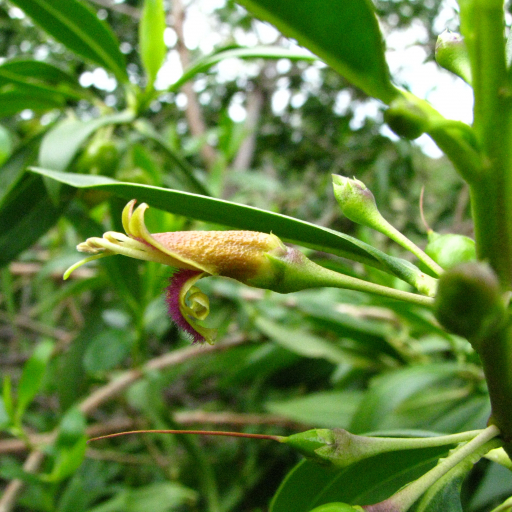
Plant Overview
Commonly known as the White Alling or Wild Olive, this Caribbean native is a master of disguise. While it mimics the silver-green elegance of a true Mediterranean Olive tree, it actually belongs to the Scrophulariaceae family, making it a closer relative to Snapdragons than your favorite kitchen oils. It is a resilient evergreen that thrives where other plants struggle, particularly along sun-drenched coastlines.
🔍 How to Identify
- 🍃 Lance-Shaped Leaves: The foliage is narrow, pointed, and leathery, closely resembling the leaves of a Daphne or a Willow, providing a dense and bushy texture.
- 🌸 Spotted Blooms: Look for small, tubular flowers that are creamy yellow or greenish on the outside, while the lower "lip" is dusted with beautiful purple or brownish spots.
- 🍒 Mimicry Fruit: It produces fleshy, egg-shaped fruits with a pointed tip that ripen from green to a dark, olive-like brown, which is where its common nickname originates.
🏡 In Your Garden
- 🌊 Salt Spray Specialist: This is one of the best choices for seaside landscapes. It is exceptionally salt-tolerant and can act as a "first line of defense" windbreak for more sensitive inland plants.
- ✂️ The Living Fence: Because of its upright growth habit and ability to bounce back from heavy trimming, it is frequently used as a formal hedge or a dense privacy screen.
- ☀️ Drought Endurance: Once established, the White Alling is remarkably water-wise. It prefers well-draining soil and can survive long periods of dry weather without losing its lush appearance.
⚠️ Safety & Toxicity
- 🚫 Mildly Toxic: The White Alling is generally considered toxic if ingested. It should not be confused with the edible Olive (Olea europaea).
- 🐾 Keep Pets Away: The attractive-looking fruits can be tempting to dogs or cats; ensure they are planted in areas where pets won't snack on fallen berries, as they can cause gastrointestinal distress.
✨ Fun Fact
- 📜 Scientific Tribute: The genus name Bontia was created to honor Jacobus Bontius, a 17th-century Dutch physician who is often considered the father of tropical medicine for his early studies of plants in the East Indies.

Detailed Care Instructions
To grow Bontia Daphnoides (also known as Coastal Dogwood), you can follow these steps:
- Choose a suitable location: Bontia Daphnoides prefers moist and well-drained soil. Select a spot that provides partial shade or filtered sunlight.
- Soil preparation: Prepare the soil by removing any weeds, rocks, or debris. Bontia Daphnoides prefers slightly acidic soil with a pH range of 5.5 to 6.5. If your soil is alkaline, consider adding organic matter like compost or peat moss to lower the pH.
- Planting: Dig a hole twice as wide and deep as the plant's root ball. Place the plant in the hole, making sure the top of the root ball is level with the ground. Fill the hole with soil and gently firm it around the plant.
- Mulching and watering: Apply a layer of organic mulch around the base of the plant to retain moisture and suppress weeds. Water the plant thoroughly after planting and continue to provide regular watering to keep the soil consistently moist, but not waterlogged.
- Pruning: Bontia Daphnoides generally doesn't require extensive pruning. However, if necessary, you can prune the plant in early spring before new growth appears to maintain its shape and remove any dead or damaged branches.
- Fertilization: You can apply a balanced slow-release fertilizer in early spring to provide essential nutrients. Follow the package instructions for the correct dosage.
- Protection: Bontia Daphnoides is generally resistant to diseases and pests. However, to avoid any potential issues, ensure good air circulation around the plant and promptly remove any diseased or damaged foliage.
- Propagation: Bontia Daphnoides can be propagated through seeds or by taking semi-hardwood cuttings in late summer or early autumn. Sow the seeds in a seed tray with well-draining soil and maintain a consistent moisture level until germination occurs. For cuttings, ensure they have a node, remove the lower leaves, and plant them in a pot filled with a mix of potting soil and perlite. Place the pot in a warm, well-lit area and mist the cuttings regularly until they root.
Remember, Bontia Daphnoides is a slow-growing plant, so be patient in seeing substantial growth. With proper care and maintenance, it will gradually establish and thrive.

Place in a bright room that is sun drenched almost all day. Or directly in a south-facing window.

1. Know the watering requirements: Before watering the plant, it is essential to know its watering requirements. Identify how much water the plant needs and how often it should be watered. Overwatering or underwatering can harm the plant's growth, so it is crucial to provide adequate water according to the plant's needs.
2. Check the soil: Check the soil moisture level before watering the plant. One way to check the soil is to stick your finger about an inch deep into the soil. If the soil feels dry, it is time to water. If it still feels moist, wait for a few more days before watering.
3. Watering frequency: The watering frequency depends on various factors like the size of the pot, location, humidity levels, and season. Generally, water the plant once a week, but during the hot summer months, the plant may require watering twice a week.
4. Watering technique: When watering the plant, make sure to water the soil around the plant instead of directly watering the leaves or stem. Water the plant slowly, allowing the soil to absorb the water gradually. Avoid using cold water or hot water as it can shock the roots.
5. Drainage: Ensure that the pot has proper drainage holes at the bottom. This will allow excess water to drain out of the soil and prevent waterlogging.
6. Moisture retention: After watering the plant, mulching can help retain the soil's moisture level. Cover the soil with a layer of organic matter like leaves, straw, or grass clippings.
7. Observation: Keep an eye on the plant's growth and foliage. Wilting leaves or yellowing foliage may be a sign of underwatering, while yellowing and mushy leaves could indicate overwatering. Adjust the watering schedule accordingly by evaluating the plant's needs.
To fertilize this plant, apply a balanced fertilizer with equal amounts of nitrogen, phosphorus, and potassium in early spring. Repeat again in late summer or early fall. Be sure to follow package instructions for application rates. Avoid applying fertilizer during the winter months or in excessive amounts, as this may damage the plant.
When planting the specific plant mentioned, ensure that the soil is well-draining and loamy. The ideal pH range for this plant is between 5.5 to 7.5, so test the soil's pH before planting. The soil should be enriched with organic matter such as compost or aged manure. A soil mixture that includes sand or vermiculite can also help with drainage. The plant prefers a moist but not waterlogged soil, so ensure that the soil is not too dense and allows for adequate water penetration. It is recommended to avoid using heavy clay soils, as they can lead to waterlogging and nutrient deficiencies.
To propagate this plant, you will need to collect seeds from ripened berries or take stem cuttings in the spring. To collect the seeds, wait until the berries have turned completely black and are soft to the touch. Remove the seeds from the berries and plant them in a seed-starting mix. Keep the soil moist and warm (around 70°F) until the seeds germinate.
To take stem cuttings, select healthy stems that are at least 6 inches long and have several sets of leaves. Cut the stems just below a node (where a leaf attaches to the stem) and remove the leaves from the bottom few inches of the stem. Dip the cut end of the stem in rooting hormone and plant it in a mixture of equal parts peat moss and sand. Keep the soil moist and warm (around 70°F) until roots form.
Regardless of the propagation method you choose, give the new plants plenty of light and water until they are established. Then, transplant them into their permanent locations in well-draining soil and partial shade.








