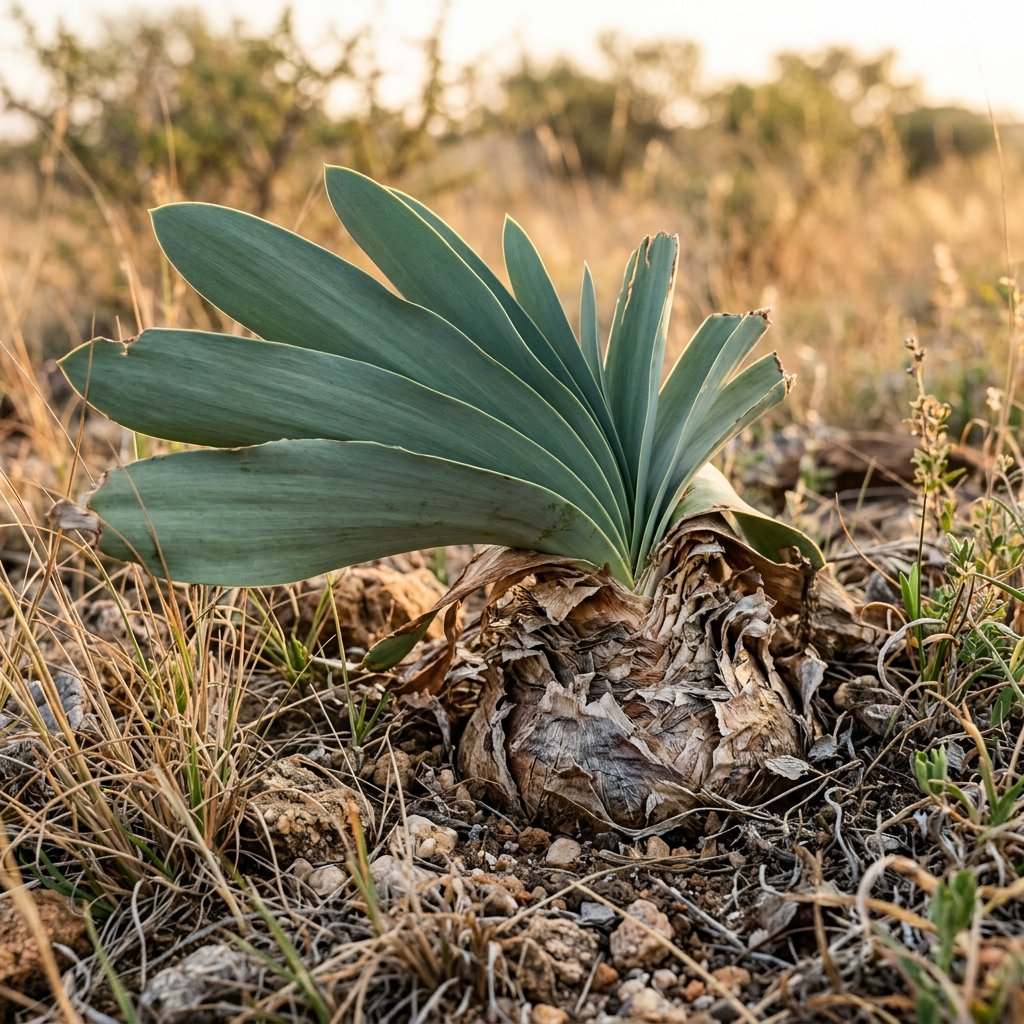
Plant Overview
Meet the Boophone disticha, often called the "Sore-eye Flower" or "Fan-leaved Boophone." This striking South African native is famous for its architectural elegance and its legendary, albeit dangerous, history. Its most iconic feature is the perfectly symmetrical, fan-like arrangement of its leaves, making it a dramatic centerpiece for any succulent collector or arid-land enthusiast.
🔍 How to Identify
- 🪭 Leaf Arrangement: The long, wavy, grey-green leaves grow in a precise, upright fan shape, resembling an open hand or a peacock’s tail spread wide.
- 🧅 The Bulb: It possesses a massive, scaly bulb that often sits partially above the soil, covered in hundreds of papery layers that protect it from intense heat and bushfires.
- 🎆 The Bloom: Before the leaves emerge, it sends up a large, spherical cluster of pinkish-red flowers on a thick stalk, looking very much like a slow-motion firework explosion.
🏡 In Your Garden
- 🏜️ Drainage is Key: This plant is a sun-worshipper and requires exceptionally well-draining, sandy soil. It is highly prone to rot if kept in soggy conditions, especially during its dormant period.
- 🛑 The Deep Anchor: Boophone develops a massive, thick root system and absolutely hates being moved. Because it relies on a long taproot, transplanting can be fatal or set the plant back several years, so choose its "forever home" carefully.
⚠️ Safety & Toxicity
- 🚫 Status: Extremely Toxic. This plant should be handled with great caution and is not recommended for households with curious pets or small children.
- 🏹 Historical Danger: Every part of the plant contains potent alkaloids. Historically, it was used by indigenous tribes in Southern Africa to create poison-tipped arrows for hunting.
- 👁️ The "Sore-Eye" Effect: Its common name comes from the belief that spending too much time near the blooming flowers in a confined space can cause eye irritation, hay fever, or even a localized headache.
✨ Fun Fact
- 🌪️ Nature's Tumbleweed: Once the seeds are ripe, the entire dried flower head (the umbel) snaps off at the stem. It then rolls across the plains with the wind like a tumbleweed, scattering its seeds across the landscape as it bounces along!

Detailed Care Instructions
To grow Boophone Disticha, also known as the desert hyacinth, you can follow these steps:
- Climate and soil conditions: Boophone Disticha is native to arid regions, so it requires a well-draining soil that is rich in organic matter. It can tolerate a wide range of temperatures but prefers warm climates. Ensure the plant receives full or partial sunlight.
- Propagation: Boophone Disticha can be propagated through seeds or bulbs. If you have access to bulbs, these are usually the easier and faster option. Bulbs should be planted in the late spring or early summer, making sure they are planted in the correct orientation (flat side down and pointed side up). If using seeds, they should be sown in a well-draining seed raising mix, barely covered, and kept warm and moist until germination.
- Planting: Choose a location with plenty of space for the Boophone Disticha to spread and grow. Dig a hole deep and wide enough to accommodate the bulb, ensuring the top of the bulb remains above the soil surface. Backfill the hole with soil, gently firming it around the bulb.
- Watering: Water the plant thoroughly after planting to settle the soil. Afterward, water the Boophone Disticha sparingly, allowing the soil to dry out between waterings. Overwatering can cause the bulb to rot. The plant is drought-tolerant and adapted to survive with minimal water.
- Fertilizing: Apply a slow-release balanced fertilizer to the soil during the growing season. Follow the manufacturer's instructions for dosage recommendations. Additional organic matter, such as compost or well-rotted manure, can also be added to the soil to enhance its fertility.
- Maintenance: Remove any weeds or competing plants around the Boophone Disticha to prevent them from robbing nutrients and water. You may also need to protect the plant from strong winds or frost if you live in a colder climate.
- Blooming and dormancy: Boophone Disticha typically blooms in late summer or early autumn. After flowering, the plant may enter a dormant period. During this time, reduce watering and allow the foliage to naturally wither and die back. When the plants are dormant, it is crucial to keep them dry to prevent rot and promote healthy bulb development.
By following these guidelines, you can successfully grow Boophone Disticha. Remember to research any specific requirements related to your climate and gardening conditions.

Place in a window with dappled sun or a spot in the middle of a room. Or directly in a window facing west or east.

Boophone Disticha plant prefers to be watered thoroughly but infrequently. Try to avoid over-watering the plant as it can cause root rot. It is important to allow the soil to dry out completely between waterings. Ensure that the soil isn't too waterlogged, as the plant's roots can quickly become damaged.
When watering, you should thoroughly soak the soil until water drains out of the bottom of the pot. Allow the plant to dry out before watering again. During the growing season (spring and summer), this plant may need watering once a week or every 10 days. In the dormant season (fall and winter), you may need to water less often.
You can check if your Boophone Disticha plant needs water by sticking your finger or a wooden skewer into the soil. If it comes out dry, it's time to water. If the soil is still damp, wait a few more days before checking again.
Overall, it is important to be mindful of the watering needs of your Boophone Disticha plant. By watering properly and not too frequently, you will ensure that your plant stays healthy and strong.
To fertilize this plant, use a balanced fertilizer with an NPK ratio of 10-10-10 or 20-20-20. Apply the fertilizer every two weeks during the growing season, which is spring and summer. Use half the recommended strength to avoid over-fertilizing the plant. Water the plant thoroughly after each fertilization to help the nutrients reach the roots. Do not fertilize during the dormant season of fall and winter.
Boophone Disticha plant is a type of plant that requires well-draining soil with a sufficient amount of organic matter. The soil should have good aeration and drainage capabilities to prevent waterlogging and root rot. The pH of the soil should be slightly alkaline around 7.0, and the soil should be deep enough to allow the plant to spread its roots. A soil mixture of coarse sand, perlite, and peat moss in a ratio of 1:1:1 is recommended for this plant. It is also important to provide the plant with enough sunlight and water to ensure healthy growth. Avoid overwatering the plant as it may rot the roots, and avoid placing it in areas with cold drafts or temperatures below 10 degrees Celsius.
Boophone Disticha plant can be propagated through bulb division. This method involves separating bulbs from the parent plant and planting them in a suitable growing medium. Bulbs should be carefully removed from the parent plant and allowed to dry for a few days before planting. It is essential to ensure that each bulb has intact roots and leaves. After planting, bulbs need to be kept in a warm, humid environment with bright, indirect light until new growth appears. Watering should be moderate, and the soil should be well-draining to prevent root rot. With proper care, Boophone Disticha plant can easily propagate through bulb division and produce new thriving plants.








