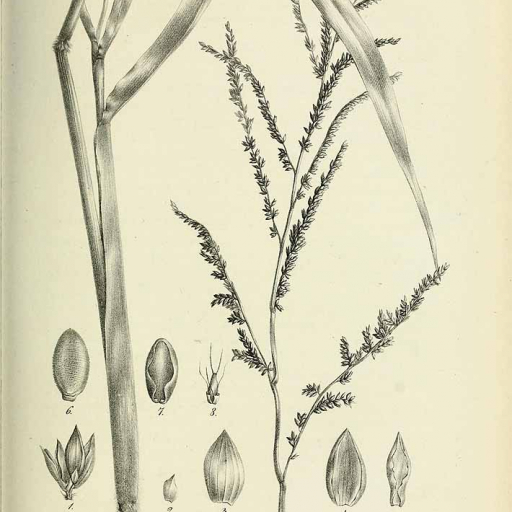
Plant Overview
Known affectionately as Para Grass or "Buffalo Grass," this vigorous traveler from Sub-Saharan Africa has paddled its way across the tropical world. It is a semi-aquatic specialist, often described as a "living carpet" for its ability to scramble over mud and floating debris. While it is a prized high-quality fodder for livestock, in a garden or wild wetland, it is a spirited colonizer that loves to keep its feet wet.
🔍 How to Identify
- 🌿 Hairy Nodes: The most distinct giveaway is the "knees" (nodes) along the stem, which are densely covered in a ruff of soft, white spreading hairs.
- 📏 Creeping Stolons: Look for thick, hollow stems that "crawl" along the ground. These runners can stretch up to 15 feet long, rooting firmly into the mud at every joint they form.
- 🍃 Broad Blades: The leaves are a vibrant dark green, relatively wide (up to 20mm), and taper to a sharp point, often appearing slightly crinkled along the edges.
🏡 In Your Garden
- 💧 The Water Lover: This isn't a grass for a dry rockery. It thrives in stagnant water, marshes, and poorly drained ditches. If you have a low-spot in your yard that stays soggy, Para Grass will happily fill it, acting as a natural filter and soil stabilizer.
- ✂️ Vigorous Habit: Because it can grow from a single broken node, it can be "pushy." In a home landscape, it requires regular boundary trimming to prevent it from leaping out of its designated area and smothering smaller ornamentals.
⚠️ Safety & Toxicity
- ✅ Safe Status: Para Grass is generally considered non-toxic to humans and common household pets like dogs and cats.
- 🐄 Grazer's Note: While it is excellent cattle feed, it can occasionally accumulate high levels of oxalates or nitrates if heavily fertilized. For the average gardener, however, it poses no chemical threat to touch or breath.
✨ Fun Fact
Para Grass is a botanical "scuba diver." It is so well-adapted to wet environments that it can survive being completely submerged under floodwaters for several weeks, waiting patiently for the tide to go down to resume its rapid growth!

Detailed Care Instructions
To grow Brachiaria Mutica, also known as para grass or buffalo grass, you can follow these steps:
- Choose the right location: Brachiaria Mutica prefers full sun but can tolerate partial shade. It thrives in moist, well-drained soil.
- Prepare the soil: Clear the area of weeds and grass. Loosen the soil by tilling or raking it. Add organic matter like compost or well-rotted manure to improve soil fertility.
- Planting: Brachiaria Mutica is commonly propagated through seeds or vegetatively by stem or root cuttings. If using seeds, sow them directly on the prepared soil at a depth of about 1/4 inch. If using cuttings, simply plant them into the soil.
- Watering: Keep the soil moist but not waterlogged. Water the newly planted seeds or cuttings regularly to establish their roots. Once established, Brachiaria Mutica has good drought tolerance.
- Fertilizing: Apply a balanced fertilizer at the beginning of the growing season to promote healthy growth. Follow the fertilizer manufacturer's instructions for the appropriate amount and frequency of application.
- Weed control: Regularly remove any weeds that compete with the Brachiaria Mutica plants. Mulching can also help suppress weed growth.
- Pruning: Prune the plants periodically to maintain a desired height, typically 4-6 inches. This helps encourage denser growth and prevents the grass from becoming too tall and floppy.
- Propagation: Brachiaria Mutica spreads easily through stolons (aboveground runners) and rhizomes (underground stems). You can propagate the plant by dividing healthy clumps and replanting them.
- Pest and disease management: Monitor the plants for pests like grasshoppers or armyworms and treat them accordingly. Brachiaria Mutica is relatively resistant to diseases, but it is always good practice to inspect the plants for any signs of infection.
- Harvesting: Brachiaria Mutica can be used for grazing animals, hay production, or erosion control. Harvest by cutting the grass about 4-6 inches above the ground level, leaving enough for it to regrow.
Remember to check with local agricultural extension services or horticultural experts for specific recommendations and guidelines tailored to your region or climate.

Place in a bright room that is sun drenched almost all day. Or directly in a south-facing window.

To water this specific type of plant properly, one should ensure that the soil remains moist but not waterlogged. It is important to water deeply and infrequently, allowing enough time for the soil to dry out in between waterings. It is recommended to water in the early morning or late afternoon/evening to reduce evaporation loss and minimize stress on the plant. Additionally, it is important to avoid getting water on the plant's leaves as this can increase the likelihood of fungal diseases.
- Before applying any fertilizer, test the soil pH levels to ensure they are between 6.0 and 7.5.
- Choose a complete fertilizer with equal parts nitrogen, phosphorus, and potassium, such as 10-10-10 or 20-20-20.
- Apply the fertilizer in early spring or late fall, when the plant is actively growing, at a rate of 2 pounds per 1,000 square feet.
- Spread the fertilizer evenly over the soil surface, avoiding direct contact with the plant leaves.
- Water the area well after applying the fertilizer to allow the nutrients to penetrate the root zone.
- Repeat the fertilizer application every 6-8 weeks during the growing season, reducing the amount by half each time.
- Monitor the plant for signs of overfertilization, such as stunted growth or yellowing leaves, and adjust the fertilization schedule accordingly.
Brachiaria Mutica is a plant species that requires specific soil conditions to grow optimally. The ideal soil for Brachiaria Mutica is one that is well-draining, with a neutral to slightly acidic pH level. It prefers sandy or loamy soil with good nutrient content, high organic matter, and good water holding capacity. The soil should be well-aerated, and it should have good drainage to prevent waterlogging. Fertilizers rich in nitrogen and phosphorus should be applied regularly to improve soil fertility. However, excess fertilizer application should be avoided, as it can lead to environmental pollution. The soil should be kept moist but not waterlogged to ensure maximum growth and productivity of the plant. Ultimately, the soil type and quality of the soil determine the growth and yield of Brachiaria Mutica, and it is important to choose the right type of soil to ensure optimal growth.
Propagation of the plant with scientific name Brachiaria Mutica can be done by using either seeds or vegetative propagation techniques. With seeds, collect them from a mature plant and then plant them in a suitable growing medium. The seeds should be placed in a warm and moist environment until they germinate, after which they can be transplanted into individual pots and then gradually acclimatized to the outdoor environment.
Vegetative propagation can be done using stem cuttings or by dividing the root system of a mature plant. For stem cuttings, select suitable stems and ensure that they are at least 4-6 inches long with several leaves attached. Remove the lower leaves and then plant the cutting in a suitable growing medium, ensuring that the soil is moist and that the cutting receives adequate light.
Root division can be done by carefully digging up a mature plant and then dividing its roots into several smaller portions. Each portion should have a few stems and roots attached and can then be replanted into separate pots or directly into the soil in a suitable outdoor location.
Propagation of Brachiaria Mutica is easy to do with either of these techniques, and it is a hardy plant that can grow in a variety of conditions.








