Plant Overview
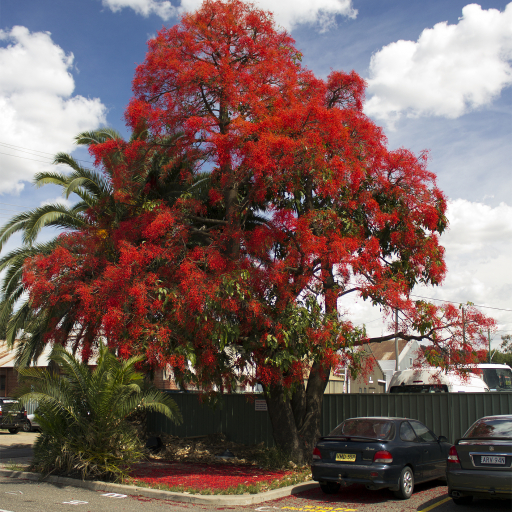
Meet the Brachychiton, Australia’s dramatic gift to architectural landscaping. Known by evocative nicknames like the "Bottle Tree," "Flame Tree," or "Kurrajong," these resilient giants are famous for their swollen, water-storing trunks and spectacular seasonal displays. Whether they are erupting in fiery red blooms or standing as a sculptural silhouette in a dry landscape, they bring a touch of prehistoric wonder to any setting.
🔍 How to Identify
- 🌳 The "Bottle" Trunk: Many species, particularly the B. rupestris, develop a distinctive bulbous trunk as they age, which functions as a living canteen to survive long droughts.
- 🍁 Variable Foliage: The leaves are incredibly diverse; depending on the species and age of the tree, they can range from simple lance-shapes to deeply lobed patterns resembling maple leaves.
- 🔔 Waxy Bell Flowers: They produce clusters of bell-shaped flowers that lack true petals. Instead, they feature a colorful, fused "calyx" that can be brilliant scarlet, creamy white, or pale pink.
🏡 In Your Garden
- 🌞 Sun & Space: These trees are sun-worshippers that crave heat. Because they are adapted to the Australian Outback, they are exceptionally drought-tolerant once established and are perfect for low-water "xeriscaping."
- 🧱 Taproot Nuance: Brachychiton species develop deep taproots early in life. This makes them wind-resistant but very difficult to move. It is vital to choose their "forever home" carefully, as they often suffer or die if transplanted once they have matured.
- 🍂 Strategic Deciduousness: Don't panic if your tree drops its leaves! Many species, like the Illawarra Flame Tree, shed their foliage entirely right before a massive flowering event to ensure the blooms are visible to pollinators.
⚠️ Safety & Toxicity
- ✅ General Safety: Most Brachychiton species are considered non-toxic to humans, cats, and dogs.
- 🧤 The "Itchy" Seed Pods: Exercise caution when handling the woody, boat-shaped seed pods. The seeds inside are often coated in fine, star-shaped hairs that can cause significant skin, eye, and throat irritation. Always wear gloves if you plan to harvest or inspect the seeds.
✨ Fun Fact
The name Brachychiton is derived from the Greek words brachys (short) and chiton (tunic), which refers to the unique, fuzzy coating found on the seeds inside the pods!

Detailed Care Instructions

To properly water this plant, it is important to consider the soil moisture level and the environmental conditions. First, check the soil by inserting a finger or tool about 2-3 inches deep into the soil. If the soil is dry, it is time to water the plant.
When watering this plant, it is important to avoid overwatering, as this can lead to root rot. Water slowly and thoroughly, ensuring the entire root ball is saturated. Watering should be done early in the morning or late in the evening to reduce water loss through evaporation. It is also important to avoid watering the foliage, as this can encourage fungal growth and disease.
Environmental conditions such as temperature, humidity, and sun exposure will also impact how often this plant needs to be watered. During hot and dry weather, the plant may require more frequent watering. On the other hand, during cooler seasons, the plant may require less frequent watering. It is also important to adjust watering frequency if the plant is growing in a container or in a particularly exposed location.
The ideal soil for a Brachychiton plant should be well-draining and nutrient-rich. It should have a pH level between 6.0 and 7.5, which is slightly acidic to neutral. The soil should also have good water retention properties, as these plants require consistent moisture but will not tolerate waterlogged conditions.
To ensure optimal growth, it is recommended to use a high-quality potting mix that contains a balanced blend of organic matter, such as peat moss or coconut coir, and perlite or vermiculite to promote drainage. Alternatively, you can mix your own soil using equal parts of peat moss, perlite, and vermiculite, along with a slow-release fertilizer.
Avoid using heavy, clay-rich soils, as these can become compacted and retain too much moisture, leading to root rot and other fungal diseases. Additionally, avoid using soil that has previously been used to grow other plants, as it may harbor pests or diseases that can harm your Brachychiton plant.







