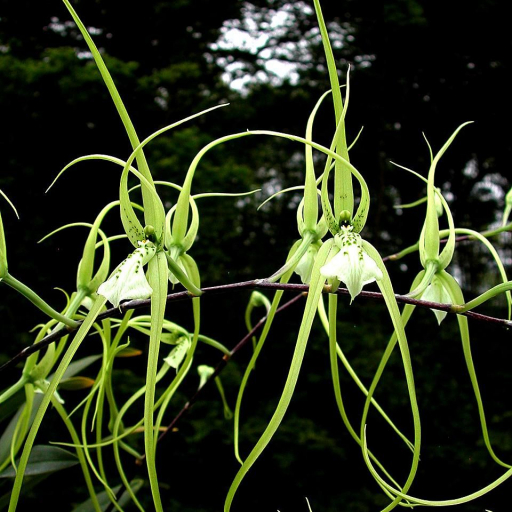
Plant Overview
Known widely as the Spider Orchid, Brassia verrucosa is a show-stopper that looks like it crawled straight out of a tropical jungle. Its spindly, long-petaled flowers resemble giant spiders perched on a web, and it is famous for its "giraff-like" appearance and a surprisingly spicy, peppery scent that fills the room during the morning hours.
🔍 How to Identify
- 🕷️ Spider-Like Blooms: The tepals (petals and sepals) are incredibly long, thin, and tapered, often reaching up to 8–10 inches from tip to tip.
- 🟢 Greenish-Yellow Palette: The flowers feature a pale green or yellowish base color, decorated with dark brown or maroon spots concentrated near the center.
- 🗯️ The "Warty" Lip: The white or cream-colored lip is covered in small, raised green bumps or "warts," which is where its Latin name verrucosa (meaning "warty") originates.
- 🪴 Pseudobulbs: It grows from large, flattened, egg-shaped green bulbs that store water, with two long, leathery leaves sprouting from the top.
🏡 In Your Garden
- 💨 Breathing Room: As an epiphyte, this orchid naturally grows on trees rather than in soil. It hates "wet feet" and requires a very airy potting mix, such as coarse fir bark or charcoal, to ensure its thick roots don't suffocate.
- 🌫️ Humidity Over Watering: It thrives in high-humidity environments. If your indoor air is dry, it may struggle to produce its iconic long sprays of flowers; a pebble tray or humidifier is highly recommended.
- ☀️ Dappled Light: It prefers bright, filtered light (like the light found under a jungle canopy). If the leaves turn a very dark green, it needs more light; if they turn yellow or bleached, it’s getting too much sun.
⚠️ Safety & Toxicity
- ✅ Pet & Child Friendly: Brassia verrucosa is non-toxic to cats, dogs, and humans. It is a very safe choice for households with curious pets.
- 🧼 General Care: While not poisonous, the sap from a broken pseudobulb or stem can occasionally cause mild skin irritation for those with highly sensitive skin. It’s always a good habit to wash your hands after pruning.
✨ Fun Fact
This orchid is a master of deception! It has evolved to be pollinated by spider-hunting wasps (genus Pepsis). The wasp sees the flower, mistakes it for a spider, and attacks it. During the "struggle," the wasp gets covered in pollen, which it then carries to the next "spider" it tries to hunt!

Detailed Care Instructions
Here are some steps you can follow to successfully grow a Brassia Verrucosa plant:
- Light: Brassia Verrucosa plants prefer bright, indirect light. Place your plant near a window where it can receive plenty of natural light, but avoid direct sunlight which can burn the leaves.
- Temperature: These plants thrive in warm temperatures between 65-80°F (18-27°C). Avoid placing them in drafts or near air conditioning units.
- Watering: Water your Brassia Verrucosa plant when the top inch of soil feels dry to the touch. Water thoroughly until water drains out of the bottom of the pot, then allow the soil to dry out slightly before watering again.
- Humidity: Brassia Verrucosa plants prefer high humidity levels. You can increase humidity by misting the plant regularly, placing a humidifier nearby, or using a humidity tray.
- Fertilization: Feed your Brassia Verrucosa plant with a balanced fertilizer diluted to half strength every 2-4 weeks during the growing season (spring and summer).
- Potting: Repot your Brassia Verrucosa plant every 1-2 years in a well-draining orchid mix. Make sure the new pot is only slightly larger than the old one to prevent overwatering.
- Pruning: Remove any dead or yellowed leaves to promote new growth and ensure the plant looks healthy.
By following these tips and providing the right care, you can help your Brassia Verrucosa plant thrive and grow successfully.

Place in a window with dappled sun or a spot in the middle of a room. Or directly in a window facing west or east.

Brassia Verrucosa plants should be watered thoroughly but infrequently. It is important to allow the top layer of soil to dry out between waterings to prevent root rot. When watering, make sure to saturate the soil completely, allowing excess water to drain out of the bottom of the pot. It is also important to avoid getting water on the leaves and pseudobulbs, as this can lead to rot or fungal issues. Using room temperature water is ideal, as cold water can shock the plant. Additionally, during the dormant season, reduce watering frequency to mimic the plant's natural growing conditions.
To fertilize Brassia Verrucosa, use a balanced fertilizer with equal amounts of nitrogen, phosphorus, and potassium. Dilute the fertilizer to half strength and apply every 2-4 weeks during the plant's growing season. Avoid fertilizing during the plant's dormant period. Water the plant thoroughly after fertilizing to help distribute the nutrients evenly throughout the soil.
Brassia Verrucosa plants thrive best in a well-draining soil mixture that is slightly acidic to neutral in pH. A recommended soil mixture for this plant may include a combination of peat moss, perlite, and fir bark to provide good aeration and drainage for the roots. It is also important to ensure that the soil is not overly compacted, as this can lead to issues with root rot. Additionally, regular repotting every 1-2 years is recommended to refresh the soil and provide the plant with the necessary nutrients for optimal growth.
Brassia Verrucosa plants can be propagated through division of established plant clumps or through stem cuttings. To propagate through division, carefully remove the plant from its pot and separate the clumps into smaller sections with roots attached. Replant these new sections in fresh soil and water thoroughly.
For propagation through stem cuttings, select a healthy stem with at least two nodes present. Cut the stem at a 45-degree angle just below a node and remove any leaves from the bottom portion of the cutting. Allow the cutting to callus over for a few days before planting it in moist soil or a potting mix. Keep the cutting in a warm, humid environment and mist regularly to encourage root growth.
It's important to provide the newly propagated plants with proper care and attention, including regular watering, adequate sunlight, and protection from pests and diseases. With time and patience, these propagated Brassia Verrucosa plants will grow into healthy, mature specimens.








