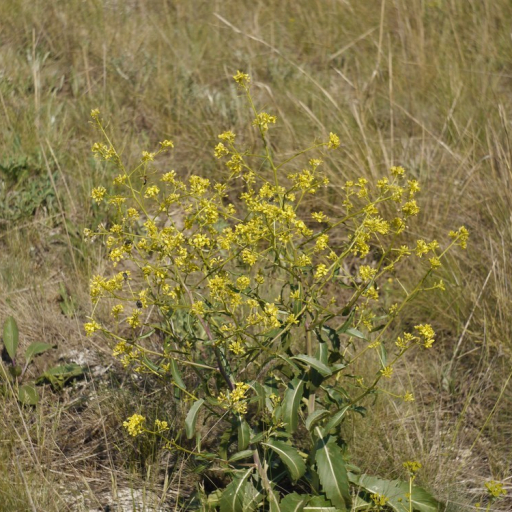
Plant Overview
Often called the Long-stalked Mustard, this wiry wanderer is a hardy and resilient member of the cabbage family. Originating from the vast steppes of Central Europe and Western Asia, it has traveled the globe as a successful "pioneer plant," often settling in places where other greenery struggles to survive. While it may look like a simple weed, it is a fascinating example of botanical endurance and minimalist beauty.
🔍 How to Identify
- 🌼 Cross-Shaped Blooms: Features clusters of small, bright yellow flowers, each consisting of four petals arranged in a distinct "cross" shape, a signature trait of the Brassicaceae family.
- 🦒 Elongated Stems: True to its name, the plant produces very long, slender, and often leafless upper stalks that give it a tall, airy, and somewhat spindly appearance.
- 🥖 Slender Seed Pods: After flowering, it develops "siliques"—tiny, needle-like seed pods that point upward along the stem, looking like miniature green beans.
🏡 In Your Garden
- 🧱 The Pioneer Spirit: This plant thrives in "disturbed" soil, meaning it loves rocky patches, roadsides, and areas where the earth has been moved. It’s an expert at colonizing dry, poor-quality ground where moisture is scarce.
- ☀️ Sun Seeker: You will rarely find this mustard in the shade. It is a sun-worshipper that requires full light to strengthen its tall stalks; in lower light, the plant becomes floppy and fails to produce its characteristic seed pods.
⚠️ Safety & Toxicity
- 🥗 Edibility Note: While many wild mustards are edible, Brassica elongata can be a "nitrate accumulator." If grown in soil with high fertilizer runoff, the leaves can store chemicals that are unhealthy for humans in large amounts.
- 🐾 Pet Safety: It is generally considered non-toxic to cats and dogs. However, due to its high fiber and mustard oil content, curious pets who munch on it may experience mild digestive upset or "gas."
✨ Fun Fact
Despite its wild and "weedy" reputation, Brassica elongata is a direct botanical cousin to some of our favorite kitchen staples, including Broccoli, Kale, and Brussels Sprouts! If you crush a fresh leaf between your fingers, you’ll notice a familiar, sharp, peppery scent.

Detailed Care Instructions
To grow Brassica elongata, or Ethiopian mustard, you can follow these steps:
- Select a suitable location: Ethiopian mustard prefers full sun but can tolerate partial shade. Ensure that the planting area has well-drained soil.
- Prepare the soil: Brassica elongata grows best in loamy soil. Add organic matter, such as compost or well-rotted manure, to improve the soil's fertility and drainage.
- Sow the seeds: Ethiopian mustard can be grown from seeds. Sow the seeds directly into the prepared soil during the appropriate planting time, typically in spring or fall. Follow the recommended spacing on the seed packet, usually 1-2 feet apart.
- Water regularly: Keep the soil evenly moist, especially during dry periods. Avoid overwatering, as it may lead to root rot.
- Fertilize: Apply a balanced fertilizer according to the manufacturer's instructions. This will help provide nutrients necessary for the plant's growth.
- Weed control: Regularly remove any weeds that may compete with the Brassica elongata plant for nutrients and space.
- Pests and diseases: Monitor the plants regularly for pests such as aphids or cabbage loopers. Treat infestations using organic or chemical insecticides, if necessary. Watch out for diseases such as powdery mildew and treat them accordingly.
- Harvesting: Ethiopian mustard leaves can be harvested when they reach the desired size, typically around 4-6 weeks after planting. Avoid harvesting all the leaves at once, as this can weaken the plant. Instead, pick outer leaves and allow the inner leaves to continue growing.
By following these steps, you should be able to successfully grow Brassica elongata or Ethiopian mustard in your garden.

Place in a bright room that is sun drenched almost all day. Or directly in a south-facing window.

Brassica Elongata plant requires regular watering to ensure proper growth and development. The best way to water this plant is to give it a thorough soak, ensuring that the soil is evenly moistened. It is important not to overwater the plant, as this can lead to root rot.
Water the plant deeply once a week, or more frequently if the weather is hot and dry. It is advisable to water the plant in the morning or evening when the temperature is cooler, as it reduces the risk of evaporation.
When watering, avoid wetting the foliage, as this can encourage the growth of fungal diseases. Instead, target the soil around the base of the plant. Use a watering can or hose with a gentle spray to avoid soil erosion and damage to the plant.
After watering, check the soil moisture level to ensure that it is not too wet or dry. Stick your finger into the soil to test for moisture, or use a moisture meter to determine the exact level. If the soil is still moist, then wait a few days before watering again.
Regular watering, in combination with good soil, fertilization, and pruning practices, will help to promote healthy growth and flowering in Brassica Elongata plant.
For optimal growth and yield, it is recommended to fertilize the Brassica Elongata plant with a balanced fertilizer containing equal amounts of nitrogen, phosphorus, and potassium. It is advisable to apply the fertilizer evenly around the base of the plant, avoiding direct contact with the stem. The recommended fertilizer application rate is based on the soil nutrient content and the plant's growth stage. Generally, it is suggested to fertilize the plant every two weeks during the growing season. Over-fertilization should be avoided as it can cause damage to the plant. It is crucial to water the plant immediately after fertilization to aid in nutrient uptake.
The ideal soil for Brassica Elongata plants is a well-draining soil that is rich in organic matter. The soil should be slightly acidic with a pH level between 6.0 and 6.5. Adding compost to the soil will help enrich it and improve its structure, allowing for better drainage and water retention. Good drainage is essential as Brassica Elongata plants are susceptible to root rot. The soil should be kept moist, but not waterlogged, and the plants should be fertilized regularly with a balanced fertilizer. In general, it's best to avoid using heavy, compacted soils or those that are highly alkaline.
To propagate this particular plant, you will need to take stem cuttings from a mature and healthy plant. It is recommended to take cuttings during the spring or summer months, when the plant is actively growing.
Select a stem that is at least 4-6 inches long and has several sets of leaves. Using clean sharp scissors or pruning shears, make a clean cut just below a node (the point where a leaf attaches to the stem). Remove any leaves from the bottom 2/3 of the cutting, leaving only a few leaves at the top.
Prepare a potting mix by combining equal parts of peat moss, perlite, and vermiculite. Moisten the mix with water until it feels moist but not soaking wet.
Dip the cut end of the stem cutting into rooting hormone powder, tapping off any excess. Make a hole in the potting mix and insert the stem cutting, firming the mix around it. Repeat this process with several cuttings, spacing them apart in the pot.
Cover the pot with a clear plastic bag or plastic dome to create a humid environment. Place the pot in a bright, indirect light location, avoiding direct sunlight.
Check the cuttings regularly to ensure the potting mix stays moist but not waterlogged. After a few weeks, gently tug on the stem cuttings to see if they have rooted. Once they have established a good root system, you can remove the plastic cover and begin caring for them as you would a mature plant.








