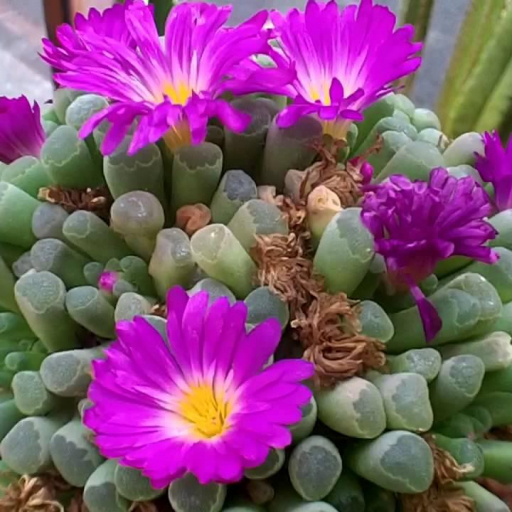
Plant Overview
Commonly known as Maximilian’s Braunsia, this South African gem is a master of the "shrubby succulent" look. Hailing from the rocky crevices of the Western Cape, it forms a low-growing, geometric carpet of silver-green foliage. It is often celebrated by collectors for its striking neon-pink flowers that look almost too bright to be real against its muted leaves.
🔍 How to Identify
- 📐 Angled Foliage: The leaves are thick, succulent, and distinctly "keeled" or triangular. They grow in opposite pairs, creating a stacked, architectural appearance.
- 🌫️ Powdery Coating: Each leaf is covered in a fine, waxy bloom (farina) that gives the plant a ghostly, blue-gray or silvery tint, which helps reflect intense sunlight.
- 🌸 Vibrant Blooms: In late winter or spring, it produces large, daisy-like flowers in shades of magenta or bright pink, often hiding the foliage entirely when in full bloom.
🏡 In Your Garden
- 🏜️ Drainage is Non-Negotiable: Because it evolved in rocky South African soil, this plant has a sensitive root system. It prefers "gritty" mixes (lots of pumice or perlite) rather than standard potting soil to prevent rot.
- ☀️ Sun-Loving Habit: To maintain its compact, "stacked" shape, it needs bright, direct light. If kept in the shade, the stems will stretch (etiolate) and lose their beautiful geometric symmetry.
- 💧 Dormancy Cues: Unlike many tropical plants, Braunsia can be opportunistic but often slows down in the heat of mid-summer. Reduce watering during the hottest weeks to allow the plant to rest.
⚠️ Safety & Toxicity
- ✅ Status: Generally Non-Toxic.
- 🐾 Details: This species is not known to be poisonous to cats, dogs, or humans. However, because its leaves are firm and crunchy, curious pets might find them tempting to chew on, which can lead to mild stomach upset simply due to the plant's fibrous nature.
✨ Fun Fact
The Braunsia maximiliani belongs to the "Ice Plant" family (Aizoaceae). It gets this family name because many of its relatives have specialized cells on their leaves that glisten like tiny ice crystals in the sun, though in Maximilian’s case, this is replaced by a sophisticated, smooth "matte" finish to survive the heat!

Detailed Care Instructions
| Humidity | Dry |
| Lighting | Full Sun |
| Difficulty | Easy |
| Hardiness Zones | 9A - 11B |
To grow a Braunsia Maximiliani plant, also known as Maximiliani Sunflower or Santa Fe Sunflower, follow these steps:
- Choose a suitable location: Braunsia Maximiliani plants prefer full sun exposure but can tolerate partial shade. Ensure the soil is well-drained, as the plant does not tolerate excessive moisture.
- Prepare the soil: Dig a hole around 12-18 inches deep and amend the soil with organic matter to improve fertility and drainage. The soil pH should be neutral to slightly acidic.
- Plant the seeds: Sow the seeds directly into the ground after the danger of frost has passed and the soil has warmed up, typically in late spring or early summer. Plant the seeds 1-2 inches deep, spaced 2-3 feet apart, as these plants can become large and bushy.
- Water appropriately: Braunsia Maximiliani plants require regular watering, but be cautious not to overwater. Water deeply when the top inch of soil is dry, but allow the soil to dry out slightly between waterings.
- Mulch for moisture retention: Apply a layer of organic mulch around the base of the plant to help retain moisture and suppress weed growth.
- Fertilize as needed: If the soil is lacking in nutrients, you can apply a balanced fertilizer at the time of planting. Otherwise, Braunsia Maximiliani plants usually do not require additional fertilization.
- Provide support if necessary: As the Braunsia Maximiliani plant can grow tall and may become top-heavy with blooms, it may require staking or support to prevent bending or breaking.
- Maintain the plant: Remove weeds regularly to prevent competition for nutrients. Prune any dead or damaged stems to maintain the plant's health and appearance. Deadhead faded flowers to promote continuous blooming.
- Harvest seeds (optional): If you want to collect seeds for future planting, allow the flowers to fully mature and dry on the plant. Once the flower heads have dried, cut them off and separate the seeds.
With proper care and maintenance, your Braunsia Maximiliani plant should thrive and produce beautiful yellow sunflower-like blooms throughout the growing season.

Place in a bright room that is sun drenched almost all day. Or directly in a south-facing window.

Braunsia Maximiliani is a perennial plant that requires regular watering. To water this plant, you can fill a watering can or use a hose to water the soil around the base of the plant, taking care not to get water on the leaves or stem.
It is important to keep the soil moist but not waterlogged, as this can lead to root rot and other issues. You should water the plant deeply and thoroughly, allowing the water to soak into the soil and reach the roots.
The frequency of watering will depend on the climate and the location of the plant. In general, you should water the plant more frequently during hot, dry weather and less often during cooler, wetter periods.
You may also want to consider using mulch around the base of the plant to help conserve moisture and keep the soil cool. This can help to prevent water loss through evaporation and reduce the need for frequent watering.
Overall, providing adequate water is crucial for the health and growth of Braunsia Maximiliani plants, so it is important to pay close attention to their watering needs.
To fertilize this plant, use a balanced fertilizer with equal amounts of nitrogen, phosphorus, and potassium. Fertilize every four to six weeks during the growing season, reducing fertilization during the winter months. Be careful not to over-fertilize, as this can damage the plant. Water the plant deeply after fertilizing to help distribute the nutrients evenly through the soil.
Braunsia Maximiliani plants thrive in well-draining soil that is rich in organic matter. A mixture of peat moss, perlite, and sand is ideal for ensuring proper drainage while also providing essential nutrients for the plant to grow healthy and strong. It is important to avoid using heavy or compacted soil, as this can lead to waterlogged conditions that may harm the plant's roots. Adding a balanced fertilizer to the soil mixture before planting can also help to promote healthy growth and flowering. Overall, choosing a lightweight, well-draining soil mixture is key to successfully cultivating Braunsia Maximiliani plants.
To propagate this plant, you can take stem cuttings in early spring before the plant starts actively growing. Make sure the stem cutting is at least 3 inches long and has at least two sets of leaves. Remove the leaves from the bottom third of the stem and dip the cut end in rooting hormone. Plant the stem cutting in a pot with well-draining soil and keep it in a warm, humid location with bright, indirect light. Water the plant regularly and mist the leaves to keep them moist. In about 4-6 weeks, the stem cutting should develop roots and can be transplanted into a larger pot or outside in a suitable location.








