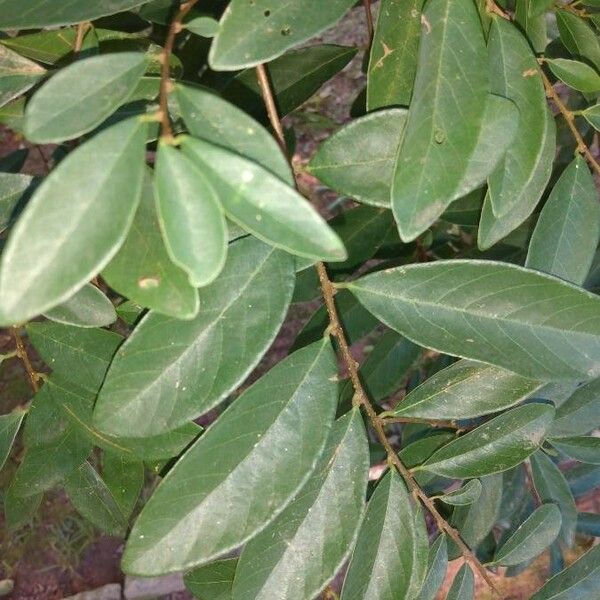
Plant Overview
Known affectionately as the Pop-gun Seed or Broom-tree, Bridelia tomentosa is a graceful, versatile shrub that thrives on the edges of forests and coastal regions across Southeast Asia and Australia. It is celebrated as a "pioneer species," often being one of the first plants to reclaim disturbed land, providing shelter for more delicate species to grow beneath its arching canopy.
🔍 How to Identify
- 🍃 Leaf Texture: The leaves are narrow and elliptic, featuring a distinct, soft velvety coating of fine hairs (tomentose) on the underside that feels fuzzy to the touch.
- 🌸 Inconspicuous Blooms: During the flowering season, you will find tiny, greenish-yellow flowers tucked away in tight clusters at the base of the leaves.
- 🍒 The Berries: It produces small, pea-sized fruits that transition from a bright green to a deep, glossy purple or black when fully ripe.
🏡 In Your Garden
- 🌳 A Natural Screen: Thanks to its weeping, arching branches and dense foliage, it is an excellent choice for a "living fence" or a privacy screen that doesn't feel overly structured.
- 🦋 Butterfly Sanctuary: This plant is a primary food source for the caterpillars of the stunning Blue Nawab butterfly, making it an essential addition to any pollinator-focused garden.
- 🌱 Tough-as-Nails: It is highly adaptable to various soil types, from sandy coastal patches to heavy clay, though it truly thrives when its roots are kept consistently moist but not waterlogged.
⚠️ Safety & Toxicity
- 🐾 Pet Safety: While not listed as a major hazard, the bark and leaves contain high levels of tannins, which can cause mild digestive upset if chewed by curious dogs or cats.
- 👶 General Caution: The berries are sometimes eaten by birds and local wildlife, but they are generally too astringent for human palates and should be kept away from small children who might mistake them for candy.
✨ Fun Fact
- 🔫 Nature's Ammunition: In rural communities, the name "Pop-gun Seed" comes from a clever childhood game. Kids would use the hard, unripe green seeds as perfect spherical "bullets" for their handmade bamboo pop-guns!

Detailed Care Instructions
To grow Bridelia tomentosa, also known as the Cape Myrtle, you can follow these steps:
- Climate and location: Bridelia tomentosa thrives in tropical and subtropical climates. Choose a location that receives full to partial sun exposure.
- Soil: The plant can tolerate a variety of soil types but prefers well-draining and loamy soil. It can grow in slightly acidic to slightly alkaline soil.
- Watering: Bridelia tomentosa prefers regular watering during its initial growth stages. Once established, it is fairly drought-tolerant.
- Propagation: There are different methods to propagate Bridelia tomentosa: through seeds, stem cuttings, or air-layering.
- Seeds: Sow the seeds in seed trays or small pots filled with a well-draining potting mix. Place the trays in a warm and moist environment. Keep the soil consistently moist until the seeds germinate. Transplant the seedlings into individual pots once they develop a few sets of true leaves.
- Stem Cuttings: Take 6 to 8-inch stem cuttings from healthy and mature plants. Strip off the lower leaves and dip the cut ends in rooting hormone powder. Plant the cuttings in a well-draining potting mix and place them in a warm and humid environment. Mist the cuttings regularly and keep the soil moist until roots develop.
- Air-Layering: Select a healthy and mature branch. Remove the bark in a ring around the branch, exposing the inner wood. Apply rooting hormone to the wounded area and cover it with moist sphagnum moss or a rooting medium. Wrap a plastic sheet around the moss and secure it with string or tape. Keep the moss moist and within a few weeks, new roots will develop. Once the roots are well-formed, cut the branch below the rooted area and plant it in a pot.
- Seeds: Sow the seeds in seed trays or small pots filled with a well-draining potting mix. Place the trays in a warm and moist environment. Keep the soil consistently moist until the seeds germinate. Transplant the seedlings into individual pots once they develop a few sets of true leaves.
- Transplanting: Whether starting from seeds, cuttings, or air-layering, transplant the young plant into a larger pot or the desired outdoor location once it has developed a good root system. Be careful not to damage the delicate roots during transplantation.
- Care: Once established, Bridelia tomentosa requires minimal care. Regularly check the moisture levels in the soil and water as needed. Apply a balanced liquid fertilizer during the growing season to promote healthy growth. Prune the plant to maintain its shape and remove any dead or diseased branches. Protect the plant from strong winds and frost if you live in a region prone to such conditions.
By following these guidelines, you can successfully grow Bridelia tomentosa and enjoy its beautiful foliage and flowers.

Place in a bright room that is sun drenched almost all day. Or directly in a south-facing window.

Bridelia Tomentosa plant should be watered regularly to ensure that it receives enough water for healthy growth. The watering frequency and amount of water depend on various factors such as the climate, soil type, and age of the plant. It is important to note that the plant prefers well-draining soil that is moist but not waterlogged. Over-watering can result in root rot, which can be fatal to the plant.
During the active growing season, the plant requires frequent watering, especially during hot and dry weather. It is advisable to water in the early morning or late afternoon to avoid water loss through evaporation. When watering, it is best to aim for the base of the plant, avoiding the leaves and stem as much as possible.
In the dormant season, the plant requires less water, and it is best to reduce watering frequency. However, it is important to ensure that the soil does not dry out completely during this period.
In general, one can monitor the plant's water needs by checking the soil moisture level regularly. One can do this by inserting a finger in the soil to feel for dampness or using a moisture meter. If the soil feels dry, it is time to water, but if it feels damp, it is best to wait before watering again.
To fertilize this plant, first ensure that it is growing in well-draining soil. Then, choose a balanced fertilizer that is appropriate for the plant's growth stage. Apply the fertilizer according to the instructions on the packaging, taking care not to apply too much. Finally, water the plant thoroughly after fertilizing to distribute the nutrients throughout the soil.
For the cultivation of Bridelia Tomentosa plant, it is recommended to use a well-draining soil that contains a good mix of organic matter and inorganic materials. The pH of the soil should be slightly acidic to neutral, around 6.0 to 7.0. The soil should be moist but not waterlogged, as excessive moisture can lead to root rot. It is also important to ensure that the soil is rich in nutrients, particularly nitrogen, phosphorous, and potassium. Organic fertilizers like compost or well-aged manure can be added to the soil to provide these nutrients. Additionally, the plant prefers a sunny or partially shady location with good air circulation. Regularly watering the plant and providing occasional fertilization can help it grow healthy and strong.
One way to propagate this plant is by taking stem cuttings. Select a healthy stem with a few leaves and cut it at a 45-degree angle using a sharp, sterilized knife. Remove any leaves from the bottom third of the cutting and dip the cut end into rooting hormone powder. Plant the cutting in a pot filled with moistened potting mix and place it in a bright but shaded location. Keep the soil consistently moist and cover the pot with a plastic bag to create a humid environment. After a few weeks, roots should start to grow from the cut end of the stem. Once the new plant has established roots, it can be transplanted into a larger pot or directly into the ground.








