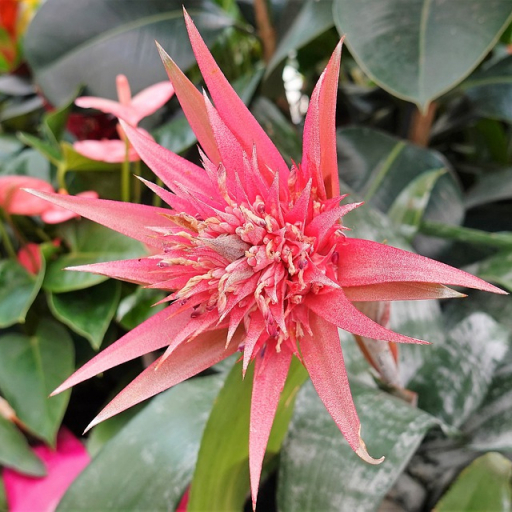
Plant Overview
Often called the "Heart of Flame," the Bromelia genus represents the wild, rugged ancestors of the common pineapple. Originating from the tropical regions of the Americas, these plants are famous for their dramatic color transformations, where the center of the plant turns a brilliant, fiery red just before it produces its exotic flowers.
🔍 How to Identify
- ⚔️ Saw-Toothed Foliage: Unlike many smooth indoor plants, Bromelia leaves are typically stiff, long, and lined with sharp, curved spines or "teeth" along the edges.
- 🌋 The "Blushing" Center: When ready to bloom, the inner leaves transition from deep green to vivid shades of crimson, scarlet, or electric pink to attract pollinators.
- 🕸️ Rosette Formation: The leaves grow in a tight, spiral circular pattern, often forming a central "cup" or "tank" designed to catch and hold rainwater.
🏡 In Your Garden
- 🌱 Terrestrial Tendencies: While many people think of bromeliads as "air plants," the true Bromelia genus consists mostly of terrestrial plants that prefer being rooted in well-draining, sandy soil rather than hanging from trees.
- 🏜️ Spreading Habit: These are not solitary sitters; they spread via underground runners (rhizomes). In a garden setting, they can quickly form a dense, prickly thicket that acts as a beautiful but formidable natural barrier.
- 💧 The Central Cup: In their natural habitat, the central rosette acts as a miniature ecosystem, providing a home for tiny frogs and insects. When watering at home, ensure the central "tank" stays refreshed but not stagnant.
⚠️ Safety & Toxicity
- 🌵 Physical Warning: While the plant is generally considered non-toxic to cats, dogs, and humans if nibbled, the leaves are extremely sharp. The "teeth" along the leaf edges can cause painful scratches or skin irritation.
- 👶 Placement Matters: Due to their spiny nature, they should be kept away from high-traffic areas or low spots where curious toddlers or pets might brush against them.
✨ Fun Fact
In parts of Latin America, Bromelia plants are grown in tight rows to create "living fences." These natural walls are so prickly and dense that they are more effective at keeping out intruders and livestock than traditional barbed wire!

Detailed Care Instructions
To grow a Bromelia plant, you can follow these steps:
- Choose a suitable location: Bromelia plants prefer bright, indirect light. Find a spot in your home or garden that receives filtered light or partial shade.
- Select the right pot: Use a well-draining container with drainage holes at the bottom. Bromelia plants don't require large pots as they have small root systems.
- Use well-draining soil: Use a well-draining potting mix specifically formulated for bromeliads or create your own by combining equal parts of sphagnum moss, perlite, and pine bark.
- Watering: Bromelia plants prefer to be kept slightly moist but not waterlogged. Water the plant thoroughly, allowing excess water to drain out. Empty any water that collects in the plant's center to prevent rotting.
- Humidity: Bromelia plants thrive in high humidity environments. If the humidity in your home is low, consider placing a tray with water near the plant or use a room humidifier to increase moisture levels.
- Temperature: Bromelia plants prefer temperatures between 65-80°F (18-27°C). Avoid exposing them to drafts or extreme temperature fluctuations.
- Fertilization: Bromelia plants can be fertilized every 2-3 months using a balanced liquid fertilizer diluted to half strength. Apply the fertilizer to the soil, avoiding contact with the leaves.
- Repotting: Repot the bromelia plant every 2-3 years, or when it outgrows its current container. Choose a slightly larger pot with fresh, well-draining soil.
- Propagation: Bromelia plants can be propagated by removing the offsets, or pups, that grow around the base of the plant. Gently separate them from the mother plant and plant them in their own pots.
- Care: Regularly remove any dead or dying leaves to maintain the plant's health and appearance. Watch out for common pests like scale insects or spider mites and take necessary measures to control them.
By following these steps, you can successfully grow and care for a Bromelia plant.

Place in a bright room that is sun drenched almost all day. Or directly in a south-facing window.

Bromelia plants are often found in tropical regions and are known for their colorful and vibrant blooms. When it comes to watering these plants, it is important to consider their unique needs to keep them healthy and thriving.
One of the key things to remember when watering Bromelia plants is that they do not like to be overwatered. These plants are used to growing in areas with a lot of humidity, but they still require proper drainage to prevent rotting. It is best to water these plants when the top layer of soil feels dry to the touch.
When watering, it is important to pour the water directly onto the soil and not onto the leaves or blooms. This can cause water to collect and lead to rotting.
In addition to watering, it is also important to keep the humidity level around Bromelia plants high. One way to do this is to mist the plant regularly. This will help to keep the leaves moist and prevent them from drying out.
Overall, when it comes to watering Bromelia plants, it is important to find a balance between providing enough moisture without overwatering. With the right care, these plants can thrive and provide a beautiful addition to any garden.
To fertilize this plant, use a balanced, all-purpose fertilizer and dilute it to half strength. Apply the fertilizer once every month in the growing season, which is usually from spring to fall. Avoid direct application of fertilizer to the leaves and flush the soil with water to prevent salt buildup.
To successfully grow and care for Bromelia plants, it is essential to use the right type of soil mix. The ideal soil mix for this plant should be a well-draining, slightly acidic mix. A good soil mix should include peat moss, perlite, vermiculite, and organic matter, such as compost. This type of soil mix provides adequate drainage, while still retaining enough moisture to support the plant's growth. It is also recommended to add some slow-release fertilizers to the soil mix to provide the necessary nutrients for the plant's growth. It is important to avoid using heavy soils that retain too much water, as this can lead to root rot and other diseases. Additionally, avoid using soils with high levels of lime or alkalinity, as this can affect the plant's growth and development.
To propagate this plant, you can use the method of removing and replanting the offsets (pups) that grow around the base of the mature plant. Wait until the pups are at least one-third the size of the mature plant before detaching them. Use clean, sharp pruning shears to cut the connecting stem that joins the pup to the mother plant. Place the pups in a pot containing well-draining soil mix and water lightly. Overwatering can lead to root rot, so it is essential to not water too frequently. Once the pups have developed root systems and have started actively growing, they can be transplanted into their permanent locations in pots or in the garden.







