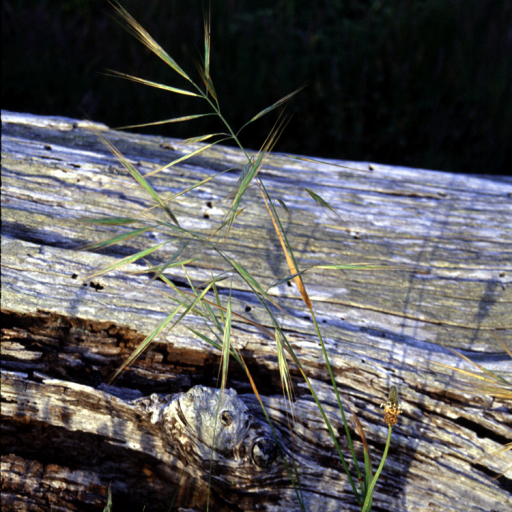
Plant Overview
Known by the menacing nickname "Ripgut Brome," this Mediterranean native has traveled the world as a hardy, opportunistic survivor. While it may look like just another swaying field grass, its rough texture and needle-sharp seeds have earned it a reputation as a serious nuisance for farmers, hikers, and pet owners alike. It is a master of colonizing disturbed lands, often appearing as a golden wave in late spring.
🔍 How to Identify
- 🌾 The Seed Heads: Look for large, nodding clusters (panicles) that hang heavily to one side. They start as a vibrant green and transition to a purplish-tan as they dry out.
- 🗡️ The Long Awns: The most defining feature is the "awn"—a stiff, needle-like bristle extending from each seed. These can reach up to 3 inches long and are covered in microscopic, backward-pointing barbs.
- 🍃 Hairy Foliage: The leaf blades and sheaths are covered in soft, fine hairs, giving the plant a slightly velvety appearance, though the stems themselves feel quite rough.
🏡 In Your Garden & Landscape
- 🚜 The Disturbance Lover: You will rarely find this grass in deep, untouched forests. It thrives in "disturbed" soil—think garden edges, gravel paths, and tilled fields where it can quickly claim empty space.
- 🏃 A Rapid Life Cycle: This is a winter annual. It germinates with the first autumn rains, grows through the winter, and finishes its life cycle by early summer. Because it grows so fast, it often sucks up all the moisture before your desired garden plants have a chance to bloom.
⚠️ Safety & Toxicity
- 🐕 High Risk for Pets: The seeds are biologically designed to "hitchhike." They easily become lodged in dog fur, paws, and ears. Because of the backward barbs, they move in only one direction—inward—and can cause painful infections or even internal injuries if inhaled or swallowed.
- 🧤 Skin Irritation: While not chemically toxic, handling dried Ripgut Brome with bare hands can lead to tiny, painful "splinters" from the barbed awns. It is best to wear gloves and long pants when clearing this grass.
✨ Fun Fact
The common name "Ripgut" isn't an exaggeration; it was coined by early ranchers who noticed that the sharp, barbed seeds could actually puncture the digestive tracts of livestock if the animals grazed on the grass after it had dried out and gone to seed.

Detailed Care Instructions
To grow Bromus diandrus, also known as Ripgut brome or great brome, you can follow the steps below:
- Climate and soil requirements: Bromus diandrus prefers a Mediterranean climate, characterized by mild, wet winters and hot, dry summers. It thrives in well-drained soils, tolerating various soil types, including sandy or loamy soils.
- Seed selection: Obtain quality Bromus diandrus seeds from a reputable seed supplier or collect seeds from mature plants if available.
- Planting time: Sow the seeds in late fall or early spring, preferably before the first frost or after the last frost, to ensure optimal germination rates.
- Seed preparation: Some gardeners recommend cold stratification of Bromus diandrus seeds to improve germination rates. This process involves placing the seeds in a sealed plastic bag with a moistened paper towel and storing them in the refrigerator for several weeks before planting.
- Site preparation: Choose a sunny location for planting, as Bromus diandrus thrives in full sunlight. Prepare the soil by removing any existing vegetation and loosening it with a garden fork or tiller. Remove any rocks, debris, or weeds from the area.
- Seed sowing: Depending on the size of your planting area, sprinkle the Bromus diandrus seeds evenly over the soil surface or sow them in rows with about 1/4 to 1/2 inch of soil covering them. Keep the seeds spaced apart to allow for healthy plant growth.
- Watering and maintenance: After sowing the seeds, water the area gently to ensure good seed-to-soil contact. Keep the soil consistently moist until the seeds germinate and establish. Once the plants are established, they are relatively drought-tolerant and require little additional watering.
- Weed control: Monitor the area regularly and remove any weeds that compete with the Bromus diandrus plants for water, nutrients, or sunlight.
- Fertilization: Bromus diandrus generally does not require heavy fertilization. However, you may add a balanced slow-release fertilizer during the growing season if necessary.
- Harvesting: Depending on your purpose for growing Bromus diandrus, you can harvest the seed heads at the desired stage of maturity. Allow the seed heads to dry before harvesting and store them in a cool, dry place for use or propagation.
By following these steps, you can successfully grow Bromus diandrus plants and enjoy their ornamental value or use them for erosion control or pasture restoration.

Place in a bright room that is sun drenched almost all day. Or directly in a south-facing window.

To water this species of plant, make sure to gently pour water at the base of the plant instead of on the leaves. Watering too much or too frequently can lead to root rot, so it's important to give the soil time to dry out between watering sessions. When checking if the plant needs water, stick your finger about an inch into the soil. If it feels dry, it is time to water. Additionally, make sure the plant has proper drainage to prevent water from pooling in the soil.
To fertilize this plant, first make sure it is well established and healthy. Choose a fertilizer with a balanced N-P-K ratio. Apply the fertilizer evenly around the base of the plant, avoiding the leaves. Water the plant thoroughly after application. Repeat fertilizer application every four to six weeks during the growing season. Be careful not to over-fertilize, as this can damage the plant.
The ideal soil for this particular plant should have good drainage and moisture retention capabilities. It should be relatively fertile and contain a good mix of organic matter, such as compost or well-rotted manure. The pH level of the soil should ideally be around 6.5 to 7.5, which is slightly acidic to slightly alkaline. This type of soil will allow the plant to establish a healthy root system and flourish, producing a strong growth habit and vibrant foliage. It is crucial to ensure that the soil is not compacted or too heavy in texture, as this may result in poor growth or damage to the plant's roots. In general, a sandy loam soil that is well-draining and rich in organic matter is the most ideal for this plant.
To propagate this plant, you can collect seeds from the mature plant and sow them in sandy soil during the fall or winter months. The seeds should be covered with a light layer of soil and then watered regularly. Once the seedlings have grown a few inches, they can be transplanted into a larger pot or outdoors into a well-draining soil.
Another method is through stem cuttings. Cut a healthy stem at least four inches long from the main plant and remove the lower leaves. Dip the stem in rooting hormone and place it in a pot filled with sandy soil. Keep the soil moist and in a location where it can receive indirect sunlight. Once the cutting has developed roots, it can be transplanted into a larger pot or planted outdoors.








