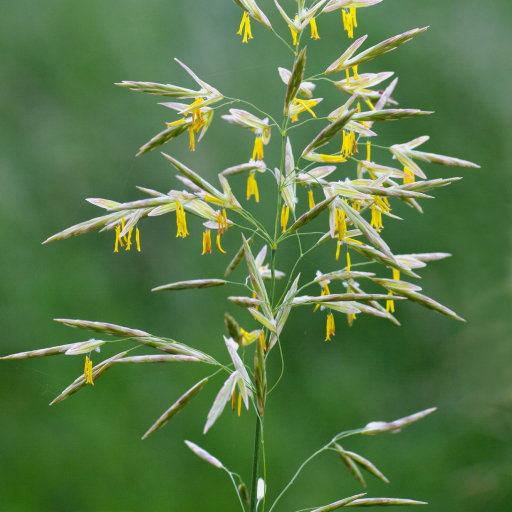
Plant Overview
Often called the "Smooth Brome" or "Hungarian Brome," this cool-season grass is the resilient marathon runner of the meadow world. Originally traveling from Europe and Siberia to North America in the 1880s, it was championed by farmers for its incredible ability to survive harsh winters and provide nutritious forage. Its Latin name inermis literally means "unarmed," a nod to its smooth, soft texture compared to its prickly, "armed" grass cousins.
🔍 How to Identify
- 🍃 The "W" Signature: Look closely at the leaf blade; you will often find a distinct transverse wrinkle that looks like the letter "W" or "M" embossed into the greenery.
- 🌾 Smooth Panicles: The flowering heads are loose, open branches that start green and turn a rich, purplish-brown as they mature, lacking the long, sharp bristles (awns) found on other Bromes.
- 🌱 Creeping Roots: Beneath the surface, this plant builds a massive network of rhizomes, allowing it to form thick, sod-like mats that are very difficult to pull up by hand.
🏡 In Your Garden
- 🧱 Erosion Expert: Because of its aggressive underground root system, it is a master at holding soil in place on steep banks or disturbed hillsides where other plants might wash away.
- 🚜 Hardy Nature: It is a "set it and forget it" plant in terms of survival; it thrives in well-drained silty soils but is famous for enduring extreme drought and sub-zero temperatures that would kill more delicate ornamental grasses.
- 🛑 Space Management: Be cautious in a small garden; while it isn't "toxic," its vigorous spreading habit can quickly crowd out native wildflowers if not kept in check by mowing or bordering.
⚠️ Safety & Toxicity
- ✅ Safe Status: Smooth Brome is non-toxic to humans, dogs, cats, and horses. It is a primary forage crop for livestock across the globe.
- 🤧 Seasonal Allergies: While safe to touch, it produces a high volume of airborne pollen during its mid-summer bloom, which can be a significant trigger for hay fever and respiratory sensitivities.
✨ Fun Fact
During the Dust Bowl era of the 1930s, Smooth Brome was one of the "hero plants" used to reclaim devastated lands, as its deep, interlocking root systems were strong enough to literally hold the American prairie together against the wind.

Detailed Care Instructions
To grow Bromus inermis (smooth brome grass), you can follow these steps:
- Choose the right location: Find a place with full sun to partial shade. Bromus inermis grows well in a variety of soil types, but it prefers well-draining soil.
- Prepare the soil: Clear the area of any weeds or debris. Loosen the soil to a depth of about 6-8 inches. You can add compost or aged manure to improve soil fertility and drainage.
- Planting: Bromus inermis can be started from seeds or planting plugs. If using seeds, spread them evenly across the prepared soil surface. Lightly rake the seeds into the soil, ensuring good seed-to-soil contact. Water gently. If planting plugs, dig holes slightly larger than the root ball of the plug, place them in the holes, and firm the soil around them.
- Watering: Keep the soil consistently moist until the plants are established. After that, water deeply but infrequently, allowing the top inch of soil to dry between waterings. Bromus inermis is a drought-tolerant plant but benefits from occasional deep watering during dry periods.
- Mulching: Apply a layer of organic mulch around the plants to retain moisture, suppress weed growth, and regulate soil temperature. Avoid piling mulch directly against the plant's base to prevent rotting.
- Fertilizing: Bromus inermis is not particularly demanding in terms of fertilizer. However, a balanced slow-release fertilizer can be applied in early spring to promote healthy growth. Follow the manufacturer's instructions for application rates.
- Maintenance: Regularly remove any weeds that may compete with the Bromus inermis plants. Additionally, you can mow the plants occasionally to maintain a desirable height and density. Avoid close mowing, as it may stress the grass.
- Winter care: Bromus inermis is a hardy grass and can tolerate winter conditions in many regions. However, if you live in a particularly cold area, you can protect the plants by applying a layer of mulch around the base before the onset of winter.
- Division: Over time, the Bromus inermis plants may become overcrowded. You can divide the clumps every 3-5 years to maintain healthy growth. Dig up the clump, separate it into smaller sections, and replant them in suitable areas.
By following these steps and providing suitable growing conditions, you can successfully grow Bromus inermis plants.

Place in a bright room that is sun drenched almost all day. Or directly in a south-facing window.

To properly water this plant, make sure to thoroughly wet the soil around the base of the plant and avoid getting water on the leaves. It is important to not overwater the plant, as it prefers dry to medium moisture levels. Additionally, it is best to water in the mornings or evenings to reduce evaporation and to ensure the water has time to soak into the soil before the heat of the day.
To fertilize this plant, apply a balanced fertilizer with equal amounts of nitrogen, phosphorus and potassium during the active growing season. This should be done in early spring and again in late summer. The amount of fertilizer to be applied will depend on the size of the plant and the soil condition, but as a general rule, apply 1 pound of fertilizer per 100 square feet of growing area. Water the plant well after fertilizing to ensure proper absorption of the nutrients. Avoid fertilizing during periods of drought or extreme heat.
To grow the plant known as Bromus Inermis, you should use a soil that is well-drained and loamy. The soil should be rich in organic matter and have a pH level between 6.0 and 7.5. In addition, the soil should be able to retain moisture and nutrients, but not become waterlogged. Adding sand or perlite to the soil can help improve drainage. It is also important to ensure that the soil is not too compacted, as this can affect the plant's root growth. Testing the soil prior to planting can help ensure that it is suitable for growing Bromus Inermis.
Bromus Inermis is a type of plant that can be propagated through various methods, including seed propagation, vegetative propagation, and division. The process of propagation involves taking a portion of the plant and reproducing it to create a new plant.
Seed propagation is the most common method of propagating Bromus Inermis. To do this, collect the seeds from the plant and store them in a cool, dry place until they are ready to be planted. Then, plant the seeds in a fertile, well-drained soil with adequate moisture. The seedlings should emerge within a few weeks and can be transplanted to their final location once they reach a certain size.
Vegetative propagation is another way to propagate Bromus Inermis. This method involves taking cuttings from the plant and placing them in a rooting hormone to encourage new root growth. The cuttings are then placed in a potting mixture of sand and peat moss until they become established. Once the cuttings start to show new growth, they can be transplanted into their final location.
Division is a method of propagation where the plant is separated into smaller sections, each with its own root system. This is done by digging up the plant and dividing it into smaller sections. Each section should have at least one healthy shoot and a good root system. The sections are then planted in the ground or pots and watered until established.
In conclusion, propagating Bromus Inermis can be achieved through seed propagation, vegetative propagation, and division. By understanding these methods and following the correct procedures, you can successfully propagate Bromus Inermis and produce a healthy and thriving new plant.








