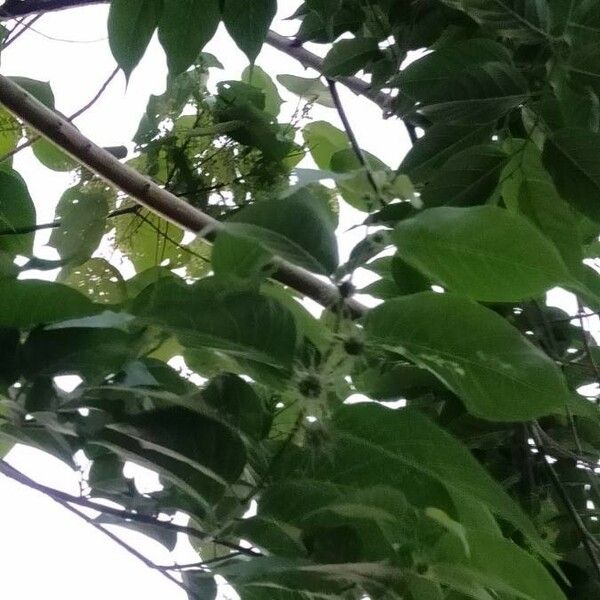
Plant Overview
Known affectionately in the Philippines as Alokon or Himbabao, this native tree is a fascinating blend of wild forest dweller and culinary treasure. While it can grow into a towering presence in the landscape, it is most famous for its long, noodle-like flowers that are a staple in traditional Northern Filipino stews. It is a resilient, fast-growing species that embodies the spirit of tropical utility and heritage.
🔍 How to Identify
- 🍃 The Foliage: The leaves are broadly ovate with a pointed tip and slightly serrated edges. If you touch them, you’ll notice a distinct, sandpaper-like roughness on the surface.
- 🐛 The "Worm" Flowers: Its most recognizable feature is the male inflorescence—long, green, pendulous spikes that look like fuzzy worms or emerald necklaces dangling from the branches.
- 🌳 The Bark: The trunk is wrapped in a greyish-brown bark that starts smooth but becomes increasingly fibrous and "birch-like" as the tree matures.
🏡 In Your Garden
- ☀️ Sun & Space: This tree is a sun-worshipper. It requires full sunlight to produce its famous flowers and can grow quite large (up to 15 meters), so it is best suited for medium-to-large gardens rather than small pots.
- 🌱 Soil Resilience: One of its best traits is its "tough love" attitude toward soil. It can thrive in poor, rocky, or sandy soils where other trees might struggle, provided it isn't sitting in stagnant water.
- ✂️ Pruning for Harvest: Because the edible flowers grow on high branches, many home growers practice "topping" the tree to keep it at a manageable height, encouraging a bushier shape that makes harvesting easier.
⚠️ Safety & Toxicity
- ✅ Status: Generally safe and non-toxic to humans; in fact, the flowers are a highly nutritious vegetable rich in vitamins.
- 🧴 Latex Warning: Like many members of the Moraceae family, the tree produces a milky white sap (latex) when a branch is broken. This sap can cause mild skin irritation or "itchiness" for some people and may upset the stomachs of curious pets if ingested in large quantities.
✨ Fun Fact
The Alokon flower is a "culinary shapeshifter." When cooked in traditional dishes like Pinakbet, it takes on a slightly slippery, mucilaginous texture similar to okra, making it a beloved secret ingredient for adding body and earthy flavor to broth!

Detailed Care Instructions
To properly water this plant, you should first look at the soil in which it is potted. Broussonetia Luzonica prefers well-draining soil, so make sure that the pot it is in has adequate drainage holes. When watering, be sure to thoroughly saturate the soil until water runs out of the bottom of the pot. Allow the soil to dry out slightly between each watering, but do not let it dry out completely. Additionally, it is important to avoid getting water on the leaves of the plant, as this can lead to fungal growth or other problems.
For the Broussonetia Luzonica plant, it is recommended to use a well-draining soil mix that is rich in organic matter. The soil should be slightly acidic to neutral with a pH range of 5.5 to 7.5. A mixture of equal parts of peat moss, perlite, and coarse sand is ideal for this plant. The soil should also be kept consistently moist but not waterlogged. It is important to avoid using heavy, clay soils or soils that are too alkaline. Additionally, a layer of mulch can be added to the top of the soil to help retain moisture and nutrients.








