Plant Overview
Known affectionately as the "Jamaican Forget-Me-Not" or the "Amethyst Flower," Browallia americana is a tropical treasure that brings a rare, vivid blue to the garden. Despite its common name, it isn't a true Forget-Me-Not; it actually belongs to the Nightshade family, making it a distant cousin to tomatoes and peppers. This charming annual is beloved for its ability to bloom profusely in shaded spots where other flowers often fail to thrive.
🔍 How to Identify
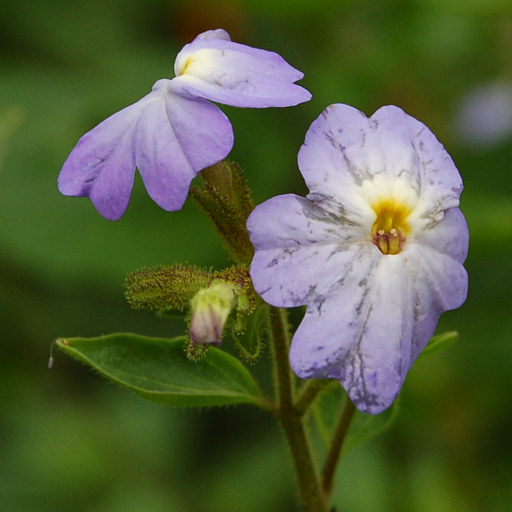
- 🌸 The "White Eye": The most striking feature is the small, five-lobed flower, which typically displays a deep violet-blue hue with a distinct white or pale yellow "eye" at the center.
- 🍃 Textured Foliage: The leaves are a rich emerald green, shaped like teardrops (ovate), and are covered in very fine, soft hairs that give the plant a slightly fuzzy feel.
- 🌿 Sprawling Habit: It grows in a delicate, mounded shape. Its stems are somewhat weak, often causing the plant to lean or cascade beautifully over the edges of containers and hanging baskets.
🏡 In Your Garden
- 🌥️ The Shade Seeker: This plant is a specialist in filtered light. While it loves brightness, the harsh afternoon sun can scorch its delicate petals. It is the perfect choice for brightening up north-facing porches or the dappled shade under tall trees.
- 💧 Moisture Consistency: Because of its tropical origins, it does not have a "storage tank" for water. It lacks a thick taproot, meaning it relies on consistent surface moisture. If the soil stays dry for too long, the plant will quickly wilt and may stop flowering for the season.
- ✂️ Self-Cleaning Nature: One of the best perks for gardeners is that it is largely "self-cleaning," meaning you don't necessarily have to deadhead the spent flowers to keep the blooms coming.
⚠️ Safety & Toxicity
- ⚠️ Potential Irritant: As a member of the Solanaceae family, Browallia americana contains alkaloids that can be toxic if ingested in significant amounts.
- 🐾 Pets and Children: It is generally classified as toxic to cats, dogs, and horses. If eaten, it may cause drooling, vomiting, or lethargy. It is best placed in hanging baskets or high tiers where curious mouths cannot reach it.
✨ Fun Fact
The genus was named by Carolus Linnaeus in honor of his friend, Johannes Browallius. Legend has it that as their friendship fluctuated, Linnaeus changed the names of the Browallia species to reflect his feelings—naming the most beautiful ones when they were on good terms and the "lesser" ones during their arguments!

Detailed Care Instructions
To grow Browallia Americana plant, you can follow these steps:
- Choose a suitable location: Browallia Americana plants thrive in partial shade to full sun, so select a spot that receives at least 4-6 hours of sunlight per day. The soil should be well-draining.
- Prepare the soil: Work the soil to loosen it and remove any weeds or debris. You can also incorporate some organic matter like compost or well-rotted manure to improve soil fertility.
- Sow seeds: Browallia Americana can be grown from seeds. Start by sowing the seeds indoors in seed trays or pots about 6-8 weeks before the last expected frost. Cover the seeds lightly with soil and keep the soil consistently moist.
- Transplant seedlings: Once the seedlings have developed a few sets of true leaves and the danger of frost has passed, transplant them into larger containers or directly into the garden. Space the plants about 12-18 inches apart.
- Watering: Keep the soil evenly moist, but avoid overwatering as the plant is susceptible to root rot. Allow the top inch of soil to dry out slightly before watering again.
- Fertilizing: Apply a balanced, slow-release fertilizer according to package instructions once every 6-8 weeks to promote healthy growth. Alternatively, you can use a water-soluble fertilizer diluted at half strength every 2-4 weeks.
- Mulching: Apply a layer of organic mulch around the plants to help retain moisture, suppress weeds, and maintain a more even soil temperature.
- Pruning: Pinch back the tips of the plant regularly to encourage branching and a more compact form. This will also help promote more abundant blooming.
- Pests and diseases: Browallia Americana plants are generally quite resistant to pests and diseases. However, keep an eye out for aphids, spider mites, or fungal diseases such as powdery mildew. Treat any issues promptly with appropriate organic or chemical solutions.
- Harvesting: Browallia Americana produces beautiful blue or purple flowers. Harvest the flowers as desired for floral arrangements or to enjoy their beauty in your garden.
With proper care and attention, Browallia Americana plants can add a splash of color to your garden and provide a habitat for pollinators like bees and butterflies.

Place in a bright room that is sun drenched almost all day. Or directly in a south-facing window.

To water this plant, one should make sure the soil is dry to the touch before watering. The plant should be watered at the base, avoiding getting the leaves wet, as this can lead to disease. Water should be poured slowly and evenly over the soil until it starts to drain out of the bottom of the pot. Overwatering should be avoided as it can lead to root rot. The plant should be allowed to dry out slightly between waterings, but not to the point where it wilts or the leaves start to droop. It is important to also take into consideration the environmental conditions and adjust watering accordingly.
To fertilize this plant, use a balanced fertilizer with equal amounts of nitrogen, phosphorus, and potassium. Apply the fertilizer according to the instructions on the label, typically every two weeks during the growing season. Be careful not to over-fertilize, as this can lead to burned roots and other issues. Additionally, make sure to water the plant thoroughly after fertilizing to help the nutrients soak into the soil.
For optimal growth and health of this plant, it is recommended to use well-draining, nutrient-rich soil that is slightly acidic with a pH level between 5.5 and 6.5. Mixing in organic matter such as compost or peat moss can help improve soil texture and fertility. Additionally, it is important to avoid soil that is too compact, as this can impede root growth and water absorption. Regular fertilization with a balanced, slow-release fertilizer can also help to promote healthy growth and blooming.
There are several methods to propagate this plant. One way is to take stem cuttings. To do this, take a healthy stem with a few leaves and cut it at a 45-degree angle. Remove any leaves on the lower half of the stem and dip the cut end of the stem in rooting hormone powder. Plant the cutting in a container with well-draining soil and keep it moist. Place the container in a warm, humid spot with indirect sunlight. The cutting should root in a few weeks and can then be transplanted into its permanent location.
Another method is to propagate the plant through division. This involves separating the plant's roots into smaller sections and planting them separately. To do this, carefully remove the plant from its container and gently shake off excess soil. Use a sharp knife or your hands to separate the roots into sections. Each section should have some roots, stems, and leaves. Plant each section in a container with well-draining soil and keep it moist. Place the container in a warm, humid spot with indirect sunlight.
Lastly, Browallia Americana can also be propagated through seed. To do this, collect the seeds from the plant when they are mature. Plant the seeds in a container with well-draining soil and keep it moist. Place the container in a warm, humid spot with indirect sunlight. The seeds should germinate in a few weeks and can then be transplanted into their permanent location.








