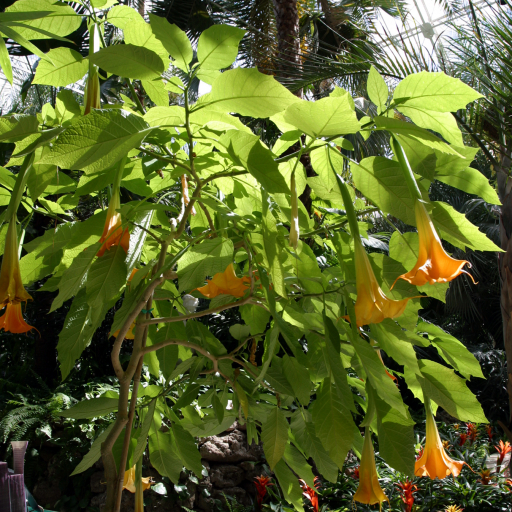
Plant Overview
Often called the "Snowy Angel's Trumpet," this plant is a horticultural masterpiece known for its dramatic, downward-hanging blooms. A natural hybrid of B. aurea and B. versicolor, it is famous for its intoxicating evening fragrance that can perfume an entire backyard after sunset. While they look like something plucked from a dreamscape, these woody shrubs carry a potent botanical power that demands respect.
🔍 How to Identify
- 🎺 Pendulous Blooms: The flowers are massive, trumpet-shaped, and hang vertically downward (unlike the upward-facing Datura). They are usually white or pale cream, often with "toothed" edges on the petals.
- 🍃 Velvety Foliage: The leaves are large, soft to the touch, and broadly ovate. They can grow up to a foot long, providing a lush, tropical backdrop for the flowers.
- 🌳 Growth Habit: It typically grows as a multi-stemmed woody shrub or a small tree. In the right conditions, it can reach heights of 10 to 15 feet.
🏡 In Your Garden
- 🍽️ Heavy Feeders: These plants are "hungry" and require frequent fertilization during the growing season to produce their massive flowers. If the leaves look yellow, it’s often a cry for more nutrients.
- 💧 Thirsty Nature: Because of their large leaf surface area, they lose water quickly through transpiration. In the heat of summer, they may need daily watering to prevent wilting.
- ✂️ Pruning Nuance: To encourage more flowers, prune the plant after the main bloom flush. However, be careful not to prune too low; flowers only form on the "Y" forks of the branches.
⚠️ Safety & Toxicity
- 🚫 High Toxicity: Every part of the Brugmansia × candida is highly toxic. It contains tropane alkaloids (scopolamine and atropine) which can be fatal if ingested.
- 🐾 Pets & Kids: Keep this plant away from curious pets and young children. Even handling the plant can cause skin irritation or blurred vision if you touch your eyes afterward, so wearing gloves while pruning is strongly recommended.
✨ Fun Fact
The intense fragrance of the Angel’s Trumpet is a clever evolutionary trick. It is specifically designed to attract its primary pollinators: Sphinx moths. Because these "hawkmoths" are most active at night, the plant saves its strongest perfume for the moonlight to ensure it gets noticed!

Detailed Care Instructions
To grow Brugmansia × Candida, also known as Angel's Trumpet, you can follow these steps:
- Choose the right location: Brugmansia × Candida thrives in full sun or partial shade. Select a location that receives at least 6-8 hours of direct sunlight per day. Ensure the area is sheltered from strong winds.
- Prepare the soil: Brugmansia × Candida prefers moist, well-draining soil. Amend the soil by adding organic matter, such as compost or aged manure, to improve the soil's fertility and drainage.
- Start from seeds or cuttings: You can start Brugmansia × Candida from either seeds or cuttings. If using seeds, soak them in warm water for 24 hours before planting them in seed-starting mix. Keep the soil consistently moist and maintain a temperature of around 70-75°F (21-24°C). Seed germination may take several weeks.
If using cuttings, take 8-10 inch (20-25 cm) stem cuttings from a mature plant. Remove the lower leaves and dip the cut end in a rooting hormone. Plant the cutting in a pot filled with well-draining soil mix and keep it moist. Provide bottom heat using a heating mat to promote root development.
- Transplanting: Once the seedlings or cuttings have developed a strong root system, transplant them into larger pots or in the garden bed. Choose containers with drainage holes and use a well-draining soil mix. If planting in the ground, space the plants about 6 feet (1.8 meters) apart.
- Watering: Brugmansia × Candida requires regular watering. Keep the soil consistently moist but avoid overwatering, as it can cause root rot. Water deeply when the top inch (2.5 cm) of soil feels dry.
- Fertilizing: Feed the plants regularly with a balanced fertilizer, such as a 10-10-10 or 14-14-14, during the growing season. Follow the package instructions for proper application rates. Avoid over-fertilizing, as it can harm the plant.
- Pruning: Prune Brugmansia × Candida to maintain its shape and promote bushier growth. Remove dead or damaged branches, and lightly trim back excessive growth after the blooming period.
- Pests and diseases: Watch out for common pests like aphids, spider mites, and whiteflies. Use organic insecticides or insecticidal soaps to control them. Brugmansia × Candida is susceptible to fungal diseases, so provide good air circulation and avoid overhead watering to prevent moisture buildup.
- Winter care: Brugmansia × Candida is not cold-hardy and should be protected during winter in most climates. Before the first frost, cut the plant back to about 2-3 feet (60-90 cm) and move it indoors to a cool, dark location, like a basement or garage. Water sparingly during this dormant period. In spring, bring the plant back outside when there is no longer a threat of frost.
Remember, Brugmansia × Candida contains toxic compounds, so it's important to keep it out of reach of children and pets.
To water this particular plant, it is important to take into account its specific needs. It requires regular watering, but must be watered deeply rather than given frequent shallow watering. The soil should be kept moist, but not waterlogged. The amount of water needed depends on various factors such as the climate, the pot size, and the soil type. It is generally recommended to water thoroughly once a week, or more often in hot and dry weather. When watering, avoid getting water on the leaves, as this can lead to fungal diseases. It is also important to ensure proper drainage to prevent water buildup and root rot. Overall, it is essential to maintain a consistent watering schedule to promote healthy growth and blooming.
To properly fertilize this plant, use a well-balanced fertilizer that contains equal parts of nitrogen, phosphorus, and potassium. The fertilizer should be applied every two weeks during the growing season and every four to six weeks during the dormant season. It is recommended to dilute the fertilizer to half strength before applying it to the soil. Additionally, make sure to water the plant thoroughly before and after fertilizing to prevent fertilizer burn.
Brugmansia × Candida prefers a well-draining soil that is rich in organic matter. The soil should be loose and airy to allow for proper drainage and root development. A pH level between 5.5 and 6.5 is ideal for this plant.
There are various specialized soil mixes available commercially that are designed for Brugmansia × Candida, but you can also create your own by combining peat moss, perlite and vermiculite. Adding some compost or aged manure can also help improve the soil fertility and structure.
It is important to avoid heavy clay or compacted soils, as these can lead to waterlogged roots and nutrient deficiencies. Additionally, the plant should be grown in a location that receives ample sunlight, protection from harsh winds and adequate moisture.
To propagate this plant, you will need to take a cutting from a healthy, mature plant. Choose a stem that is at least 6 inches long and has a healthy set of leaves. Using a sharp, sterilized pruner, make a clean cut just below a leaf node.
Remove the leaves from the bottom 2-3 inches of the stem, leaving only a few leaves at the top. Dip the cut end of the stem in rooting hormone powder, making sure to cover the entire cut surface.
Fill a small pot with well-draining soil and make a hole in the center. Insert the cutting into the hole and gently press the soil around it to hold it in place.
Water the cutting thoroughly and place it in a bright, shaded location. Keep the soil moist but not waterlogged, and mist the leaves regularly to maintain a humid environment.
After a few weeks, the cutting should start to form roots. You can gently tug on the stem to check for resistance, which indicates that the roots have formed properly.
Once the plant has established a root system and is growing well, you can transplant it to a larger container or into the ground. Remember to provide plenty of water and fertilizer as the plant grows to ensure healthy growth and flowering.








