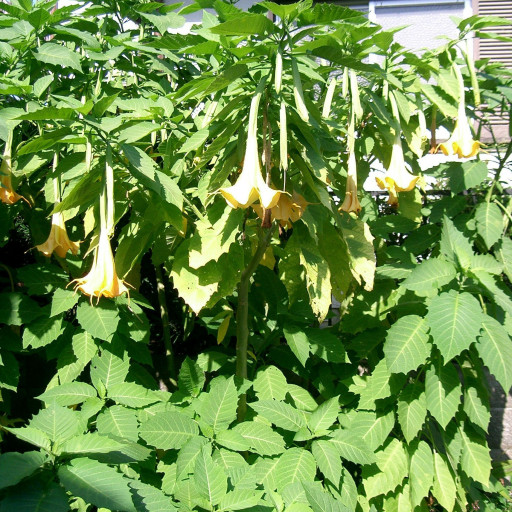
Plant Overview
Known famously as the Angel’s Trumpet, Brugmansia suaveolens is a tropical masterpiece originally hailing from the rainforests of Brazil. It is beloved for its massive, downward-hanging blooms that look like heavenly instruments and emit an intoxicating, sweet fragrance as the sun sets. While it creates a stunning "jungle" atmosphere in any landscape, this plant is a powerful member of the Nightshade family and demands respect for its potent chemistry.
🔍 How to Identify
- 🎺 The Trumpets: Enormous, pendulous flowers (reaching up to 12 inches in length) that hang straight down. They typically bloom in snowy white, though pale yellow and soft pink varieties are common.
- 🍃 The Foliage: Large, matte-green leaves with a slightly velvety texture and wavy margins. The leaves can grow quite large, providing a lush, dense canopy.
- 🪵 The Structure: A woody, multi-stemmed shrub or small tree that can reach heights of 10–15 feet. Its branches are somewhat brittle and grow in a wide, spreading habit.
🏡 In Your Garden
- 🥣 A Heavy Consumer: Think of the Angel’s Trumpet as the "athlete" of your garden. Because it grows so fast and produces such giant flowers, it requires a massive amount of water and regular feeding to prevent its leaves from drooping.
- 🌙 The Moon Garden Star: This plant is specifically evolved for nocturnal pollinators. Its scent is almost non-existent during the day but becomes incredibly powerful at night to attract Sphinx moths, making it the perfect centerpiece for a patio where you sit after dark.
⚠️ Safety & Toxicity
- 🚫 Extreme Toxicity: WARNING. Every part of this plant—especially the seeds and flowers—is highly toxic if ingested. It contains tropane alkaloids (like scopolamine) that can cause hallucinations, paralysis, or worse.
- 🧤 Handle with Care: Keep this plant away from areas where children or pets play. Gardeners should wear gloves when pruning, as the sap can cause skin irritation or accidentally dilate your pupils if you touch your eyes after handling the branches.
✨ Fun Fact
- 🦋 Despite being found in gardens all over the world, Brugmansia species are technically classified as "Extinct in the Wild." They no longer exist in their native habitats without human cultivation, largely because the original prehistoric animals that dispersed their seeds are now extinct!

Detailed Care Instructions
| Color | White |
| Soil Ph | 6.5-7 |
| Humidity | Normal |
| Lighting | Full Sun |
| Toxicity | Poisonous |
| Soil Type | Moist, Humus Rich, Fertile, Well-Drained Soils |
| Bloom Time | Sporadically From Spring Until Late Fall, With The Heaviest Profusion Occurring In Fall; Year-Round In Warmer Climates |
| Difficulty | Medium |
| Plant Type | Perennial Shrub |
| Mature Size | 10–16 Ft. Tall |
| Native Area | Brazil |
| Temperature | 5°C - 25°C |
| Sun Exposure | Full Sun, With Afternoon Shade In Warmer Climates |
| Hardiness Zones | 9-11 |
To grow Brugmansia suaveolens, also known as angel's trumpet, you will need to follow these steps:
- Choose the right location: Brugmansia suaveolens prefers a spot with full sun to partial shade. It should be protected from strong winds and extreme temperatures.
- Prepare the soil: The plant will thrive in well-draining soil that is rich in organic matter. You can amend the soil with compost or well-rotted manure to improve fertility and drainage.
- Propagation: Brugmansia suaveolens can be propagated from seeds or cuttings. You can collect seeds from mature pods and sow them in a seed-starting mix. Keep the soil moist and warm, and the seeds should germinate in a few weeks. If using cuttings, take 6-8 inch long cuttings from a healthy plant and remove the lower leaves. Dip the cut end in rooting hormone and place it in moist potting soil.
- Planting: When the seedlings or cuttings have grown a few inches tall, you can transplant them into containers or into the ground. The containers should be large enough to accommodate the plant's growth. If planting in the ground, dig a hole deep and wide enough to accommodate the root ball.
- Watering: Brugmansia suaveolens prefers consistently moist soil. Water the plant when the top inch of soil feels dry. Be careful not to overwater, as it may lead to root rot.
- Fertilization: Feed your Brugmansia suaveolens with a balanced, water-soluble fertilizer every two weeks during the growing season. This will help promote healthy growth and abundant flowering.
- Pruning: Pruning is important for shaping the plant and maintaining its size. You can prune the plant in late winter or early spring before new growth appears. Remove any dead or damaged branches, as well as old, woody growth. Prune back the remaining branches to promote branching and fuller growth.
- Protect from pests and diseases: Brugmansia suaveolens is susceptible to pests such as aphids, spider mites, and whiteflies. Regularly inspect your plant for any signs of infestation and treat with insecticidal soap or neem oil if necessary. Also, watch out for common diseases such as fungal leaf spot or powdery mildew and treat accordingly.
Remember, Brugmansia suaveolens contains toxic compounds and all parts of the plant are poisonous. Take necessary precautions if you have children or pets around.

Place in a window with dappled sun or a spot in the middle of a room. Or directly in a window facing west or east.

To water this plant, it is important to first check the soil moisture level by inserting a finger or a moisture meter into the soil. If the soil feels dry or the moisture meter reads low, it is time to water the plant.
When watering, it is important to use room temperature water and to avoid getting water on the leaves or flowers, as this can cause damage or disease. Slowly pour water onto the soil, being sure to saturate the entire root zone.
It is also important to ensure proper drainage, as this plant does not like to sit in water. If there is excess water in the saucer or container, it should be removed after watering.
During hot or extremely dry weather, this plant may require more frequent watering, while during cooler or moist periods, it may require less. It is important to monitor the plant's moisture level and adjust watering accordingly.
To fertilize this plant, use a slow-release fertilizer with an NPK ratio of 10-8-10. Apply the fertilizer around the base of the plant, avoiding contact with the leaves. Water the plant thoroughly after fertilizing. Repeat this process every 4-6 weeks during the growing season. Be sure to follow the manufacturer's instructions for proper application and dosage.
The ideal soil to use for this particular plant is a well-draining, nutrient-rich soil that is slightly acidic in nature. A soil mixture that contains high-quality compost and organic matter is recommended, as well as a balanced blend of minerals and nutrients. It is important to avoid using soils that are heavy and compacted, as this may lead to poor drainage and root rot. Additionally, adding perlite or coarse sand to the soil mixture can improve drainage and aeration.
Propagation of this plant can be done by taking cuttings from the parent plant. The best time to take cuttings is during the spring or early summer when the plant is actively growing. Cut a stem from the main plant that has a length of at least 6 inches and remove the leaves from the bottom half of the stem. Dip the cut end in rooting hormone powder and plant it in a pot filled with moist potting soil. Keep the soil moist and the cutting in a warm location with bright, but indirect sunlight. After a few weeks, roots should begin to form and new growth will emerge from the top of the cutting. Once the plant is established, it can be transplanted into a larger pot or into the ground.
Common pests of the angel's trumpet include Scale insect, mealybugs, spider mites, aphids, thrips. Make a habit of checking your angel's trumpet frequently for pests so that any infestations can be caught and managed early.








