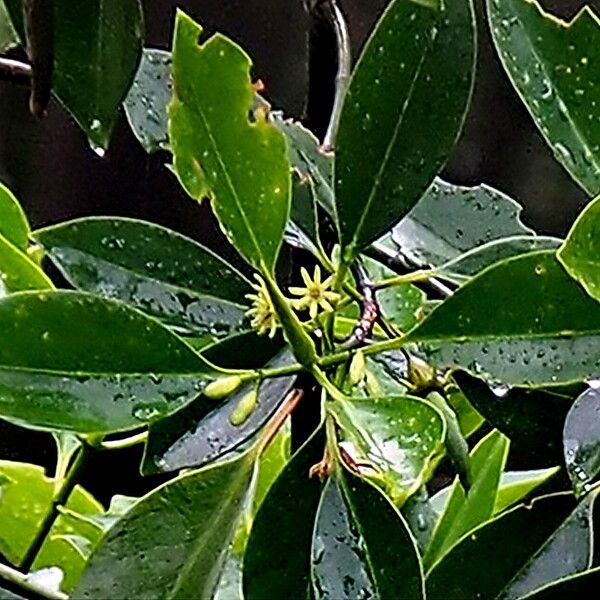
Plant Overview
Often called the Small-leafed Orange Mangrove, Bruguiera cylindrica is a hardy survivor of the intertidal zone. It is a cornerstone species of coastal ecosystems across Southeast Asia and Australasia, acting as a natural "seawall" that protects coastlines from erosion. While it may not have the giant stilt roots of its cousins, its architectural "knee roots" create a prehistoric landscape in the muddy banks it calls home.
🔍 How to Identify
- 🍃 Elliptic Leaves: The leaves are small, leathery, and dark green with a slightly yellowish tint underneath. They are arranged in opposite pairs, helping the tree conserve water in salty environments.
- 🦴 Knee Roots: Look at the ground; this species is famous for its "pneumatophores" that look like bent knees or knobby joints poking out of the mud to breathe.
- 🥒 Cylindrical Fruit: The fruit (hypocotyl) is shaped like a slender green cigar or a bean. It is distinctive because it curves slightly toward the end, unlike the straight fruits of other mangrove species.
🏡 In Your Garden & Habitat
- 🌊 Clay Specialist: In the wild, this plant prefers firm, heavy clay soils on the landward side of the mangrove forest. It is rarely kept as a traditional garden plant unless you are participating in a coastal restoration project.
- 🧂 Salt Filtration: It is a master of "ultra-filtration." The roots are so efficient at blocking salt that the water inside the plant is significantly fresher than the seawater surrounding it.
⚠️ Safety & Toxicity
- ✅ Safe to Touch: This plant is non-toxic to the touch and does not cause skin irritation for most people.
- 🐾 Pet & Human Safety: While not considered poisonous, the leaves and bark are not edible. In some traditional medicine, parts of the tree are used, but raw consumption can lead to severe digestive discomfort.
- 🦀 Ecological Importance: Because it is a protected species in many regions, removing or "foraging" these plants from the wild is often illegal.
✨ Fun Fact
Bruguiera cylindrica is viviparous, meaning the seeds germinate and begin to grow into a seedling while they are still hanging from the parent tree! Once the seedling (the "cigar") is heavy enough, it drops into the water, floating vertically until it hits mud and instantly begins to take root.

Detailed Care Instructions







