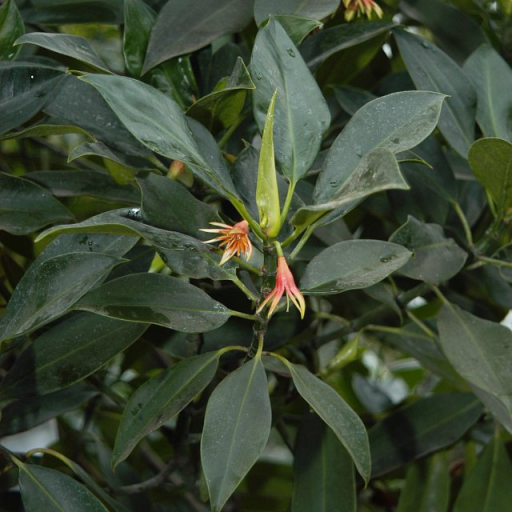
Plant Overview
Known as the Large-leafed Orange Mangrove or the "Oriental Mangrove," this coastal architect is a cornerstone of tropical shorelines. While most plants flee from salt, Bruguiera gymnorhiza thrives in the mud, acting as a sturdy bridge between the ocean and the land. In folklore, these mangroves are often seen as the "Silent Sentinels" that protect villages from the wrath of the sea.
🔍 How to Identify
- 🍃 The Foliage: Large, leathery, elliptic leaves that are a deep, glossy green. They often grow in dense clusters at the ends of branches to catch maximum sunlight.
- 🌺 The "Flowers": What looks like a bright red or orange flower is actually the calyx (the outer part of the flower). It is bell-shaped and rigid, protecting the delicate creamy-white petals inside.
- 🦵 Knee Roots: Unlike the arching prop roots of the Red Mangrove, this species produces distinctive "knee roots." These look like knobby wooden knees poking out of the mud to breathe during high tide.
- 🎋 Cigar Seeds: It produces long, green, spear-shaped seedlings called "propagules" that hang from the branches like organic cigars.
🏡 In Your Garden & Landscape
- 🌊 Saline Specialist: This isn't a typical backyard plant unless you live on a brackish canal or a coastal property. It requires "wet feet" and thrives in heavy, silty mud where oxygen is low.
- 🌱 Viviparous Growth: This plant exhibits a fascinating survival strategy called vivipary. The seeds germinate while still attached to the parent tree. If you find a "cigar" seedling on the beach, you can plant it upright in a pot of saturated, salty sand.
- 🛡️ Coastal Protector: If you have a shoreline property, planting these helps prevent erosion. Their complex root systems trap sediment and create a nursery for small fish and crabs.
⚠️ Safety & Toxicity
- 🟢 Status: Generally non-toxic and safe to handle.
- 🧤 Skin Sensitivity: The bark is extremely rich in tannins (historically used for tanning leather and dyeing nets). While not poisonous, the sap can be a mild skin irritant for those with sensitive skin, and it will definitely stain your clothes!
- 🐾 Pet Safety: It is not known to be toxic to dogs or cats, though the fibrous leaves and seedlings are not digestible and could cause an upset stomach if chewed.
✨ Fun Fact
The "cigar" seedlings are master navigators. Once they fall from the tree, they can float in the ocean for months. When they finally hit a muddy bank, they are weighted at the bottom so they float vertically, allowing them to "stab" into the mud the moment the tide goes out!

Detailed Care Instructions
To grow Bruguiera Gymnorhiza (also known as the Large-leafed Mangrove) plant, follow these steps:
- Obtain seeds or seedlings: You can get Bruguiera Gymnorhiza seeds from a reputable seed supplier or collect them from mature fruits found in mangrove areas. Alternatively, you can buy seedlings from a nursery specialized in mangrove plants.
- Prepare a suitable planting site: Choose a location near coastal areas that receive full or partial sun. The planting site should have well-drained soil, preferably sandy or loamy soil. Bruguiera Gymnorhiza can tolerate saline conditions, but it grows best in areas with tidal water exchange and aeration.
- Plant the seeds or seedlings: If using seeds, soak them in water for a day or two to remove the outer coating and aid germination. Plant the seeds about 1 cm deep in pots filled with a mixture of sand, loam, and peat. Keep the soil moist but not waterlogged. Transplant the seedlings to the desired location after they have grown to a suitable size (about 20 cm or more).
- Maintain proper watering: Water the Bruguiera Gymnorhiza plants regularly, especially during the establishment phase. Ensure the soil remains moist but not waterlogged. Irrigate with freshwater if the planting location doesn't have natural tidal water exchange.
- Provide adequate sunlight: Bruguiera Gymnorhiza plants require full or partial sunlight for optimal growth. Ensure they receive at least 6 hours of direct sunlight each day.
- Protect from extreme temperatures: Bruguiera Gymnorhiza is tolerant of high temperatures but sensitive to frost. If you live in a region with cold winters, consider providing protection such as mulching or wrapping the plant to shield it from freezing temperatures.
- Prune if necessary: Prune the Bruguiera Gymnorhiza plants as needed to remove dead or damaged branches and maintain desired shape. Pruning should be done during the dormant phase or after flowering and fruiting.
- Maintain appropriate humidity levels: Bruguiera Gymnorhiza thrives in high humidity environments. Regularly mist the leaves or use a humidifier if the air is dry to increase the humidity around the plant.
- Monitor for pests and diseases: Watch out for common plant pests like scale insects and aphids. If you notice any pests, treat them with suitable insecticides or organic pest control methods. Regularly inspect the plants for any signs of diseases and take necessary actions to prevent their spread.
Remember to respect local regulations and guidelines when growing Bruguiera Gymnorhiza, particularly if it is a protected or endangered species in your region.

Place in a bright room that is sun drenched almost all day. Or directly in a south-facing window.

The Bruguiera Gymnorhiza plant should be watered regularly but not excessively. It is important to ensure that the soil remains moist but not waterlogged, as this can lead to root rot. When watering, it is best to use room temperature water and to pour it directly onto the soil rather than the leaves. The frequency of watering will depend on the climate and season, with more frequent watering required during hot and dry periods. To check if the plant needs watering, you can test the soil moisture level by inserting your finger a few centimeters into the soil. If the soil feels dry, it is time to water the plant.
To fertilize this plant, use a balanced fertilizer with equal proportions of nitrogen, phosphorus, and potassium. Apply the fertilizer during the plant's active growth period in the spring and early summer.
Dilute the fertilizer to half strength, and apply it to the soil around the plant's roots. Avoid getting the fertilizer on the leaves or stems of the plant.
Water the plant thoroughly after fertilizing to help the nutrients absorb into the soil and reach the roots. Repeat the fertilization process once every 4-6 weeks during the growing season.
Be careful not to over-fertilize as this can damage the plant and reduce its growth. Always follow the instructions on the fertilizer packaging and adjust the frequency of fertilization if necessary based on the plant's response.
The recommended soil for this plant should be a well-draining, nutrient-rich and slightly acidic soil with a pH level ranging from 6.0 to 6.5. The ideal soil mixture should consist of equal parts of peat moss, perlite, and sand. It is important to ensure that the soil is damp but not waterlogged to avoid root rot and fungal diseases. Furthermore, this plant prefers soils that are moderately saline and can tolerate some waterlogging. Therefore, it is recommended to use a soil mixture that has a good amount of organic matter and is able to hold moisture. The plant should be regularly fertilized with a balanced and slow-release fertilizer to maintain its optimum growth and health.
To propagate this plant, select a mature healthy plant and take cutting from its stem or branches during the active growing season. Cut the stem of the plant at an angle, a few inches below a leaf node, or where the stem is slightly woody. Remove any leaves from the bottom half of the stem.
Dip the cut end of the stem into rooting hormone powder and then plant it into a pot with well-draining soil. Lightly water the cutting and place it in a bright location that receives indirect sunlight.
Keep the soil moist but not too wet, and provide humidity by covering the cutting with a plastic bag or a small plastic tunnel. Check the cutting regularly for signs of root growth and new leaf growth. Once the cutting has rooted and begun to grow, it can be transplanted into a larger pot or directly into the ground.








