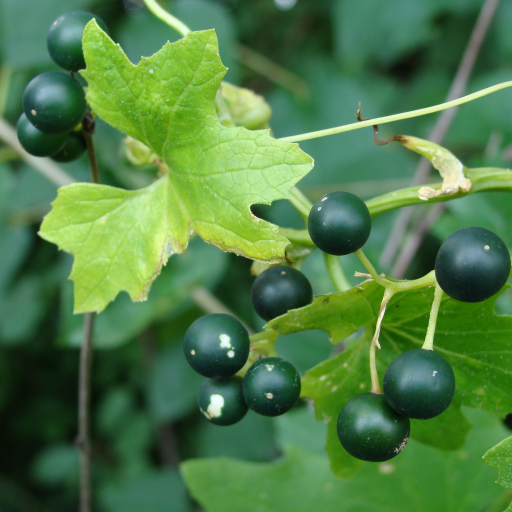
Plant Overview
Known as "False Mandrake" or "Devil's Turnip," Bryonia alba is a vigorous climber that feels like it’s straight out of a dark fairytale. Historically, its massive, fleshy roots were often carved into human shapes and sold to unsuspecting folks as magical Mandrake roots. While its delicate, lace-like vines and spiraling tendrils look charming, this plant is a powerhouse of growth that demands respect and caution.
🔍 How to Identify
- 🌿 Vine & Tendrils: It is a perennial climbing herb that uses tightly coiled, spring-like tendrils to hitchhike onto nearby trees, shrubs, or fences, often reaching lengths of 30 feet.
- 🍃 Rough Leaves: The leaves are broadly heart-shaped with five distinct lobes. They are covered in tiny, stiff hairs, giving them a rough, sandpaper-like texture when touched.
- ⚫ The Berries: In late summer, the plant produces clusters of small berries. They start as a pale green marble but ripen into a deep, glossy, ink-black color.
🏡 In Your Garden
- 🧗 The Master of Smothering: In many regions, particularly the Pacific Northwest of the US, this plant is considered a noxious weed. It grows with such speed that it can completely blanket native vegetation, blocking sunlight and eventually killing the "host" plant it climbs on.
- 🪴 The "Iceberg" Root: If you find this in your garden, be aware that the vine is only the tip of the iceberg. It develops a massive, fleshy taproot that can grow as large as a human head. To truly remove the plant, you must dig up the entire root, as even a small fragment left behind can regenerate into a new vine.
⚠️ Safety & Toxicity
- 🚫 High Toxicity: WARNING: All parts of the White Bryony are highly toxic. It contains bryonin, a potent glycoside that can cause severe abdominal pain, vomiting, and respiratory failure if ingested.
- 🐾 Pet & Child Hazard: The berries are the most dangerous feature because they look remarkably like small grapes or currants. Keep children and pets far away; as few as 40 berries can be a lethal dose for an adult, and far fewer for a small animal or child.
- 🧪 Skin Irritation: The sap can cause blistering or painful rashes on sensitive skin. Always wear gloves if you are attempting to prune or remove this plant.
✨ Fun Fact
In medieval Europe, because the real Mandrake (Mandragora) was so expensive and rare, swindlers would grow Bryony roots inside shaped ceramic molds to force them into "human" forms. They would then dry them and sell them as magical talismans that were said to protect the home!

Detailed Care Instructions
| Humidity | Normal |
| Lighting | Part Sun |
| Toxicity | Poisonous |
| Difficulty | Medium |
| Hibernation | Cold Period |
| Hardiness Zones | 5 - 9 |
To grow a Bryonia Alba plant, also known as white bryony or wild hops, you can follow the steps below:
- Seed Selection: Acquire fresh seeds of Bryonia Alba from a reputable source or collect them from mature plants.
- Germination: Soak the seeds in water for 24 hours before planting to enhance germination. Then, plant the seeds about 1 inch deep in a small seed tray or individual pots filled with well-draining soil.
- Ideal Growing Conditions: Bryonia Alba prefers full sun or partial shade and thrives in loamy soil with good drainage. It requires a warm climate, so ensure the temperature stays above 50°F (10°C) during the growing season.
- Watering: Keep the soil evenly moist but not waterlogged. Water the plants when the top inch of soil becomes dry, around once a week. Beware of overwatering, as it can lead to root rot.
- Support: As Bryonia Alba is a climbing plant, provide a support structure like a trellis or stakes for it to climb. This will allow the vines to grow vertically and maximize space.
- Fertilization: Apply a balanced, slow-release organic fertilizer to the soil once a month during the active growing season. This will provide essential nutrients for healthy growth.
- Training: As the plant grows, gently guide the vines onto the support structure to encourage climbing. It may need some initial help until the tendrils can naturally cling to the support.
- Pruning: Prune or trim the plant as needed to maintain its shape and prevent overcrowding. Remove any dead or diseased parts to promote healthy growth.
- Harvesting: Harvest the mature Bryonia Alba fruits when they change color from green to a deep black or red. Use gloves when handling the plant, as it can cause skin irritation for some individuals.
- Propagation: Save and dry some of the harvested seeds for the following growing season. You can also propagate Bryonia Alba by dividing the roots in early spring or by taking stem cuttings and rooting them in water or a rooting medium.
Remember that Bryonia Alba is a vigorous climber and can become invasive if not properly managed. Consider planting it in a controlled environment or using containers to restrict its growth if you are concerned about it spreading.

Place in a bright room that is sun drenched almost all day. Or directly in a south-facing window.

To properly water this plant, you will need to check the moisture level of the soil frequently. You can use a moisture meter or stick your finger into the soil to determine if it is dry or damp. Water the plant thoroughly when the top inch of soil is dry. The water should be applied slowly and evenly to avoid causing damage to the roots. Ensure that the water has drained completely from the bottom of the pot and never allow the plant to sit in standing water as this can lead to root rot. It is also important to avoid getting water on the leaves of the plant as this can cause damage or disease.
- Choose a well-draining soil with a pH range of 6.0 to 6.5.
- Use a balanced fertilizer with equal amounts of nitrogen, phosphorous, and potassium.
- Apply the fertilizer in early spring, just as the plant begins to emerge from dormancy.
- Use caution when applying the fertilizer near the roots, as Bryonia Alba has a shallow root system.
- Water the plant thoroughly after applying the fertilizer.
Bryonia alba plants prefer well-draining soil that is slightly acidic to neutral in pH. A sandy loam soil mixed with organic matter such as compost or peat moss is ideal for plant growth. Avoid using heavy or compacted soils that retain too much moisture, as this can lead to root rot and other diseases. It is also important to ensure that the soil is rich in nutrients, so incorporating a balanced fertilizer or organic amendments is recommended. Overall, providing a loose, fertile soil will help promote healthy growth and development of Bryonia alba plants.
Bryonia Alba is a plant that can be propagated using a few different methods. Here are the steps to propagate this plant without using its common names:
- Find a healthy, mature Bryonia Alba plant with well-established roots.
- Take a cutting from the plant, making sure it is at least 4-6 inches long and has several leaves. Use a clean, sharp pair of scissors or shears to make the cut.
- Remove the bottom set of leaves from the cutting, leaving only the top few leaves intact.
- Dip the cut end of the stem in rooting hormone powder to help encourage root growth.
- Prepare a small pot with well-draining soil.
- Plant the cutting in the soil, making sure it is buried deep enough to cover the bottom node (where the leaves were removed).
- Water the cutting thoroughly and place it in a bright, humid location. Keep the soil moist but not waterlogged.
- After a few weeks, you should see new growth from the cutting. This indicates that roots have formed and the cutting has successfully propagated.
- Continue to care for the new plant as you would any other Bryonia Alba plant.








