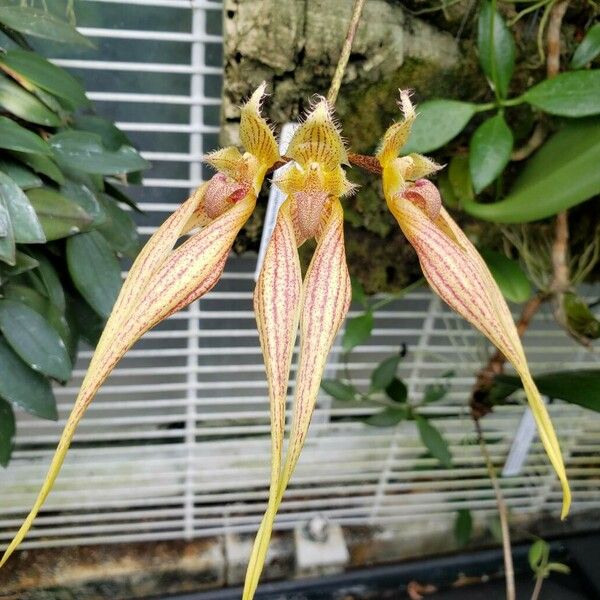
Plant Overview
Living up to its name, the Bulbophyllum fascinator is an orchid that looks like it belongs in a sci-fi film or a high-fashion boutique. Often referred to by its older name, Cirrhopetalum fascinator, this Southeast Asian native is famous for its long, wind-swept "tails" and delicate, quivering fringes. It doesn't just sit there; it is designed to move with the slightest breeze, acting like a biological mobile to catch the eye of its pollinators.
🔍 How to Identify
- 🌸 The "Long Tails": The most striking feature is the pair of lateral sepals that extend into incredibly long, wispy streamers, often reaching 4 to 6 inches in length.
- 💃 The Hinged Lip: It features a tiny, fleshy "labellum" (lip) that is delicately hinged. It jiggles and tips back and forth with the slightest vibration or air current.
- 🧵 Fringed Details: The top petal and the dorsal sepal are adorned with fine, hair-like "cilia" or fringes that shimmer and shake, adding to its alien-like appearance.
🏡 In Your Garden
- 🌬️ Air and Moisture Balance: Because this is an epiphyte (a plant that grows on trees), it hates "wet feet" but loves high humidity. It is happiest when mounted on a piece of cork bark or nestled in a shallow, slatted wooden basket where air can circulate freely around its roots.
- 💧 The Humidity Trick: This orchid is a humidity hog. If the air is too dry, those spectacular fringed petals will shrivel prematurely. In a home setting, it often requires a humidity tray or a dedicated mister to mimic its tropical rainforest home.
⚠️ Safety & Toxicity
- 🐾 Pet Friendly: Like the vast majority of the orchid family, Bulbophyllum fascinator is considered non-toxic to cats, dogs, and horses.
- 🚫 Handle with Care: While safe, the plant is physically delicate. The long "tails" and moving lip can be easily snapped off if handled roughly, which can stress the plant and ruin its bloom cycle.
✨ Fun Fact
The Bulbophyllum fascinator is a master of deception! It uses its "moving parts" and a slightly musky scent to trick carrion flies into thinking it’s a source of food. The hinged lip is actually a "trapdoor" that tips the fly forward into the column of the flower, ensuring the insect picks up a packet of pollen before it flies away.

Detailed Care Instructions







