Plant Overview
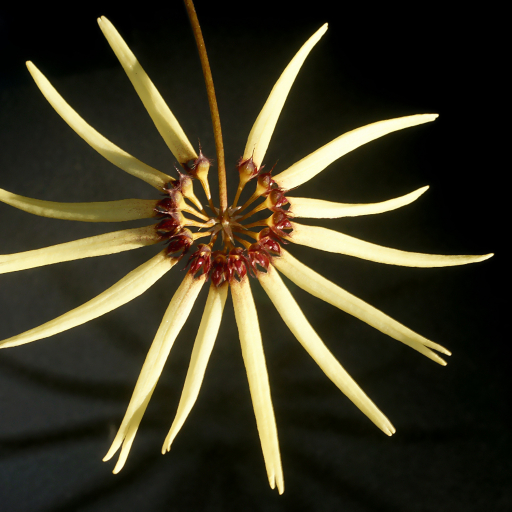
Commonly known as the Daisy Orchid, Bulbophyllum makoyanum is a show-stopping miniature species native to the tropical forests of Southeast Asia. Unlike the tall, upright stems of common supermarket orchids, this plant produces a stunning "umbel"—a circular cluster of flowers that looks like a golden sunburst or a tiny, delicate fan. It is a prized possession for collectors who enjoy the "weird and wonderful" side of the orchid world.
🔍 How to Identify
- 🌸 The Fan Formation: The most striking feature is the flower arrangement. About 10 to 12 thin, elongated flowers grow from a single point, spreading out in a perfect 180-degree fan that mimics the shape of a daisy.
- 🍃 Pseudobulbs & Leaves: It features small, egg-shaped "pseudobulbs" (the plant's water storage tanks) that grow along a creeping rhizome. Each bulb produces a single, thick, leathery leaf.
- 🎨 Spotted Details: While the flowers appear yellow or creamy from a distance, a closer look reveals intricate reddish-purple spots and a tiny, hinged "lip" that moves with the slightest breeze.
🏡 In Your Garden
- ☁️ Humidity Seekers: Because it originates from misty rainforests, this orchid is a "humidity hog." It thrives in terrariums or humid greenhouses. If kept on a windowsill, it requires frequent misting or a pebble tray to keep its roots from shriveling.
- 🪵 Mounted Living: In the wild, it grows on tree branches rather than in the ground. It is happiest when "mounted" on a piece of cork bark or cedar with a little sphagnum moss, allowing its roots to breathe and its "fans" to hang gracefully.
⚠️ Safety & Toxicity
- 🐾 Non-Toxic: The Bulbophyllum genus is generally considered non-toxic to cats, dogs, and humans. It is a safe choice for pet-filled households.
- 🧤 Delicate Structure: While not poisonous, the flower stalks are incredibly thin and brittle. Keep it out of reach of curious paws or high-traffic areas to prevent the "fans" from being snapped off.
✨ Fun Fact
The "lip" of the Bulbophyllum makoyanum flower is actually a finely balanced seesaw! It is so sensitive that when a small fly lands on it, the lip tips the insect backward, gently bumping it against the pollen packets to ensure the plant gets pollinated.

Detailed Care Instructions
To successfully grow Bulbophyllum Makoyanum (Makoy's Bulbophyllum), follow these steps:
- Lighting: Provide bright, indirect light, similar to the conditions of rainforests. Avoid direct sunlight, as it can damage the plant. A north or east-facing window is ideal.
- Temperature: These orchids prefer warm temperatures, ranging from 65-85°F (18-29°C). Avoid drastic temperature fluctuations.
- Humidity: Bulbophyllum Makoyanum requires high humidity levels, around 50-70%. You can achieve this by placing the pot on a tray filled with water and pebbles or using a humidifier. Mist the leaves regularly, especially during dry periods.
- Watering: Water thoroughly once the top inch of the potting mix feels dry. Avoid overwatering, as it can lead to root rot. Ensure good drainage to prevent water from accumulating around the roots.
- Potting mix: Use a well-draining potting mix specifically formulated for orchids. A mix containing bark, sphagnum moss, and perlite is ideal.
- Fertilizer: Apply a balanced orchid fertilizer once every 2-3 weeks during the growing season (spring and summer) and reduce frequency during the dormant period (fall and winter). Follow the instructions on the fertilizer package for proper dilution.
- Repotting: Bulbophyllum Makoyanum prefers to be slightly root-bound, so repot only when necessary, usually every 2-3 years. Repotting can be done after flowering or when you observe overcrowding of roots. Use a slightly larger pot and fresh potting mix.
- Air circulation: Provide good air circulation around the plant to prevent stagnant air that may promote fungal or bacterial problems. An oscillating fan or open windows can help achieve this.
- Flowering: Bulbophyllum Makoyanum produces unique, cascade-like inflorescences with tiny, maroon-colored flowers. It typically blooms in spring or early summer when provided with the appropriate care.
- Pests and diseases: Keep an eye out for common orchid pests like aphids, mealybugs, and spider mites. Regularly inspect the plant for signs of disease or pests and take immediate action if necessary.
Remember, growing orchids requires patience and attention to detail. Each plant may have specific care requirements, so adjust the care based on your plant's condition.
Bulbophyllum makoyanum is an epiphytic orchid species native to Southeast Asia. When it comes to watering this plant, it is essential to replicate its natural habitat to promote healthy growth. Here are some detailed guidelines on watering the Bulbophyllum makoyanum plant:
- Understand the plant's natural habitat: Bulbophyllum makoyanum is typically found growing in humid rainforests, often growing on trees or rocks. This means that it thrives in high humidity and prefers a consistently moist environment.
- Watering frequency: Aim to water your Bulbophyllum makoyanum plant about once or twice a week, but adjust the frequency based on the environmental conditions and the plant's specific needs. It's important to monitor the moisture level of the potting medium regularly to determine when it requires watering.
- Water quality: Use water that is at room temperature or slightly warm for watering. Avoid using water that is too cold or contains chemicals such as chlorine, as these can harm the sensitive roots of the plant.
- Soaking vs. misting: Bulbophyllum makoyanum benefits from a combination of soaking and misting. Start by gently pouring water onto the potting medium until it is thoroughly saturated, allowing excess water to drain out. Additionally, mist the leaves regularly to maintain high humidity around the plant.
- Potting medium: The potting medium for Bulbophyllum makoyanum should be well-draining yet capable of holding moisture. Orchid-specific bark mix or a blend of fine-grade orchid bark, sphagnum moss, and perlite is commonly used. This type of medium allows excess water to escape, preventing waterlogging that can lead to root rot.
- Watering technique: When watering, ensure that the water reaches the potting medium evenly, avoiding direct contact with the leaves or pseudobulbs. This helps prevent bacteria or fungal infections and keeps the plant's vulnerable parts dry.
- Humidity requirements: Bulbophyllum makoyanum thrives in high humidity levels, ideally around 50-70%. To enhance humidity, you can place a humidity tray filled with water near the plant, use a room humidifier, or group plants together to create a microclimate.
- Monitor plant response: Pay attention to how your Bulbophyllum makoyanum plant reacts to watering. If the leaves become spongy or wrinkled, it may indicate underwatering. Conversely, yellowing or rotting leaves may suggest overwatering. Adjust your watering schedule accordingly based on the plant's response.
Remember, while these guidelines provide general directions for watering Bulbophyllum makoyanum, every plant and environment is unique. Fine-tune your watering routine based on the specific conditions of your plant and closely observe its response to maintain optimal health and growth.
To fertilize Bulbophyllum Makoyanum, you can follow the below instructions:
- Start fertilizing the plant during the active growing season, which is typically spring and summer. Avoid fertilizing during the dormant period.
- Choose a balanced fertilizer with an N-P-K ratio of around 10-10-10 or similar. A balanced fertilizer ensures that the plant receives a mix of essential nutrients.
- Dilute the fertilizer according to the instructions provided on the packaging. Typically, a concentration of 1/4 to 1/2 strength is ideal for orchids like Bulbophyllum Makoyanum.
- Apply the diluted fertilizer to the plant's roots using a watering can or sprayer. Water the plant thoroughly to ensure the fertilizer reaches the roots. Avoid applying the fertilizer directly on the leaves or flowers.
- Fertilize the plant once every two to four weeks during the active growth period. This frequency helps provide a consistent supply of nutrients without overwhelming the plant.
- Monitor the plant's response to the fertilizer. If you notice any signs of over-fertilization, such as burnt roots or leaf tips, reduce the frequency or dilution of the fertilizer.
- Flush the pot with water periodically to remove any accumulated fertilizer salts and prevent salt buildup, which can harm the plant's roots.
- During the plant's dormant period, limit or stop fertilization as the plant's nutrient requirements decrease. Resume fertilizing when new growth appears.
Remember, it is always important to read and follow the instructions on the fertilizer packaging, as different brands may have specific guidelines for application and dosage.
Bulbophyllum Makoyanum is an epiphytic orchid that requires a specific type of soil to thrive. The ideal soil composition for this plant is a well-draining mix that replicates its natural growing conditions in its native habitat. It is recommended to use a mixture of high-quality orchid bark, sphagnum moss, and perlite or other similar components to create a suitable growing medium.
The orchid bark serves as the main component of the soil mix, providing excellent drainage and preventing waterlogging, which can be detrimental to the plant's root system. It also helps to mimic the natural growing conditions by simulating the tree bark on which the orchid typically attaches itself.
Sphagnum moss adds additional moisture retention properties to the soil mix while promoting air circulation. This type of moss is highly absorbent and can hold water for longer periods, ensuring that the plant receives adequate hydration between watering.
Perlite, or other comparable materials like pumice or volcanic rock, is included to enhance drainage further. These lightweight components prevent the soil from compacting, allowing air to reach the roots and reducing the risk of root rot or fungal diseases that can occur in overly saturated conditions.
It is important to note that Bulbophyllum Makoyanum is an epiphytic orchid, meaning it naturally grows on other plants rather than in soil. Therefore, it is crucial to choose a soil mix that closely resembles its natural habitat to promote optimal growth and development.
Propagation of Bulbophyllum Makoyanum can be done through division of its rhizomes or by using its pseudobulbs. Here's a step-by-step guide on how to propagate this plant:
- Prepare a suitable potting mix: Bulbophyllum Makoyanum thrives in a well-draining mixture. Prepare a potting mix by combining equal parts of orchid bark, sphagnum moss, and perlite.
- Choose a healthy plant: Select a mature and healthy Bulbophyllum Makoyanum plant from which you want to propagate. Ensure that the plant has several stems or pseudobulbs.
- Division method:
a. Gently remove the plant from its pot and shake off excess soil.
b. Inspect the rhizomes and locate sections that have at least one healthy pseudobulb and a few healthy roots.
c. Carefully separate these sections from the main rhizome by cutting or twisting them apart.
d. Each divided section will form a new plant. Make sure each section has a sufficient number of pseudobulbs and roots.
- Pseudobulb method:
a. Choose a mature pseudobulb from the plant.
b. Using a sterile, sharp knife, carefully cut the pseudobulb away from the main plant.
c. Ensure that the pseudobulb has an intact growing point or buds, as well as healthy roots.
- Prepare pots for planting:
a. Select small pots with drainage holes, as these will ensure proper water drainage and prevent waterlogged conditions.
b. Fill the pots with the prepared potting mix, leaving enough space for the new plant to settle.
- Planting the divisions or pseudobulbs:
a. Place the divided sections or pseudobulbs on top of the potting mix in the pots, ensuring that the roots are spread out.
b. Gently press the mix around the roots, anchoring the new plant in place. Make sure the buds or growing points are facing up.
c. Provide support if needed, using stakes or orchid clips.
- Caring for the newly propagated plants:
a. Place the pots in a location with bright, indirect light. Avoid direct sunlight, as it can scorch the plants.
b. Maintain a high humidity level by covering the pots with a plastic bag or placing them in a humidity tray.
c. Water the newly propagated plants regularly, keeping the potting mix slightly moist. Avoid overwatering, as it can lead to root rot.
d. Fertilize the plants with a balanced orchid fertilizer, following the manufacturer's instructions.
e. Monitor the plants regularly for any signs of pests or diseases and take appropriate action if necessary.
By following these steps, you can successfully propagate Bulbophyllum Makoyanum and expand your collection of these unique orchids.








