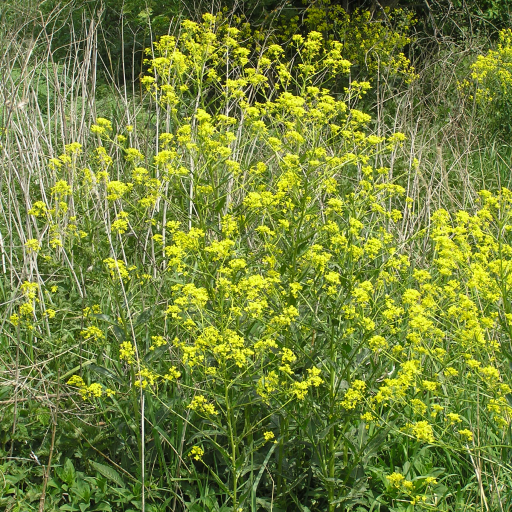
Plant Overview
Commonly known as Turkish Rocket or Warty Cabbage, Bunias orientalis is a powerhouse of the plant world. While some gardeners cherish it as a reliable "perennial broccoli," others view it as a formidable invader due to its incredible resilience. Native to the Caucasus and Eastern Europe, it has traveled across the globe, often claiming territory with its deep, unshakeable roots.
🔍 How to Identify
- 🌼 Sunny Blooms: It produces dense, fragrant clusters of bright yellow flowers. Each flower has four petals arranged in a cross shape, a classic hallmark of the mustard family.
- 🍃 Jagged Foliage: The lower leaves are large and lance-shaped with deep, irregular lobes, resembling a giant version of arugula or dandelion greens.
- 🦠 The "Warts": If you look closely at the stems and seed pods, you’ll notice small, dark, bumpy protrusions. These "tubercles" give the plant its nickname, Warty Cabbage.
🏡 In Your Garden
- 🌱 The Taproot Anchor: This plant is famous for its massive, deep taproot. This makes it exceptionally drought-tolerant, but it also means it hates being moved. Once you plant Turkish Rocket, it is likely there for a lifetime.
- 🍽️ Permaculture Favorite: In forest gardens, it is grown for its edible "broccolini" buds. However, beware of its spread; it is a prolific self-seeder and can quickly take over a flower bed if the spent blooms aren't trimmed back.
- 🪴 Soil Specialist: It isn't picky about soil quality and can thrive in heavy clay or disturbed ground where other plants might struggle to find a foothold.
⚠️ Safety & Toxicity
- ✅ Status: Generally safe and non-toxic to humans and common household pets.
- 🥗 Edibility Note: The young leaves, flower buds (before they open), and even the peeled stems are edible and have a nutty, mustard-like flavor.
- 🚜 Ecological Warning: While not "poisonous," it is considered a noxious weed in several regions. Its ability to outcompete native wildflowers makes it a threat to local biodiversity if it escapes your garden.
✨ Fun Fact
Turkish Rocket is considered nearly "immortal" in the gardening world. Even a small fragment of the root left in the soil can regenerate into a full-sized plant, making it a true survivor of the botanical kingdom!

Detailed Care Instructions
To grow Bunias Orientalis, also known as Turkish rocket or Asian rocket, follow these steps:
- Choose a suitable location: Select a sunny spot in your garden with well-drained soil. This plant can tolerate various soil types but prefers slightly alkaline soil.
- Prepare the soil: Clear any weeds or debris from the area. Loosen the soil to a depth of about 8-10 inches and mix in organic matter such as compost or well-rotted manure to improve soil fertility.
- Sow the seeds: Sow the Bunias Orientalis seeds directly into the prepared soil in early spring or fall. Scatter the seeds on the surface and lightly press them into the soil. Keep the seeds spaced about 12-18 inches apart.
- Watering: Water the newly planted seeds gently but consistently to keep the soil moist until germination occurs, usually within 7-14 days. After germination, water the plants regularly, providing about 1 inch of water per week. Be careful not to overwater, as this plant prefers slightly dry conditions.
- Thinning: When the seedlings are a few inches tall, thin them out, leaving the strongest plants spaced appropriately (12-18 inches apart). This will prevent overcrowding and improve airflow around the plants.
- Mulching: Apply a layer of organic mulch, such as straw or wood chips, around the plants to help retain moisture, suppress weed growth, and keep the soil cool.
- Fertilizing: Bunias Orientalis does not require heavy fertilization; however, you can apply a balanced slow-release fertilizer once or twice during the growing season to provide additional nutrients.
- Maintenance: Remove any weeds that compete with the Bunias Orientalis plants for water and nutrients. Regularly monitor the plant for pests or diseases and take appropriate measures to control them.
- Harvesting: Harvest the young leaves and shoots when they are tender, typically in late spring or early summer. Avoid harvesting older leaves as they can become tough and bitter.
- Winter care: In areas with chilly winters, the plant may die back in the winter, but it often resprouts from the base in the following spring. Mulching heavily around the plant in late fall can help protect it during colder months.
By following these steps, you should be able to successfully grow Bunias Orientalis in your garden.

Place in a bright room that is sun drenched almost all day. Or directly in a south-facing window.

To properly water this plant, you should first check the soil around the base of the plant to see if it is dry to the touch. If it is, you can proceed with watering. Use a watering can or hose to slowly water the plant at the base and make sure the water is penetrating the soil deeply. Avoid watering the leaves or flowers of the plant as this can lead to disease. Depending on the climate and environment, you may need to water the plant once a week, or more frequently during hotter months. It is important to not overwater this plant, as it prefers well-draining soil and can be susceptible to root rot.
- Choose a well-draining soil that is rich in organic matter.
- Apply a balanced fertilizer with equal parts of nitrogen, phosphorus, and potassium.
- Fertilize the plant during its active growth period, typically in spring and early summer.
- Apply the fertilizer evenly around the plant, taking care not to apply it directly to the leaves or stem.
- Water the plant immediately after fertilizing to ensure proper nutrient absorption.
- Repeat fertilization every 4-6 weeks during the growing season, adjusting the amount and frequency based on the plant's growth and overall health.
The best soil to use with this plant is a well-draining mixture that is rich in nutrients. A pH level of 6.5 to 7.5 is ideal for optimal growth. It is recommended to use a mixture of equal parts of sand, loam, and peat moss to create the best soil for this plant. It is important to ensure that the soil is not too compact or too sandy, as this can affect the plant's growth and health. The soil should be kept moist, but not too wet, to prevent root rot. Adding compost or organic fertilizer can also be beneficial to help promote healthy growth and blooms.
Bunias Orientalis can be propagated by several methods. One way is through seed propagation. Collect the seeds from the plant and sow them in a well-drained soil mixture. Cover the seeds lightly with soil and provide adequate moisture for growth.
Another way is through stem cuttings. Take cuttings of the plant with a sharp, sterilized knife. Make sure the cuttings are 4-6 inches long and have at least two nodes. Remove the lower leaves from the cutting and plant it in a well-drained soil mixture. Keep the soil moist and the cutting should root in 2-4 weeks.
Bunias Orientalis can also be propagated through division. Carefully dig up the plant and separate the root system into smaller sections with a sharp, sterilized knife. Plant the sections in a well-drained soil mixture and provide adequate moisture for growth.
No matter which method of propagation is used, it is important to keep the soil moist and provide adequate light for growth. With proper care, Bunias Orientalis can be easily propagated and grown successfully.








