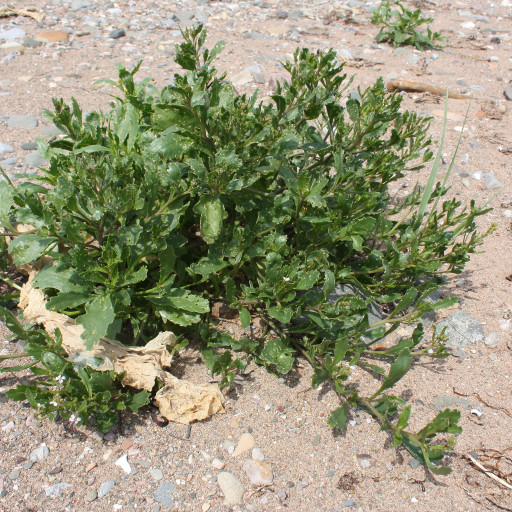
Plant Overview
Often called the "Coastal Pioneer" or the American Sea Rocket, this hardy succulent-like herb is a true beach lover. Thriving in the harsh, salt-sprayed environment of North American sand dunes, it is one of the first plants to colonize the shoreline. Its name comes from its rapid growth and the surprising "rocket-like" peppery kick found in its leaves, which belong to the same family as mustard and horseradish.
🔍 How to Identify
- 🍃 Fleshy Leaves: The foliage is thick, waxy, and succulent, designed to store water in salty conditions. The edges are often wavy or lobed, giving it a distinct "crinkled" look.
- 🌸 Four-Petal Flowers: It produces clusters of small, delicate flowers that range from pure white to pale lavender. Like all members of the mustard family, the flowers have exactly four petals arranged in a cross shape.
- 🚀 Jointed Seed Pods: The most unique feature is the fruit—a two-jointed pod that looks like a small green rocket. The top half is designed to break off and float away on the tide to start a new colony elsewhere.
🏡 In Your Garden & Habitat
- 🏖️ Coastal Specialist: While rarely grown in traditional inland gardens, it is a superstar for seaside restoration. It acts as a "dune builder," trapping wind-blown sand around its base to help stabilize the beach.
- ☀️ Sun & Sand Nutrients: It requires full, unobstructed sun and thrives in poor, sandy soil where other plants would wither. It has a deep taproot that anchors it against heavy coastal winds and allows it to find moisture deep beneath the sand.
⚠️ Safety & Toxicity
- 🟢 Status: Generally considered non-toxic and is historically known as an edible wild plant.
- 👅 Peppery Punch: The leaves and seed pods have a very strong, wasabi-like flavor. However, because it grows on shorelines, it can absorb pollutants or heavy metals from ocean runoff. It is best enjoyed as a visual marvel rather than a snack unless you are certain the beach is pristine.
- 🐾 Pet Safety: There are no known toxic effects for dogs or cats, though the high salt content from its natural environment might cause tummy upset if ingested in large quantities.
✨ Fun Fact
The Sea Rocket uses a "bet-hedging" survival strategy: the top half of its seed pod is buoyant and travels the ocean to find new beaches, while the bottom half stays attached to the plant, ensuring that if the current spot is good, at least one seed stays right where it is!

Detailed Care Instructions
| Humidity | Dry |
| Lighting | Shade |
| Difficulty | Medium |
| Hibernation | Cold Period |
| Hardiness Zones | Max 6 |
To grow Cakile Edentula, also known as sea rocket, follow these steps:
- Choose the right location: Cakile Edentula is a salt-tolerant plant that thrives in coastal areas. It prefers full sun and sandy soil.
- Obtain Cakile Edentula seeds: You can purchase seeds from a reputable nursery or online seed supplier.
- Prepare the soil: Sandy soil is best for Cakile Edentula. If your soil is not sandy, you can amend it by adding sand to improve drainage.
- Sow the seeds: Sow the seeds directly in the ground in early spring after the last frost. Make sure to space the seeds about 6-12 inches apart. Lightly cover the seeds with a thin layer of soil.
- Watering: Keep the soil consistently moist, but not overly saturated. Water the plants whenever the top inch of soil feels dry.
- Mulching: Apply a layer of organic mulch, such as straw or wood chips, around the base of the plants to help conserve moisture and suppress weed growth.
- Maintenance: Remove any weeds that may compete with the Cakile Edentula plants for nutrients and space. Monitor the plants regularly for any signs of pests or diseases. Prune or trim any dead or yellowing foliage.
- Harvesting: Harvest the edible leaves and flowers when they are young and tender. The leaves have a salty, cabbage-like flavor and can be used in salads, stir-fries, or as a garnish.
Remember to check your local regulations before planting Cakile Edentula, as it may be considered an invasive species in some areas.

Place in a bright room that is sun drenched almost all day. Or directly in a south-facing window.

To water this plant, ensure that the soil is dry to the touch before watering. When watering, slowly pour water onto the soil around the base of the plant. Avoid getting water on the leaves as this can cause damage. Water deeply, enough to reach the roots of the plant, but do not overwater as this can lead to root rot. The frequency of watering will depend on the temperature and humidity of the environment, as well as the soil type and drainage of the pot or garden bed. It is recommended to water this plant regularly but to allow the soil to dry out between watering sessions.
To fertilize this plant, use a balanced fertilizer with equal amounts of nitrogen, phosphorus, and potassium. Apply the fertilizer once a month during the growing season, which is typically spring and summer. Be sure to water the plant thoroughly after fertilizing to ensure the nutrients are absorbed by the roots. Avoid overfertilizing, as this can cause damage to the plant.
Cakile Edentula plant requires a well-draining soil that is slightly alkaline. The soil should be moderately rich in nutrients and should have a good water-holding capacity. The plant is tolerant of salt spray and can grow in sandy or gravelly soil, as well as in rocky areas. It prefers a soil pH of between 7 and 8 and can grow in soils with a high salt content. Additionally, the soil should be free of any heavy metals or toxic substances that might harm the plant. A mixture of sand, compost, and loam soil can be used to create a suitable growing medium for Cakile Edentula plant.
To propagate this plant, you will need to collect seeds from mature plants. Wait until the seed pods have turned brown and dried out before harvesting the seeds. Next, clean the seeds by removing any remaining debris or plant matter.
Prepare a small pot or container with well-draining soil. Plant the seeds in the soil and cover lightly with additional soil. Water the soil thoroughly and keep the container in a warm, sunny location.
It may take several weeks or even months for the seeds to germinate. Once the seedlings have grown to a suitable size, they can be transplanted into larger pots or directly into the ground in a sunny location with well-draining soil.
Regular watering is essential for newly propagated plants as they establish their root systems. Once established, Cakile Edentula is an easy-to-care-for plant that thrives in coastal, sandy habitats.








