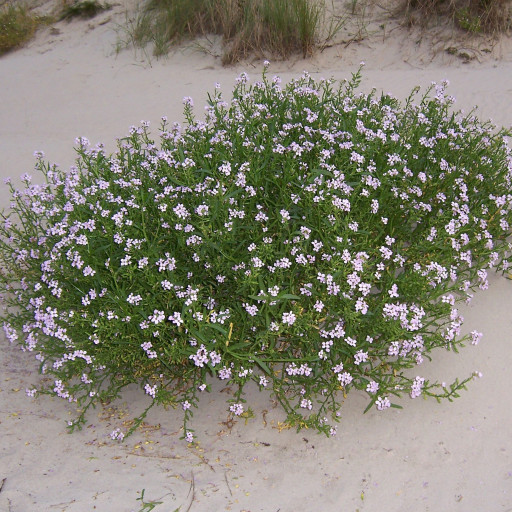
Plant Overview
Known as the Sea Rocket, Cakile maritima is a resilient pioneer that thrives where most plants perish—the salt-sprayed, shifting sands of the coastline. Its name comes from its aerodynamic, jointed seed pods that look like tiny green rockets ready to launch into the surf. This coastal specialist is a master of survival, often found growing closer to the tide line than almost any other flowering plant.
🔍 How to Identify
- 🍃 Succulent Foliage: The leaves are thick, fleshy, and often deeply lobed. This waxy texture helps the plant store precious freshwater and resist the drying effects of salt and wind.
- 🌸 Cross-Shaped Blooms: Like other members of the mustard family, it produces clusters of small flowers with four petals, ranging in color from pale lavender to bright white.
- 🚀 Rocket Seed Pods: The most distinct feature is the fruit—a two-jointed, corky pod. The top half is shaped like an arrowhead, designed to break off and float away on the ocean currents.
🏡 In Your Garden & Habitat
- 🏖️ Coastal Specialist: In a garden setting, it requires extremely well-draining, sandy soil. It will struggle in heavy clay or rich potting mixes that stay wet, as it is adapted to the "lean" nutrition of the dunes.
- ⚓ The Anchor Root: It develops a remarkably long, sturdy taproot to anchor itself against shifting sands and gale-force winds. Because of this, it is notoriously difficult to transplant; once it starts growing, it prefers to stay put.
- 🌊 Salt Tolerance: It is one of the few plants that actually enjoys sea spray. It uses salt to regulate its internal water pressure, making it a perfect choice for beachfront rockeries where other plants wither.
⚠️ Safety & Toxicity
- 🟢 Generally Safe: The Sea Rocket is considered non-toxic to humans and pets. In fact, it is a historical "famine food," with its leaves and seed pods having a pungent, mustard-like kick.
- 🧂 High Salt Content: Because the plant grows in saline environments, its tissues can be very high in sodium. While not poisonous, it may cause mild stomach upset if pets consume large quantities due to the salt and sulfur compounds common in the Brassicaceae family.
✨ Fun Fact
The Sea Rocket is a world traveler! Its seed pods are filled with a corky tissue that allows them to float for months in saltwater without losing their ability to sprout. A single "rocket" can drift hundreds of miles across the ocean to colonize a completely new beach.

Detailed Care Instructions
| Humidity | High |
| Lighting | Full Sun |
| Difficulty | Medium |
| Hibernation | Cold Period |
| Hardiness Zones | 5 - 9 |
To grow Cakile maritima, also known as sea rocket, you can follow these steps:
- Obtain seeds: You can purchase Cakile maritima seeds from a reputable nursery or online seed suppliers.
- Choose a suitable location: Cakile maritima is a coastal plant, so it prefers sandy or well-draining soil. Find a location in your garden or outdoor area with full sun exposure.
- Prepare the soil: If you have heavy clay soil, add sand or organic matter such as compost to improve drainage and create a sandy environment.
- Sow the seeds: In early spring, scatter the seeds directly onto the prepared soil surface. Start by lightly scratching the soil's surface with a rake, then sow the seeds. Alternatively, you can start the seeds indoors in containers six to eight weeks before the last spring frost and transplant them later.
- Water regularly: Keep the soil moist during germination and early growth. Provide a deep watering once or twice a week if rainfall is inadequate.
- Thin the seedlings: Once the seedlings have grown a few inches tall, thin them to maintain a spacing of about 8 to 12 inches between plants. This will allow the plants ample room to grow and spread.
- Weed control: Monitor for weeds regularly and remove them promptly. Weeds can compete with young Cakile maritima plants for nutrients and water.
- Mulch: Consider applying a layer of organic mulch, such as straw or wood chips, around the plants. Mulch helps conserve moisture, suppresses weed growth, and provides insulation for the roots.
- Pest and disease management: Cakile maritima is generally resistant to common pests and diseases. However, monitor for any issues and treat accordingly if necessary.
- Harvesting and propagation: When the plants mature, usually within three to four months after sowing, you can harvest the leaves for culinary use. To propagate more plants, collect the mature seeds and sow them in the same manner as described above.
Remember to check your local regulations before collecting any wild plants, as Cakile maritima may grow naturally in coastal areas.

Place in a bright room that is sun drenched almost all day. Or directly in a south-facing window.

Cakile maritima is a type of plant that grows near the sea and is widely used in landscaping and water conservation. Watering the plant is an important aspect of the plant's growth. When watering the plant, it is critical to mimic the natural rainfall patterns in the plant's native habitat. The plant requires ample water throughout the growing season, which can be achieved by watering it once every two weeks during normal rainfall periods. However, in periods of drought or high temperatures, the plant requires more frequent watering to prevent wilting.
When watering Cakile maritima, it is essential to avoid overwatering, as this can cause root rot and fungal infections. The best way to water the plant is to water it deeply, allowing the water to penetrate the soil, and then allow the soil to dry out partially before watering again. The soil should never be allowed to completely dry out, as this can cause the plant's leaves to turn yellow or brown.
When choosing a watering method, it is recommended to use a drip irrigation system or a soaker hose, as these methods allow water to penetrate the soil slowly and uniformly rather than quickly running off the surface. Mulching around the plant can also help to retain moisture in the soil and reduce evaporation.
Overall, proper watering is essential for the health and growth of Cakile maritima. By following these watering tips, gardeners and landscapers can ensure that the plant stays healthy and thriving.
To fertilize this plant, use a balanced fertilizer with equal amounts of nitrogen, phosphorus, and potassium. Apply it once every four weeks during the growing season. Make sure to follow the instructions on the fertilizer packaging regarding the amount to use per square foot or per plant. Avoid fertilizing during periods of drought or extreme heat.
Cakile Maritima is a plant that grows in coastal regions and sandy soils. It requires a soil that is well-draining, fast-drying and rich in nutrients. The ideal soil for Cakile Maritima is a sandy loam that has a pH level between 6.5 and 7.5. It should be mixed with organic matter such as compost or peat moss to provide additional nutrients to the plant. The soil should be moist but not waterlogged, and it should have good drainage to prevent water accumulation which can lead to root rot. Fertilizer can be added during planting and throughout the growing season to provide additional nutrients to the plant. Overall, the best soil for Cakile Maritima would be sandy loam mixed with organic matter and well-draining.
Cakile Maritima is a type of plant that can be propagated easily through the process of cuttings. In order to propagate this plant, you will need to find healthy and well-established Cakile Maritima plants in your area. Once you have identified these plants, you can take cuttings from them.
The first step in propagating Cakile Maritima is to prepare your cuttings. To do this, you will need to use a sharp pair of pruning shears to cut a healthy stem from the parent plant. The stem should be approximately 3 inches long and should have at least two leaves attached to it. Once you have removed the stem from the parent plant, you should remove the leaves from the bottom of the stem.
After you have prepared your cuttings, you should prepare a potting mix for them. To do this, you will need to mix together equal parts of peat moss and perlite. This potting mix will provide your Cakile Maritima cuttings with the nutrients and moisture they need to grow.
Next, you should plant your Cakile Maritima cuttings in the potting mix. To do this, make a small hole in the potting mix and insert the stem into the hole. Be sure to press the potting mix firmly around the stem to ensure that it is secure.
Once your cuttings are planted, you should water them thoroughly. Be sure to keep the potting mix evenly moist until the cuttings have established roots and are growing well. During this time, it is important to keep the cuttings in a warm and well-lit location.
After a few weeks, your Cakile Maritima cuttings should begin to develop roots and new growth. Once they have established themselves, you can transplant them into larger pots or into your garden. With proper care and attention, your new Cakile Maritima plants should grow and thrive for years to come.








