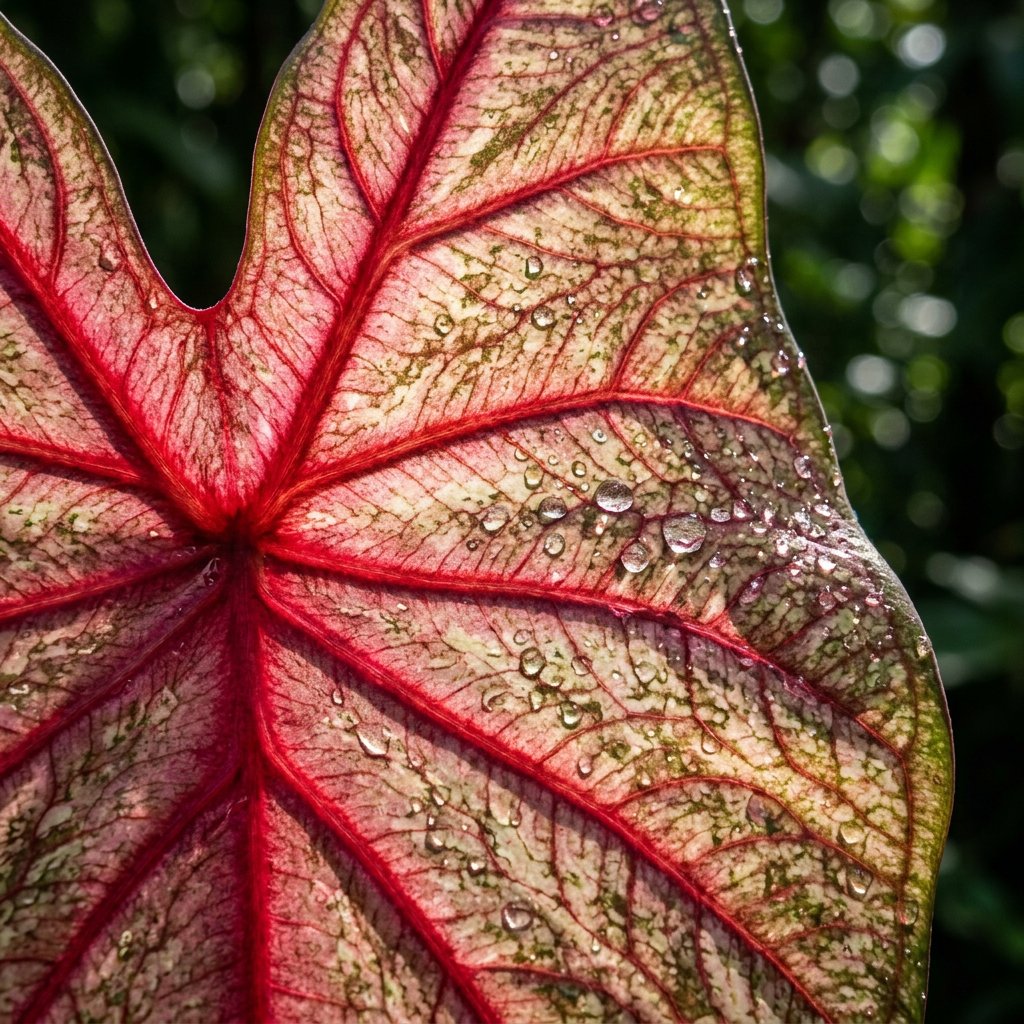
Plant Overview
Often called "Angel Wings," "Elephant Ears," or "Heart of Jesus," Caladiums are the true artists of the shade garden. Originating from the humid banks of the Amazon basin, these tropical gems are grown almost exclusively for their spectacular foliage. They prove that you don't need flowers to have a garden full of vibrant, breathtaking color.
🔍 How to Identify
- 🍃 Leaf Shape: Distinctly heart-shaped, lance-shaped, or arrow-shaped (sagittate). The leaves grow on long, slender stalks that emerge directly from underground tubers.
- 🎨 Color Mosaics: The foliage looks like a watercolor painting, featuring splashes, veining, and gradients of white, pink, rose, and deep red, usually framed by a deep green border.
- 📄 Leaf Texture: The leaves are remarkably thin—almost like parchment or high-quality tissue paper. This makes them appear translucent when the sun hits them from behind.
🏡 In Your Garden
- ☁️ The Shade Sweet Spot: Caladiums are experts at brightening dark corners. Because their leaves are so thin, direct afternoon sun can act like a magnifying glass and scorch them; they prefer dappled light or "bright shade" to keep their colors vivid.
- 💤 Seasonal Sleepers: One of the most common mistakes is throwing the plant away when it withers in the fall. Caladiums are tuberous perennials that go dormant. They "die back" to rest during the winter, only to sprout again once the soil warms up in the spring.
- 🌡️ Warmth is Mandatory: These are true children of the tropics. They will stop growing and may rot if the soil temperature drops below 60°F (15°C). They are best suited for warm, humid environments or as seasonal indoor guests.
⚠️ Safety & Toxicity
- 🚫 Toxic Status: All parts of the Caladium plant are considered toxic.
- 🐾 Pet & Child Risk: The plant contains insoluble calcium oxalate crystals. If leaves or stems are chewed, these crystals cause immediate mouth pain, swelling of the throat, and drooling. Keep them out of reach of curious cats, dogs, and toddlers.
- 🖐️ Skin Irritation: Some sensitive individuals may experience mild skin irritation (dermatitis) when handling the sap or tubers, so wearing gloves during repotting is a smart move.
✨ Fun Fact
Because of their thinness and brilliant hues, Caladiums were historically nicknamed "the vegetable kaleidoscope." In their native habitats in South America, they are often found growing along the edges of forests where they can catch filtered light through the canopy.

Detailed Care Instructions
| Color | Bi-Colored Leaves, Variable |
| Humidity | Normal |
| Lighting | Shade |
| Toxicity | Poisonous |
| Soil Type | Moist, Fertile, Well-Drained Soil |
| Difficulty | Easy |
| Plant Type | Perennial |
| Mature Size | 18 - 24 Inches Tall |
| Native Area | South America |
| Temperature | 15°C - 21°C |
| Sun Exposure | Part Shade To Full Shade |
| Hardiness Zones | 9 - 12 |
Here are some steps to help you grow Caladium plants:
- Choose the right location: Caladium plants prefer indirect or filtered light, so find a spot where they can get bright but indirect sunlight. They also like warm temperatures, around 70-85°F (21-29°C). Avoid direct sunlight as it can scorch the leaves.
- Prepare the soil: Caladium plants prefer well-draining soil that is rich in organic matter. Use a mixture of equal parts peat moss, perlite, and potting soil. This will provide good drainage while also retaining moisture.
- Planting: Plant your Caladium bulbs or tubers about 2-3 inches deep, with the eyes or buds facing up. If you are using potted Caladiums, carefully transplant them without disturbing the root system.
- Watering: Keep the soil consistently moist but not waterlogged. Water thoroughly whenever the top inch of soil feels dry. Avoid overwatering as it can lead to root rot.
- Fertilizing: During the growing season, use a balanced liquid fertilizer every two to four weeks to promote healthy growth. Follow the package instructions for the correct dosage.
- Provide humidity: Caladiums thrive in humid conditions. To increase humidity, you can place a tray with water near the plant or mist the leaves regularly with a spray bottle.
- Pruning: Remove any yellow or damaged leaves to maintain the plant's health and appearance. This will also encourage the growth of new foliage.
- Overwintering: If you live in a region with cold winters, you will need to dig up the Caladium tubers before the first frost. Allow them to dry for a few days, then store them in a cool, dry place (around 50-60°F or 10-15°C) for the winter. Replant them in the following spring.
By following these steps, you should be able to successfully grow Caladium plants and enjoy their vibrant foliage.

Place in a window with dappled sun or a spot in the middle of a room. Or directly in a window facing west or east.

To properly water a certain variety of plant belonging to the Caladium family, you need to follow these guidelines:
1. Place the plant in a location where it can receive bright, indirect light or partial shade.
2. Make sure the soil is well-draining and stays moist, but not waterlogged, at all times.
3. Water the plant thoroughly once the surface of the soil feels dry to the touch, but do not let the soil completely dry out between waterings.
4. Avoid getting water on the foliage, as it can cause leaf spotting or fungal diseases.
5. If the plant is grown in a container, allow the excess water to drain out of the pot after watering.
6. During winter months, reduce the frequency of watering to prevent root rot.
7. Use room temperature or slightly warm water when watering the plant to avoid shocking the roots with temperature changes.
For optimal growth, provide your plant with a balanced fertilizer that is high in nitrogen during the growing season. Apply the fertilizer every two to three weeks, according to the manufacturer's instructions, to promote healthy foliage growth. Alternatively, you can use a slow-release fertilizer that will feed the plant gradually over a longer period of time. Be sure to water your plant thoroughly before and after fertilizing to prevent damage to the roots. Avoid over-fertilizing, as excessive nutrients can lead to burned or wilted leaves.
The best type of soil to use for the Caladium plant is a well-draining, moist, and rich soil. The soil should have a slightly acidic pH, between 5.5 and 6.5. A mix of peat moss, perlite, and vermiculite can provide the ideal soil consistency and moisture retention. It is important to ensure that the soil is not too compacted, as this can inhibit growth and reduce drainage. Additionally, adding organic matter such as compost can improve the soil's nutrient content and promote healthy growth.
Caladium plant can be propagated through tubers. To do this, the tubers should be removed from the existing plant in the late fall or early winter, when they are dormant. The tubers should be allowed to dry out for a few days, then placed in a container filled with peat moss or sand. The container should be kept in a warm, humid location until the tubers begin to sprout. Once the new plants have grown to a few inches tall, they can be transplanted into individual pots or into a larger container. The new plants should be kept in a warm, bright location, and should be watered sparingly until they become established. Once the plants are well-established, they can be transferred to a larger container or planted in the ground.
Common pests of the angel's wings include Mealybugs, spider mites, aphids, thrips. Make a habit of checking your angel's wings frequently for pests so that any infestations can be caught and managed early.







