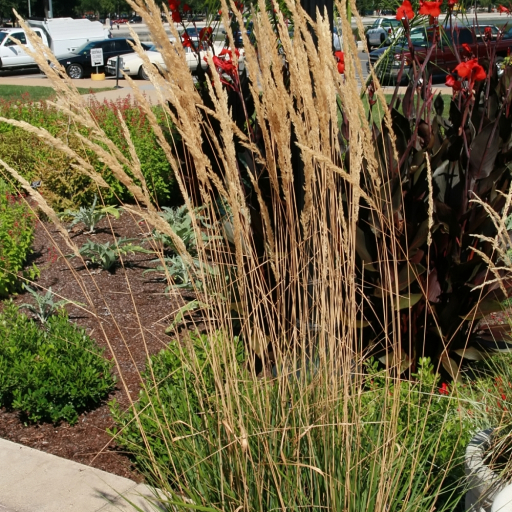
Plant Overview
Commonly known as Feather Reed Grass, this architectural beauty is the "supermodel" of the ornamental grass world. Often nicknamed the "Vertical Masterpiece," it is beloved by designers for its perfectly straight, upright habit that never flops over, even after a heavy rain. Because it is a sterile hybrid, it offers all the beauty of wild grasses without the worry of it spreading uncontrollably through your garden.
🔍 How to Identify
- 🍃 Growth Habit: It forms tight, slender clumps of deep green foliage that grow vertically rather than spreading outward, reaching heights of 3 to 5 feet.
- 🌾 The Plumes: In early summer, it sends up feathery flower spikes that start with a subtle purple-bronze tint before maturing into a soft, wheat-like tan.
- ❄️ Winter Silhouette: Unlike many perennials that disappear in winter, this grass maintains its stiff, golden stalks throughout the cold months, providing a striking structural element against the snow.
🏡 In Your Garden
- 🌞 Cool-Season Vigor: This is a "cool-season" grass, meaning it wakes up early in the spring while other plants are still dormant. It thrives in full sun but is remarkably tolerant of heavy clay soils that stay moist.
- ✂️ Pruning Timing: To keep it looking its best, cut the entire plant down to about 6 inches in late winter. You must do this before the new green shoots appear in early spring, or you’ll end up with "flat-topped" leaves where you accidentally trimmed the new growth.
⚠️ Safety & Toxicity
- ✅ Safe for All: Calamagrostis × acutiflora is non-toxic to dogs, cats, and horses, making it an excellent choice for pet-friendly landscapes.
- 🧤 Physical Caution: While not poisonous, the leaf blades have tiny, microscopic serrations. If you are handling the plant or pruning large batches, wear gloves to avoid "grass cuts" which can be similar to paper cuts.
✨ Fun Fact
The most famous cultivar of this plant, 'Karl Foerster', was named after a legendary German nurseryman who discovered it in a botanical garden. It was the first ornamental grass ever to be named "Perennial Plant of the Year" (in 2001), sparking the global trend for using grasses in modern home landscapes!

Detailed Care Instructions
To successfully grow Calamagrostis × Acutiflora, also known as Feather Reed Grass, follow these steps:
- Choose the right location: Feather Reed Grass prefers full sun to light shade. Ensure that the planting area has well-draining soil.
- Prepare the soil: Loosen the soil by removing any weeds or grass. Mix in organic matter like compost to improve soil fertility.
- Planting: Dig a hole that is slightly wider and deeper than the root ball. Place the plant in the hole, making sure that the top of the root ball is level with the soil surface. Backfill the hole with soil and gently firm it around the plant.
- Watering: Immediately after planting, give the Feather Reed Grass a good soak. Afterward, water regularly to keep the soil consistently moist, especially in the first growing season.
- Mulching: Apply a layer of mulch around the plant to help retain moisture, suppress weed growth, and insulate the roots during extreme temperatures.
- Fertilization: Feather Reed Grass generally does not require much fertilization. However, if the plant shows signs of nutrient deficiency, you can use a slow-release or balanced fertilizer in the early spring.
- Pruning: In late winter or early spring, before new growth begins, cut back the previous year’s growth to about 2-3 inches from the ground.
- Dividing: Over time, the grass may become crowded, leading to a decline in vigor. Dividing the plant every 2-3 years will help rejuvenate it. This is best done in early spring, just as new growth starts to appear.
- Winter Care: Feather Reed Grass is generally hardy and can tolerate freezing temperatures. However, in colder regions, it is beneficial to leave the foliage intact during winter to provide some protection for the roots. Cut back the older growth in early spring.
By following these steps, you can successfully grow Calamagrostis × Acutiflora and enjoy its beautiful and feathery plumes in your garden.

Place in a window with dappled sun or a spot in the middle of a room. Or directly in a window facing west or east.

To properly water this plant, it is important to take into consideration the soil type, weather conditions, and the location where it is planted. Typically, this plant prefers consistently moist soil, so it is recommended to water it deeply once or twice a week.
Before watering, it is crucial to check the soil moisture level. One way to do this is by sticking a finger or a moisture meter into the soil to determine if it is dry or moist. If the soil is dry to the touch, it is time to water the plant.
When watering, it is best to use a hose or watering can with a gentle flow of water to avoid damaging the plant or compacting the soil. Water should be applied evenly around the base of the plant until the top few inches of soil are thoroughly moist.
However, it is important not to overwater the plant, as excessive moisture can lead to root rot and other diseases. If the soil remains wet for an extended period of time, it is important to adjust the watering schedule accordingly.
In summary, to water this plant effectively, check the soil moisture level, water deeply once or twice a week, use a gentle stream of water, and avoid overwatering.
To fertilize this plant, use a balanced fertilizer with equal proportions of nitrogen, phosphorus, and potassium. Apply the fertilizer in the early spring, just as growth begins, and then again in early summer. Water the plant thoroughly after fertilizing, and avoid applying too much fertilizer, as this can cause the plant to grow too quickly and become weak and prone to disease.
The ideal soil for the plant is well-draining and rich in organic matter, with a slightly acidic to neutral pH level. The soil should have a good balance of nutrients, including nitrogen, phosphorus, and potassium, to promote healthy growth. It should also be able to retain moisture without becoming waterlogged, as the plant prefers consistently moist soil. A sandy loam or loam soil type is recommended, as it allows for good root growth and aeration. Avoid using heavy clay or compacted soils, as they can restrict root development and lead to drainage issues.
To propagate this plant, you will need to cut a healthy stem from the parent plant using sharp, sterilized scissors. Make sure the stem is about 4-6 inches long and has several sets of leaves. Remove any leaves from the lower half of the stem. Dip the cut end of the stem into rooting hormone powder or gel.
Then, plant the stem into a well-draining soil mixture, making sure the bottom half of the stem is buried in the soil. Keep the soil moist but not waterlogged and place the cutting in a bright, shaded location.
After a few weeks, the cutting should begin to grow roots. Once the roots have established themselves and the plant is growing well, it can be transplanted to a larger container or directly into the ground. Water the newly propagated plant regularly and ensure it receives adequate sunlight to encourage growth.
Common pests of the feather reed grass include Thrips. Make a habit of checking your feather reed grass frequently for pests so that any infestations can be caught and managed early.








