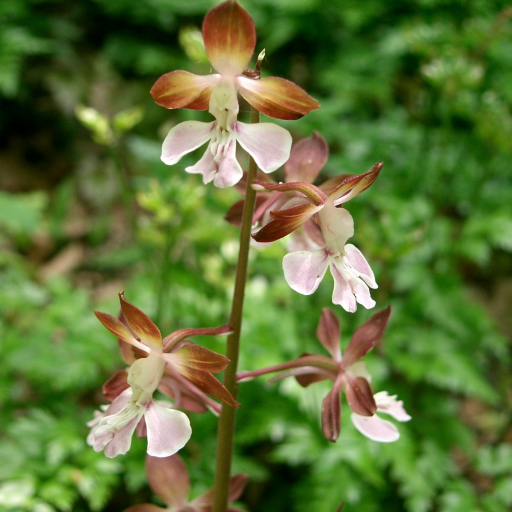
Plant Overview
Often called the Ebine (Shrimp Root) in its native Japan, Calanthe discolor is a resilient woodland orchid that brings an air of quiet elegance to the shaded corners of a garden. Unlike its high-maintenance tropical cousins, this terrestrial orchid stays grounded in the forest floor, producing striking bicolor blooms that look like tiny, dancing figures. It is a celebrated "collector’s plant" that bridges the gap between wild forest flora and refined garden design.
🔍 How to Identify
- 🍃 Pleated Foliage: The leaves are broad, oval, and deeply "pleated" or ribbed, giving them a rich, textural appearance even when the plant isn't in bloom.
- 🌸 Bicolor Contrast: The flowers are famous for their two-tone look; they usually feature mahogany or greenish-brown outer sepals that contrast sharply with a white or pale pink "lip" (labellum).
- 📏 Elegant Spikes: In mid-to-late spring, the plant sends up a vertical flower spike (raceme) that can hold anywhere from 10 to 20 nodding blossoms.
🏡 In Your Garden
- 🌳 The Canopy Effect: To keep this orchid happy, mimic the forest floor. It craves "dappled" sunlight—bright enough to see your shadow, but never direct afternoon sun, which will bleach and burn the delicate pleats of the leaves.
- 🍂 Organic Richness: This plant hates heavy clay or sandy voids. It performs best in loose, airy soil rich in leaf mold or compost. Because it grows from a shallow rhizome, it is sensitive to being buried too deep; keep the "eyes" of the plant just at the soil surface.
⚠️ Safety & Toxicity
- 🐾 Pet Safe: Good news for pet owners! Calanthe discolor is generally considered non-toxic to cats and dogs, making it a worry-free addition to a low-level garden bed.
- 👶 Child Safety: While not poisonous, the plant is purely ornamental. Ingesting any garden orchid can cause mild stomach upset in small children, so it’s best treated as a "look but don't taste" treasure.
✨ Fun Fact
The Japanese name Ebine translates literally to "Shrimp Root." This isn't because of the flower color, but because the plant's underground rhizomes are segmented and curved, bearing an uncanny resemblance to the tail of a shrimp!

Detailed Care Instructions
To grow Calanthe Discolor plants, follow these steps:
- Choose a suitable location: Calanthe Discolor plants thrive in partially shaded areas. They prefer well-draining soil that is rich in organic matter.
- Planting: Dig a hole that is about twice as wide and deep as the plant's root ball. Place the plant in the hole, ensuring that the top of the root ball is level with the soil surface. Backfill the hole with the soil mixture, gently firming it around the plant.
- Watering: Water the plant immediately after planting to settle the soil. Calanthe Discolor plants require regular watering, especially during dry periods. Ensure the soil remains consistently moist, but not waterlogged, throughout the growing season.
- Fertilizing: Apply a balanced, slow-release fertilizer in early spring and midsummer to promote healthy growth. Follow the manufacturer's instructions for application rates.
- Mulching: Apply a layer of organic mulch, such as wood chips or shredded bark, around the plant. This helps retain moisture, control weed growth, and maintain a more constant soil temperature.
- Pruning: Remove any dead or yellowing foliage to maintain the plant's appearance. Prune spent flowers by cutting off the spent flower spike at its base.
- Propagation: Calanthe Discolor plants can be propagated by dividing the rhizomes. This is best done in early spring or autumn. Carefully dig up the plant, separate the rhizomes into smaller clumps, ensuring each clump has several growth points, and replant them.
- Pest and disease control: Regularly inspect the plants for pests, such as aphids or snails, and treat appropriately if necessary. Calanthe Discolor plants are generally disease resistant but may occasionally experience fungal issues. Proper air circulation, avoiding overwatering, and providing adequate spacing between the plants can help prevent these problems.
By following these guidelines, you can enjoy a thriving Calanthe Discolor plant in your garden or indoor space.

Place in a window with dappled sun or a spot in the middle of a room. Or directly in a window facing west or east.

Calanthe Discolor is a terrestrial orchid species that requires specific watering techniques to thrive. Here's how to water this plant effectively:
1. Understanding the Natural Habitat: Calanthe Discolor is native to regions with high rainfall, such as tropical rainforests. This indicates that the plant prefers consistently moist conditions but not waterlogged soil.
2. Choosing the Right Pot and Soil: Select a pot with good drainage holes to prevent waterlogging. It should be filled with a well-draining potting mix that retains enough moisture without becoming overly saturated.
3. Watering Frequency: Water your Calanthe Discolor plant regularly to maintain even moisture levels in the soil. Aim for a balance between not letting the soil dry out completely and avoiding waterlogging. Frequent watering, considering the particular habitat requirements of the species, is crucial.
4. Observing Plant Needs: Observe the plant's response to watering. If the roots become soggy or water accumulates in the pot's saucer, reduce the watering frequency. Similarly, if the plant shows signs of wilting or if the topsoil dries out quickly, increase the watering frequency.
5. Watering Method: Water the plant thoroughly but gently by pouring water onto the soil surface until it starts to flow out of the drainage holes. Avoid wetting the leaves or pseudobulb, as excess moisture on these parts can lead to rot or fungal infections.
6. Humidity Considerations: As a tropical plant, Calanthe Discolor appreciates elevated humidity levels. You can increase ambient humidity by placing the pot on a tray filled with water and pebbles, misting the plant regularly, or using a humidifier.
7. Seasonal Variations: Adjust the watering frequency slightly based on seasonal changes. In warmer months or during active growth phases, the plant may require more frequent watering. During cooler or dormant periods, reduce watering to prevent over-moist soil.
8. Monitor Soil Moisture: Check the soil moisture level frequently by lightly poking your finger into the soil. If the top 1-2 inches feel dry, it's an indication that the plant needs watering.
Remember, these are general guidelines and may need to be adjusted based on the specific environmental conditions and individual plant needs. Understanding the watering requirements will help you provide optimal care for your Calanthe Discolor plant.
To fertilize Calanthe Discolor plant, you will need a balanced water-soluble fertilizer with a 10-10-10 or 20-20-20 NPK ratio. Here are the instructions:
- Dilute the fertilizer according to the package instructions. Typically, you'll mix 1 teaspoon of fertilizer per 1 gallon of water.
- Water the plant thoroughly before applying the fertilizer. This ensures the nutrients will be absorbed properly.
- Pour the diluted fertilizer around the base of the plant, avoiding direct contact with the leaves. Be cautious not to over-fertilize as it can damage the plant.
- Repeat the fertilization every two to four weeks during the growing season, which usually spans from spring to early fall. Reduce the frequency to once a month or suspend fertilization during the dormant period.
- Monitor the plant's response to the fertilizer. If you notice any signs of burn or excessive growth, you may need to reduce the frequency or concentration of the fertilizer.
Remember to always follow the manufacturer's instructions regarding the specific fertilizer you are using, as each may have slightly differing guidelines.
Calanthe Discolor is a terrestrial orchid that requires a specific soil type to thrive. The recommended soil for this plant is a well-draining mixture that mimics the conditions found in its natural habitat.
The ideal soil for Calanthe Discolor is a combination of peat moss, sphagnum moss, and a coarse orchid bark. This mixture creates a loose and airy substrate that allows for good water drainage and aeration while retaining enough moisture for the plant's roots.
Peat moss helps to retain moisture while providing acidity, which is beneficial for the plant. Sphagnum moss adds to the moisture-holding capacity of the soil and helps maintain an optimal humidity level around the roots. Coarse orchid bark promotes air circulation and prevents the soil from becoming compacted.
It is important to note that Calanthe Discolor prefers slightly acidic soil conditions, so incorporating some additional acidic amendments, such as pine bark or leaf litter, can be beneficial.
Furthermore, as with many orchids, the roots of Calanthe Discolor require some exposure to air. This is why using a well-draining soil mix is crucial, as it prevents waterlogged conditions that can lead to root rot.
Overall, Calanthe Discolor thrives in a specific type of soil that mimics its natural habitat, providing good drainage, aeration, and moisture retention. By creating an appropriate soil mixture, you can ensure the optimal growth and health of this beautiful orchid.
Propagation of Calanthe Discolor plant can be achieved through division of older rhizomes. To begin, carefully dig up the plant during the dormant season, which is typically in the fall or early winter. Gently separate the rhizomes, ensuring that each division has at least two to three healthy growth points or "eyes."
Once divided, immediately replant the rhizomes in a suitable growing medium. It is beneficial to choose a well-draining potting mix that retains moisture while allowing excess water to drain away to prevent rot.
Place the divisions in containers or pots, ensuring that they are planted at a suitable depth. Ideally, the rhizomes should be planted just beneath the soil surface. Water lightly to settle the soil and provide the necessary moisture for the newly propagated plants.
After planting, it is crucial to provide the right conditions for the divisions to establish successfully. Place them in a warm and humid environment with indirect sunlight. Maintain a consistent temperature range of around 65-75°F (18-24°C) and avoid exposure to cold drafts or extreme temperatures.
Keep the potting mix evenly moist, but never waterlogged, as excessive moisture can lead to rot. Provide water when the top inch of soil feels dry to the touch. Mist the plants regularly to maintain humidity and prevent desiccation.
Within a few weeks, new growth should emerge from the divisions as they establish themselves in their new containers. It is important to continue to care for the propagated plants by maintaining suitable light conditions, proper watering, and optimal humidity levels.
Once the new divisions have established a strong root system and showed robust growth, they can be gradually transitioned to their permanent growing location. These plants prefer partial shade and moist, well-draining soil. With proper care, the propagated Calanthe Discolor plants should continue to thrive and produce beautiful blooms in their new environment.








