Plant Overview
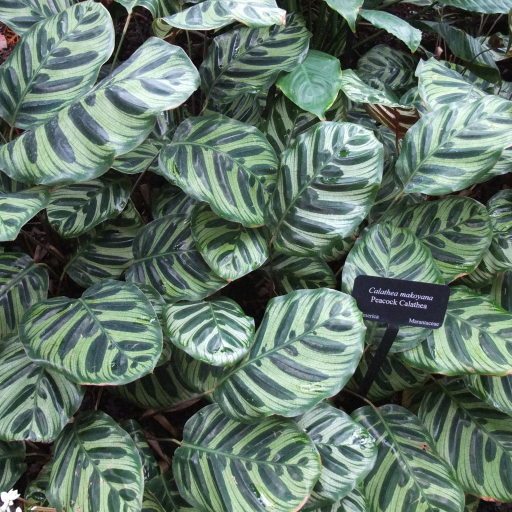
Often called the "Peacock Plant" due to its ornate, feather-like foliage, Calathea makoyana is a show-stopping tropical perennial. Hailing from the humid rainforests of Brazil, it is famous for its "cathedral window" effect—when the light hits the thin leaves, the patterns are visible from both sides. It is a rhythmic member of the "prayer plant" family, folding its leaves upward at night as if in quiet meditation.
🔍 How to Identify
- 🦚 The Foliage: Large, paper-thin, egg-shaped leaves featuring a pale green background with dark green, oblong blotches that mimic the eyes of a peacock feather.
- 🟣 The Underside: Turn the leaf over to find a stunning deep burgundy or royal purple reflection of the top-side pattern, creating a dual-toned display.
- 🌿 Growth Habit: It grows in elegant clumps, with leaves sprouting from tall, slender, reddish-burgundy stems that can reach up to 2 feet in height.
🏡 In Your Garden & Home
- ☁️ Humidity is Non-Negotiable: Because it originates from the damp forest floor, this plant "breathes" through humidity. If the air is too dry, the edges of its beautiful leaves will quickly turn brown and crispy.
- 💧 A Mineral Diva: This species is highly sensitive to the chemicals found in municipal tap water. To avoid leaf spotting or "burn," it is best to use distilled water, rainwater, or tap water that has sat out overnight to dechlorinate.
- ☀️ Light Sensitivity: Unlike many succulents, the Peacock Plant hates direct sun, which can bleach its intricate patterns. It prefers "dappled" or medium indirect light, mimicking the shade of a rainforest canopy.
⚠️ Safety & Toxicity
- 🐾 Status: Non-Toxic and Pet-Friendly.
- 👶 Details: This is one of the safest choices for a "green" home. It is entirely non-toxic to cats, dogs, and curious children, making it a worry-free addition to any low-light corner.
✨ Fun Fact
The Peacock Plant performs a daily "dance" called nyctinasty. A small "joint" located between the leaf and the stem (the pulvinus) reacts to light changes, physically pulling the leaves upright at night and lowering them during the day to maximize light absorption!

Detailed Care Instructions
| Color | White |
| Soil Ph | Acid, Neutral, Slightly Alkaline |
| Humidity | High |
| Lighting | Part Sun |
| Soil Type | Moist But Well-Drained |
| Bloom Time | Anytime, But Flowers Are Small |
| Difficulty | Medium |
| Plant Type | Evergreen, Herbaceous, Perennial |
| Hibernation | Cold Period |
| Mature Size | Up To 4 Ft. Tall |
| Native Area | Brazil |
| Temperature | 18°C - 25°C |
| Sun Exposure | Partial Sun, Full Shade |
| Hardiness Zones | 10-11 |
To grow a Calathea Makoyana plant, follow these steps:
- Choose a suitable location: Calathea Makoyana prefers indirect or filtered light, so place it in a spot away from direct sunlight. The plant also thrives in high humidity, so consider placing it in a bathroom, kitchen, or near a humidifier.
- Provide the right temperature: The plant prefers temperatures between 65-80°F (18-27°C). Avoid exposing it to cold drafts or extreme temperatures.
- Use well-draining soil: Calathea Makoyana prefers moist but well-draining soil. Use a potting mix specifically formulated for houseplants or create one by combining equal parts of peat moss, perlite, and potting soil.
- Water appropriately: Keep the soil consistently moist but make sure not to overwater. Allow the top inch of soil to dry out slightly before watering again. Always water the plant thoroughly and discard any excess water sitting in the saucer to prevent root rot.
- Maintain high humidity: Calathea Makoyana thrives in high humidity environments. You can increase humidity by misting the plant with water daily, placing a tray of water near the plant, or using a humidifier.
- Fertilize regularly: During the growing season (spring and summer), feed the plant with a balanced houseplant fertilizer every 4-6 weeks. Follow the instructions on the fertilizer packaging for dosage and frequency.
- Prune if needed: Remove any yellow or brown leaves as necessary. Calathea Makoyana can get leggy over time, so you can also prune the plant to encourage branching and fullness.
- Propagate if desired: You can propagate Calathea Makoyana by division. Carefully remove the plant from its pot and separate the bulbs or rhizomes, ensuring each division has a healthy root system. Repot each division into a separate container with fresh soil.
Remember that Calathea Makoyana can be sensitive to changes in its environment, so it may take some time to adjust. With proper care and attention to its specific needs, your plant should thrive and grow.

Place in a window with dappled sun or a spot in the middle of a room. Or directly in a window facing west or east.
Calathea Makoyana plants require regular watering to maintain optimal growth and health. You can water your plant using room temperature water.
To water this plant, fill a watering can with water and pour it slowly over the soil until it is moist to the touch. Avoid getting water on the leaves as this can cause damage.
During the winter months, reduce watering to avoid waterlogged soil and root rot. In summer, increase watering if the soil starts to dry out.
It is important to maintain a consistent watering schedule to prevent the soil from becoming too dry or too wet. A soil moisture meter may be used to determine if the plant needs to be watered.
Remember not to overwater your Calathea Makoyana, as this can lead to problems such as root rot or yellowing leaves.
To fertilize this type of plant, it is recommended to use a balanced, water-soluble fertilizer with an N-P-K ratio of 20-20-20 or 10-10-10. Dilute the fertilizer according to the label's instructions, and apply it to the soil every two weeks during the growing season (spring and summer). Be sure to water the plant thoroughly before and after application to avoid burning the roots. During the winter months, reduce fertilization to once a month or stop altogether if the plant becomes dormant.
The Calathea Makoyana plant requires a well-draining soil that is rich in nutrients and organic matter to ensure healthy growth. It is best to use a mixture of peat moss, perlite, and vermiculite to create a loose, airy soil that holds moisture but does not become compacted. This will allow for proper root growth and efficient absorption of water and nutrients. It is important to avoid using heavy, dense soils or those that do not allow for proper drainage. Additionally, adding fertilizer or compost to the soil can further enhance its quality and provide essential nutrients for the plant's growth.
To propagate this plant, you will need a healthy and mature parent plant. Begin by selecting a stem that has several leaves and cutting it with a sharp and sterile pair of scissors or garden shears. Make sure that the cutting is about three to four inches long and has at least one node, which is where the leaves emerge from the stem.
Remove the lower leaves from the cutting and dip the cut end into rooting hormone powder. Fill a small pot with a well-draining potting mix and place the cutting into the soil. Firmly press the soil around the cutting to hold it in place and water it thoroughly.
Place the pot in a warm, bright, and humid location, ideally near a window with filtered light. Keep the soil consistently moist, but not waterlogged, and mist the cutting often to keep the humidity levels high.
After a few weeks, the cutting should begin to produce new growth, which is a sign that it has successfully rooted. Wait until the new plant has grown at least two to three inches tall before transplanting it into a larger pot with fresh potting soil.
Remember to keep the new plant in a warm, bright, and humid environment for the first few months, as it establishes its roots and grows into a mature plant.








