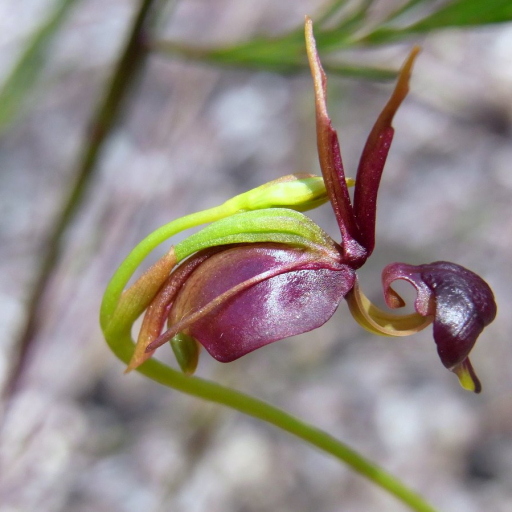
Plant Overview
The Flying Duck Orchid is one of nature’s most whimsical masterpieces. Native to the eucalyptus forests of Australia, this tiny terrestrial orchid looks exactly like a miniature mahogany duck caught in mid-flight. It has gained a cult following among nature photographers and botanical enthusiasts for its uncanny, almost cartoonish resemblance to a bird.
🔍 How to Identify
- 🦆 The "Duck Head": The labellum (the orchid's lip) is shaped like a bulbous duck head and "beak," usually appearing in shades of deep reddish-brown or dark purple.
- 👐 The "Wings": Two narrow, strap-like sepals point upwards and outwards, perfectly mimicking wings raised for takeoff.
- 🍃 The Single Leaf: This plant is quite small, often under 20 inches tall, and produces only a single, narrow, reddish-green leaf at the very base of the stem.
🏡 In Your Garden (and the Wild)
- 🍄 The Fungal Connection: This is a "look but don't touch" plant. It is notoriously impossible to grow in a typical home garden because it relies on a highly specific symbiotic relationship with underground fungi. Without these exact fungi to provide nutrients, the plant cannot survive or bloom.
- 🦗 The Clever Trap: The "duck head" isn't just for show—it's a trap! When a male sawfly lands on the lip, the "head" snaps downward, pinning the insect inside the "body" of the flower. This forces the fly to crawl through pollen before it can escape, ensuring the orchid gets pollinated.
⚠️ Safety & Toxicity
- ✅ Status: Non-toxic to humans and pets.
- 🚫 Environmental Sensitivity: While not poisonous, the Flying Duck Orchid is highly sensitive. It is often protected by law in its native habitat. Attempting to transplant one from the wild is almost always a death sentence for the plant, as their root systems are fragile and dependent on local soil chemistry.
✨ Fun Fact
✨ Despite its fame, the Flying Duck Orchid is surprisingly tiny—the flower itself is usually less than an inch long! You could easily walk right past a whole colony of them without noticing these little "ducks" hiding in the grass.

Detailed Care Instructions

Place in a bright room that is sun drenched almost all day. Or directly in a south-facing window.

Some plants require more regular watering than others, which should be done every few days. It's critical to maintain the soil moist all of the time. The water requirements of the same plant placed in pots with varying sizes will differ. Because the water in the smaller pot evaporates faster than the water in the larger pot, it will require more watering. Regardless of pot size, the surface should constantly be maintained moist.








