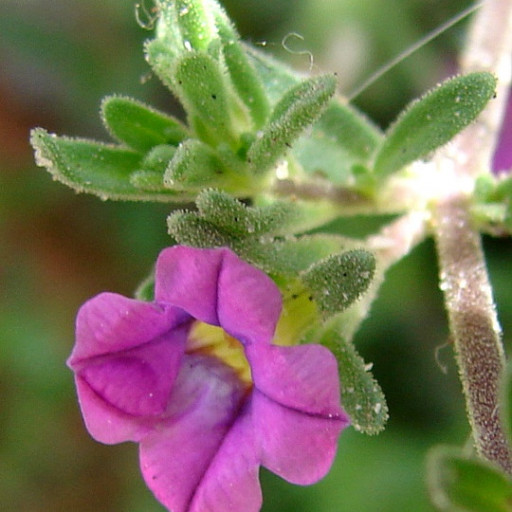
Plant Overview
Often called the Seaside Petunia, this charming South American native is the wild ancestor of the popular "Million Bells" found in hanging baskets worldwide. Unlike its flamboyant garden cousins, Calibrachoa parviflora is a rugged survivor, sprawling across sandy shores and rocky crevices with a delicate, "pixie-like" grace.
🔍 How to Identify
- 🌸 The Bloom: Miniature, trumpet-shaped flowers that rarely exceed half an inch in diameter. They typically feature shades of violet, purple, or blue with a distinct yellow "throat" at the center.
- 🍃 The Foliage: Small, narrow, elliptical leaves that are slightly fleshy. If you touch them, you’ll notice they are covered in tiny, sticky hairs that help the plant retain moisture.
- 🌿 Growth Habit: A low-growing, prostrate plant that forms dense, creeping mats. It rarely stands tall, preferring to trail elegantly over the edges of pots or ground covers.
🏡 In Your Garden
- 🌊 Salt Tolerance: True to its "Seaside" nickname, this plant is exceptionally tolerant of salt spray and sandy soils, making it a hero for coastal gardeners where other flowers might wither.
- 🚿 The "Dry Feet" Rule: While it loves sunshine, it absolutely detests soggy roots. It is highly susceptible to root rot if the soil doesn't drain quickly. It prefers to dry out slightly between waterings rather than sitting in a puddle.
⚠️ Safety & Toxicity
- 🟢 Status: Generally considered non-toxic.
- 🐾 Details: It is not known to be poisonous to cats, dogs, or horses. However, the sticky sap on the stems can occasionally cause mild skin irritation for people with sensitive skin, and ingestion may cause minor stomach upset in curious toddlers or pets.
✨ Fun Fact
Until 1990, scientists thought these were just tiny petunias! They were eventually moved to their own genus (Calibrachoa) when researchers discovered they have 18 chromosomes, whereas true Petunias have only 14.

Detailed Care Instructions
| Color | Red, Purple, Pink |
| Soil Ph | 5.0-6.5 |
| Lighting | Full Sun |
| Soil Type | Moist Soil Rich In Organic Material |
| Bloom Time | Spring Through Fall |
| Plant Type | Herbaceous Perennial Flower Often Grown As An Annual |
| Mature Size | 6–12 In. Tall |
| Native Area | South America |
| Sun Exposure | Full Sun To Part Shade |
| Hardiness Zones | 9-11 |
To grow Calibrachoa Parviflora, also known as "Million Bells," follow these steps:
- Choose a location: Calibrachoa enjoys full sun to partial shade. Select an area that receives at least 6 hours of direct sunlight each day.
- Prepare the soil: Ensure that the soil is well-draining and rich in organic matter. Amend the soil with compost to improve its texture and fertility.
- Planting: In the spring, when all chances of frost have passed, dig small holes or trenches that are spaced 12-16 inches apart. Each hole should be slightly larger than the root ball of the plant.
- Transplanting: If you purchased young seedlings, carefully remove them from their containers and gently massage the root ball to loosen the roots. Place the seedling into the prepared hole, ensuring that the top of the root ball is level with the soil surface. Backfill the hole with soil, gently firming it around the roots.
- Watering: Water the newly planted Calibrachoa thoroughly to settle the soil around the roots. Keep the soil consistently moist but not waterlogged. Water deeply whenever the top inch of soil feels dry to the touch.
- Fertilization: Apply a balanced, slow-release fertilizer according to the package instructions, or use a liquid fertilizer diluted to half strength every 2-4 weeks during the growing season.
- Pruning: Calibrachoa tends to grow low and spread laterally. Prune back any leggy or straggly growth to encourage bushiness. Pinch off the spent flowers regularly to promote continuous blooming.
- Pest and disease control: Monitor your plants regularly for common pests such as aphids, spider mites, and whiteflies. Treat infestations promptly with appropriate insecticidal soap or organic pesticides. Additionally, ensure good air circulation between plants to minimize the risk of diseases like powdery mildew.
- Winter care: In regions with frost or freezing temperatures, Calibrachoa is typically grown as an annual. However, it can be overwintered indoors as a houseplant in a sunny location. Trim back the plant before bringing it inside and reduce watering. Resume regular care in the spring when temperatures rise.
Remember to provide regular care and maintenance, and your Calibrachoa Parviflora plants should thrive and produce an abundance of colorful blooms throughout the growing season.

Place in a bright room that is sun drenched almost all day. Or directly in a south-facing window.

When watering this particular plant, it is important to do so regularly and consistently, without over-watering. It is recommended to check the soil moisture before each watering, as it should be slightly moist but not saturated. It is also important to water the plant at the base, rather than from above, as this can help prevent damage to the delicate flowers. In terms of frequency, watering every 1-2 days may be necessary in warmer weather, but less frequent watering may be needed in cooler weather. Overall, attention to the plant's individual needs and environmental conditions is key when determining the proper watering schedule.
To fertilize the plant, use a balanced fertilizer with equal amounts of nitrogen, phosphorus, and potassium. Mix the fertilizer with water according to the instructions on the package. Apply the solution to the soil around the base of the plant, being careful not to get any on the leaves or flowers. Fertilize every two weeks during the growing season. Additionally, make sure the plant is adequately watered before and after fertilizing.
Calibrachoa Parviflora plant prefers a well-drained soil that is rich in nutrients. The soil should be slightly acidic, with a pH between 5.5 and 6.5. It is recommended to use a high-quality potting mix that is specifically designed for container gardening. The soil should be loose and airy to promote healthy root growth and prevent waterlogging. Additionally, adding organic matter such as compost or peat moss can help improve the soil's fertility and moisture retention. It is important to avoid using heavy soils or those that have a tendency to pack tightly, as this can lead to poor drainage and root rot.
To propagate this plant, one can take stem cuttings during the growing season. The cuttings should be taken from healthy, vigorous shoots that are free from pests and diseases.
The stems should be cut to a length of around 5-6 inches and the lower leaves should be removed.
The cuttings can then be dipped in rooting hormone to encourage root development and planted in a well-draining potting mix.
The pots should be kept in a warm and humid location and misted regularly to prevent them from drying out.
Once roots have formed, the cuttings can be transplanted into individual containers or into the garden.
Common pests of the seaside petunia include Spider mites, aphids. Make a habit of checking your seaside petunia frequently for pests so that any infestations can be caught and managed early.








