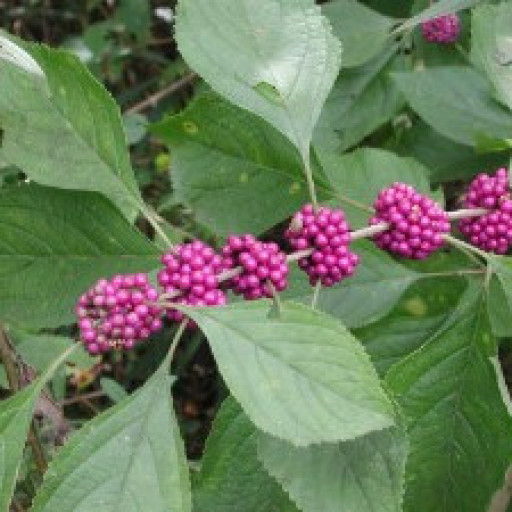
Plant Overview
Known affectionately as the "American Beautyberry" or "French Mulberry," this shrub is a showstopper in any woodland garden. Native to the southeastern United States, it is famous for its almost surreal, neon-magenta berries that cluster tightly around its stems in the fall. Long before it became a garden favorite, rural farmers would crush its leaves and tuck them into the harnesses of their horses to ward off biting flies.
🔍 How to Identify
- 💜 The Berries: Its most iconic feature is the dense, metallic-purple fruit clusters that appear in late summer and autumn, encircling the woody stems at regular intervals.
- 🍃 The Foliage: Large, yellowish-green leaves that are fuzzy to the touch on the underside and arranged oppositely along the arching branches.
- 🌸 The Blooms: In early summer, tiny, inconspicuous lavender or pink flowers emerge, providing a subtle prelude to the dramatic berry display.
🏡 In Your Garden
- ✂️ Pruning Strategy: This shrub blooms on "new wood," meaning it's best to prune it back significantly in late winter. This encourages long, vigorous new branches which will be heavily laden with berries by fall.
- 🐦 Wildlife Magnet: While the berries are too bitter for humans to eat raw, they are a vital "survival food" for over 40 species of birds, including Mockingbirds and Finches, who rely on them during the lean winter months.
- 💧 Adaptability: It is surprisingly tough; while it prefers moist, rich soil under the canopy of larger trees, it is remarkably drought-tolerant once its root system is established.
⚠️ Safety & Toxicity
- ✅ Generally Safe: The berries are considered non-toxic to humans and are frequently used to make "Beautyberry Jelly."
- 🐾 Pets & Kids: While not known to be poisonous, eating large amounts of the raw berries may cause mild stomach upset in curious toddlers or pets.
- 🌿 Skin Sensitivity: The crushed leaves contain compounds like callicarpenal; while great for repelling bugs, some people with very sensitive skin might experience mild irritation.
✨ Fun Fact
Native American tribes and early settlers discovered that the leaves of the Beautyberry contain a natural chemical that is as effective at repelling mosquitoes, ticks, and fire ants as many modern synthetic sprays!

Detailed Care Instructions
These shrubs can survive for several years in the right conditions. Plus, they often drop seeds that can stay dormant in the soil, bursting to life after the original plant is gone.
What are alternatives to beautyberry?
Beautyberry is not the only plant that offers beautiful berries as its centerpiece. Cotoneaster offers vivid red berries in fall and winter. Buckland is an evergreen shrub known for its purple berries. And, of course, American holly is famous for its vivid berries and uniquely shaped leaves.
Can beautyberry grow indoors?
Beautyberry can be started as a seedling or cutting indoors and nurtured to prepare for planting. But because the shrub loves to spread out and needs space for its wide root system, it is best grown in a garden setting outdoors.
| Color | Pink |
| Soil Ph | 5 To 7 |
| Lighting | Full Sun |
| Soil Type | Moist, Rich Soil |
| Bloom Time | Late Spring To Mid-Summer |
| Plant Type | Perennial Shrub |
| Mature Size | Four To Five Feet Tall And Wide; Can Grow Up To Nine Feet High |
| Native Area | Indigenous To North America |
| Sun Exposure | Full Sun To Partial Shade |
| Hardiness Zones | 5 Through 8 |
To grow Callicarpa americana, also known as American beautyberry, follow these steps:
- Choose the right location: Select a spot that receives full sun to partial shade. The site should have well-draining soil.
- Prepare the soil: Beautyberries prefer fertile, loamy soil. Improve the soil by adding compost or organic matter to enhance its nutrient content and drainage.
- Planting: Dig a hole that is slightly larger than the root ball of the plant. Place the beautyberry in the hole, with the top of the root ball level with or slightly above the soil surface. Fill the hole with soil and gently firm it around the plant.
- Watering: After planting, thoroughly water the beautyberry to help settle the soil and eliminate any air pockets. Keep the soil moist but not waterlogged, especially during the first growing season. Once established, beautyberry is fairly drought-tolerant.
- Mulching: Apply a layer of organic mulch around the base of the plant to help retain moisture, suppress weeds, and provide insulation during extreme temperatures.
- Pruning: Beautyberries benefit from yearly pruning to promote a more compact and attractive shape. Prune in late winter or early spring, before new growth emerges. Remove any dead, damaged, or crossing branches. Cut back any excessively long branches to maintain the desired form.
- Fertilizing: Use a slow-release balanced fertilizer in early spring to provide nutrients throughout the growing season. Follow the package instructions for application rates.
- Pests and diseases: Beautyberries are relatively resistant to pests and diseases. However, occasional issues may include aphids, spider mites, or powdery mildew. Monitor your plant for any signs of pests or diseases and take appropriate measures if needed.
- Propagation: You can propagate beautyberry through stem cuttings, typically taken in spring or early summer. Dip the cut ends in rooting hormone and plant them in a well-draining propagation mix. Keep the cuttings in a warm, humid environment until they root.
With proper care, your Callicarpa americana plant will thrive and produce its characteristic vibrant purple berries that attract birds and add beauty to your garden.

Place in a window with dappled sun or a spot in the middle of a room. Or directly in a window facing west or east.

Callicarpa Americana plant should be watered moderately, avoiding both over-watering and allowing the soil to dry out completely. The soil should be kept slightly moist, but not waterlogged. A good test is to stick your finger about an inch into the soil, and if it feels dry, it's time to water. Watering should be done at the base of the plant, avoiding getting water on the leaves or flowers as this can cause fungal issues. During the growing season, which is typically spring through fall, watering may need to be increased as the plant uses more water. In the dormant season, watering can be decreased. Overall, it's important to pay attention to the soil and adjust watering accordingly to keep the plant healthy and hydrated.
For best results when fertilizing this plant, use a balanced fertilizer with equal amounts of nitrogen, phosphorus, and potassium. Apply the fertilizer once in early spring and again in mid-summer, following the package instructions for dosage and application. Be sure to water the plant well before and after fertilizing to avoid burning the roots. Avoid overfertilizing, as this can lead to excessive growth and weakened stems.
Callicarpa Americana thrives best in well-draining soil that is rich in organic matter. The soil should have a slightly acidic pH level, ranging between 5.5 to 6.5. It is important not to plant the Callicarpa Americana in soil that is prone to waterlogging or in excessively sandy soil, as this could affect its growth and development negatively. Adding compost, aged manure, or peat moss to the soil can help improve its texture and moisture retention. A light layer of mulch around the plant can also help to retain moisture and provide a nutrient-rich environment for the plant to grow. Regular watering is essential for this plant, especially during the hot and dry summer months.
Callicarpa Americana is a plant that can be easily propagated by a few simple methods. One of the easiest ways to propagate this plant is through stem cuttings. To do this, select a healthy stem and make a clean cut just below a leaf node. Remove any leaves from the lower half of the stem and dip the cut end into rooting hormone powder. Plant the stem cutting in a pot filled with moistened potting soil and cover it with a plastic bag to create a humid environment. Keep the cutting in a warm, bright location out of direct sunlight, and water it regularly. In about 4-6 weeks, the cutting should develop roots.
Another method of propagation is through layering. This involves bending a low-hanging stem to the ground and pinning it to the soil with a wire or garden staple. The portion of the stem that is underground will eventually develop roots, forming a new plant. After several months, the new plant can be cut away from the parent plant and potted up.
Lastly, Callicarpa Americana can also be propagated through division. This method involves carefully digging up the entire plant and dividing it into smaller sections. Each section should have a portion of the roots and some above-ground growth. The divided plants can be replanted in pots or directly into the garden. It's best to do division in the early spring or fall when the plant is dormant.








