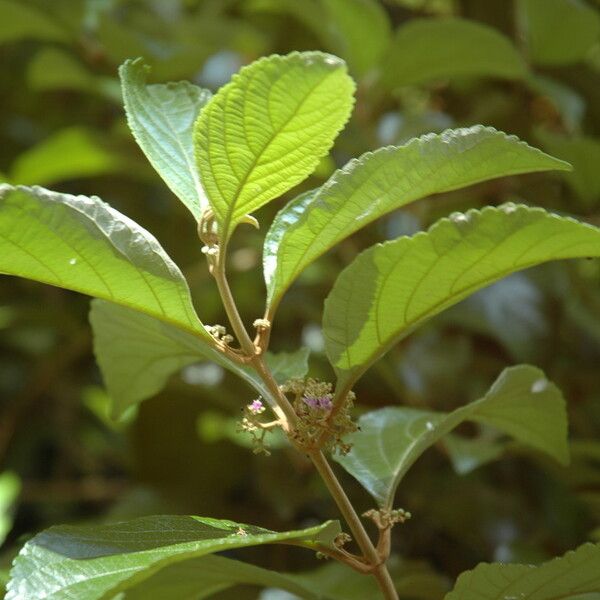
Plant Overview
Often called the Great Woolly Beautyberry, this shrub is a hidden gem of the tropical and subtropical world. Native to Southeast Asia and parts of Australia, it is prized for the striking contrast between its "frosted" foliage and its metallic, amethyst-colored berries. It carries a sense of ancient herbal wisdom, often appearing in traditional folklore as a plant of protection and healing.
🔍 How to Identify
- 🍃 The "Woolly" Leaves: Large, oval-shaped leaves that are dark green on top but covered in dense, velvety, silvery-white hairs underneath, giving the plant a soft, bicolor appearance.
- 🌸 Axillary Blooms: Tiny, delicate lilac or pale purple flowers that grow in tight, pom-pom-like clusters where the leaf meets the stem.
- 🔮 Jewel-Like Berries: Small, glossy, magenta-to-purple fruits that persist on the branches long after the flowers fade, looking like clusters of tiny, vibrant beads.
🏡 In Your Garden
- ☀️ Sun & Silver: The silvery undersides of the leaves are a natural adaptation to reflect intense sunlight. While it thrives in bright spots, providing light afternoon shade will keep the foliage from scorching and help the berries retain their deep color.
- 💧 Thirsty but Breathable: This plant loves the humidity of its native tropics but hates "wet feet." It requires well-draining soil because its root system is prone to rot if left in standing water during the rainy season.
⚠️ Safety & Toxicity
- 🐾 Pet Safety: Most Callicarpa species are considered non-toxic to cats and dogs, though the berries are quite bitter and may cause mild stomach upset if a curious pet eats them in large quantities.
- 🌿 Skin Sensitivity: The fine, woolly hairs on the leaves can occasionally cause mild itching or irritation for those with very sensitive skin; it is best to wear gloves during heavy pruning.
✨ Fun Fact
In various Southeast Asian cultures, the crushed leaves of Callicarpa candicans were traditionally used as a natural insect repellent. Modern studies have even investigated the plant for compounds that may effectively ward off mosquitoes and ticks!

Detailed Care Instructions
To grow Callicarpa Candicans plant, also known as silver beautyberry, follow these steps:
- Choose the right location: The plant prefers full sun or partial shade. Ensure the soil is well-draining to prevent waterlogging.
- Prepare the soil: Mix organic matter, such as compost or well-rotted manure, into the soil to improve its fertility and drainage. The pH level should be slightly acidic to neutral.
- Planting: Dig a hole slightly larger than the plant's root ball. Place the plant in the hole, ensuring it sits at the same depth as it was in the nursery pot. Backfill the hole with soil and lightly firm it around the root ball.
- Watering: Give the plant a thorough watering after planting. Thereafter, water regularly to keep the soil moist, especially during dry spells. Avoid overwatering, as it can lead to root rot.
- Mulching: Apply a layer of mulch around the base of the plant to help conserve moisture and suppress weed growth. Keep the mulch a few inches away from the stems.
- Pruning: Silver beautyberry tends to grow in a loose, arching form. Prune it in late winter or early spring to maintain its shape and remove any dead or damaged branches.
- Fertilizing: Apply a balanced, slow-release fertilizer in early spring to promote healthy growth. Follow the product's instructions for the correct dosage.
- Propagation: You can propagate Callicarpa Candicans through seeds or by taking stem cuttings in late spring or early summer. Seed propagation may take longer, while stem cuttings usually root faster.
- Pests and diseases: While relatively resistant to pests and diseases, keep an eye out for common garden threats like aphids, scale insects, and powdery mildew. Treat any infestation promptly using appropriate insecticides or fungicides.
- Winter care: In regions with cold winters, provide winter protection by mulching heavily around the base of the plant. This helps insulate the roots from freezing temperatures.
By following these guidelines, you should be able to successfully grow Callicarpa Candicans and enjoy its beautiful silver foliage and purple berries.
The best way to water this plant is to wait until the soil feels slightly dry to the touch before watering it thoroughly. Make sure the water reaches deep down to the roots. Avoid letting the soil become too dry or too water-logged. If planted in a pot, make sure it has proper drainage holes. If planted in the ground, mulching around the base of the plant can help retain moisture in the soil. In general, this plant prefers to be kept evenly moist.
To fertilize the Callicarpa Candicans plant, apply a balanced, slow-release fertilizer in the spring just before new growth appears. Use a granular or liquid fertilizer with equal amounts of nitrogen, phosphorus, and potassium. Apply according to the instructions on the package, being careful not to overfertilize. Water the plant immediately after fertilization to help the nutrients absorb into the soil. Repeat fertilization once or twice during the growing season, depending on the plant's growth and soil conditions.
The ideal soil for the Callicarpa Candicans plant should be well-draining, with a pH level of 5.5 to 6.5. It should be rich in organic matter and nutrients, such as nitrogen, phosphorus, and potassium. The soil should also be slightly acidic, which is beneficial for the growth and development of this plant. A soil mix containing equal parts of peat moss, perlite, and vermiculite is ideal for growing Callicarpa Candicans as it provides excellent drainage, aeration, and moisture retention capabilities. Additionally, adding some compost or a slow-release fertilizer will provide the plant with the necessary nutrients for healthy growth. It's important to avoid using heavy soils with poor drainage or those that are too alkaline, as this may stunt the plant's growth and make it more susceptible to disease and pests.
To propagate this plant, you will need to start by selecting a healthy plant with sturdy stems. Using a sharp, sterilized pruning shears, take cuttings that are around 4-6 inches long and have at least one leaf node. Remove the leaves from the lower half of the stem and dip the cut end of the stem in rooting hormone powder.
Next, place the cuttings in a container filled with a well-draining potting mix, and water them until the soil is moist but not waterlogged. Cover the container with a clear plastic bag, and place it in a bright, warm location that receives indirect sunlight.
Check the cuttings regularly, and mist them with water to keep the soil moist and the humidity high. In 2-3 weeks, you should start to see roots forming on the cuttings. Once the roots have grown to around an inch long, you can transfer the cuttings to individual pots filled with a similar potting mix and keep them in a shaded area for a few days.
After a few weeks, the plants can be slowly acclimated to brighter light and eventually moved to their permanent location in well-draining soil.








