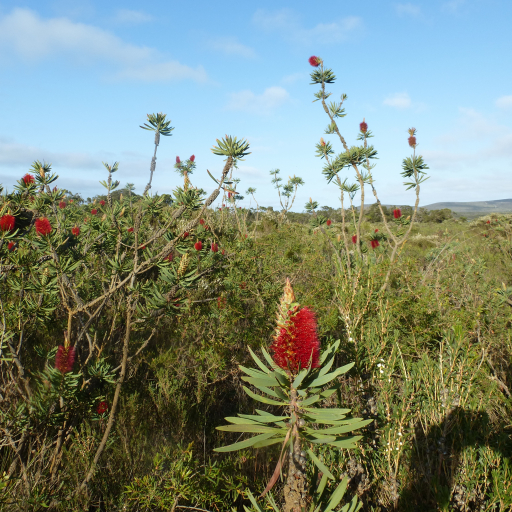
Plant Overview
Often called the Albany Bottlebrush or the Showy Bottlebrush, this Australian native is a showstopper that looks like it belongs in a botanical firework display. Originating from the damp, coastal regions of Western Australia, it is beloved for its "electric" red flower spikes that appear to glow against its stiff, dark foliage. It is a favorite among gardeners who want to invite a parade of nectar-seeking birds into their backyard.
🔍 How to Identify
- 🔴 The "Brush" Bloom: It produces dense, cylindrical flower spikes (up to 5 inches long) made of brilliant red filaments tipped with tiny yellow dots of pollen, perfectly mimicking a traditional bottle cleaner.
- 🌿 Leathery Foliage: The leaves are narrow, lance-shaped, and quite rigid, often possessing a slight blue-green (glaucous) tint that helps the plant conserve moisture.
- 🪵 Woody Seed Capsules: After the flowers fade, they leave behind small, gray, woody "buttons" that cling tightly to the stems for years, holding seeds until triggered by heat or age.
🏡 In Your Garden
- 💧 The "Wet Feet" Exception: While many Australian plants demand perfect drainage, Callistemon speciosus is surprisingly tolerant of boggy soil and heavy clay, making it a hero for those low-lying spots in the garden where other plants might drown.
- ✂️ The Pruning Trick: To keep it from becoming "leggy," prune it immediately after the flowers finish. However, be careful not to cut back into the old, leafless wood, as the plant struggles to grow new shoots from very old branches.
- 🐦 Pollinator Magnet: This plant acts as a natural bird feeder. The high nectar production attracts honeyeaters, hummingbirds, and bees, turning your garden into a buzzing sanctuary.
⚠️ Safety & Toxicity
- ✅ Status: Generally non-toxic and safe for homes.
- 🐝 Sting Risk: While the plant itself isn't poisonous to cats, dogs, or children, its heavy nectar production attracts large numbers of bees. Those with bee allergies should plant it away from high-traffic walkways or doorways.
- 🖐️ Scratches: The leaves and woody seed pods can be quite sharp and stiff; wearing gloves during pruning is recommended to avoid skin irritation.
✨ Fun Fact
Early European settlers in Australia took the plant's name literally—they actually used the stiff, dried flower spikes of various Callistemon species as makeshift brushes to scrub out glass jars and dirty lamp chimneys!

Detailed Care Instructions
Callistemon speciosus, also known as bottlebrush plant, is a popular ornamental plant that can be easily grown in a variety of climates. Here are some tips on how to grow Callistemon speciosus:
- Choose a sunny location: Callistemon speciosus thrives in full sun, so make sure to choose a spot in your garden that receives at least 6-8 hours of direct sunlight each day.
- Soil: Callistemon speciosus prefers well-draining soil that is slightly acidic. If your soil is heavy or compacted, consider amending it with organic matter such as compost to improve drainage.
- Watering: Water newly planted Callistemon speciosus regularly to help establish a strong root system. Once established, the plant is fairly drought-tolerant and only needs occasional watering during dry periods.
- Pruning: Regular pruning can help promote bushier growth and encourage the plant to produce more flowers. Prune after flowering to remove any dead or damaged wood and shape the plant as desired.
- Fertilizing: Fertilize Callistemon speciosus in spring with a slow-release fertilizer formulated for flowering shrubs. Avoid over-fertilizing, as this can lead to excessive foliage growth at the expense of flowers.
- Propagation: Callistemon speciosus can be easily propagated from semi-hardwood cuttings taken in late summer or early fall. Dip the cut end of the cutting in rooting hormone and plant it in a well-draining potting mix. Keep the cutting moist and warm until roots develop.
- Pests and diseases: While generally pest and disease resistant, Callistemon speciosus may occasionally be affected by common garden pests such as aphids or scale insects. Monitor your plants regularly and treat any infestations promptly with insecticidal soap or neem oil.
By following these tips, you can successfully grow and care for Callistemon speciosus in your garden. Enjoy the vibrant flowers and unique bottlebrush-shaped blooms that this plant has to offer!

Place in a bright room that is sun drenched almost all day. Or directly in a south-facing window.

Callistemon Speciosus plants should be watered regularly, ensuring that the soil remains consistently moist but not waterlogged. Water deeply, allowing the water to penetrate the soil to a depth of at least six inches. Be sure to water the plant at the base, avoiding getting the foliage wet to prevent disease. During the growing season, water the plant more frequently, especially during hot, dry periods. In the winter months, reduce watering but ensure that the soil does not completely dry out. Monitor the plant regularly to determine its watering needs and adjust accordingly.
To fertilize the Callistemon Speciosus plant, you can apply a balanced fertilizer in the early spring before new growth appears. Use a slow-release fertilizer to avoid over-fertilizing. Follow the instructions on the fertilizer packaging for the correct application rate. Water the plant after applying the fertilizer to help distribute the nutrients evenly into the soil. Repeat the fertilization process once or twice during the growing season to promote healthy growth and blooming. Avoid fertilizing during the winter months when the plant is dormant.
The Callistemon Speciosus plant prefers well-draining soil that is slightly acidic to neutral in pH. A good soil mix for this plant would be a combination of sandy loam, perlite, and peat moss to ensure good drainage and aeration. Adding organic matter such as compost or leaf mold can also help improve the soil structure and provide nutrients for the plant. It is important to avoid using heavy clay soils or soils that retain too much moisture, as they can lead to root rot and other problems for the Callistemon Speciosus plant.
Callistemon Speciosus can be propagated through seeds or through cuttings.
To propagate through seeds, collect mature seeds from the plant and sow them in a well-draining potting mix. Keep the soil consistently moist and place the pot in a warm, bright location. Germination typically occurs within a few weeks.
To propagate through cuttings, take a 4-6 inch cutting from a healthy, mature plant. Remove the lower leaves and dip the cut end in rooting hormone. Plant the cutting in a well-draining potting mix and place it in a warm, bright location. Keep the soil consistently moist and the cutting should develop roots within a few weeks.
Once the new plants have established roots, they can be transplanted into larger pots or directly into the garden. Make sure to provide adequate sunlight, water, and nutrients to help the plants thrive.








