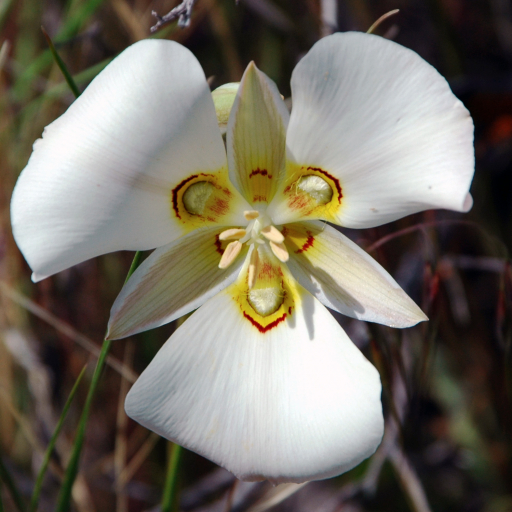
Plant Overview
The Sego Lily (Calochortus nuttallii) is a delicate desert gem known as the state flower of Utah. This elegant wildflower holds a sacred place in history; legend says its nutritious bulbs saved early pioneers from starvation during a cricket plague, earning it a reputation as a "life-saving" plant. Its name "Sego" comes from the Ute word for edible bulb, and it remains a symbol of resilience across the American West.
🔍 How to Identify
- 🌸 Petal Pattern: Three elegant, waxy white petals, each featuring a striking deep maroon or purple crescent and a bright yellow base that creates a "bullseye" for pollinators.
- 🍃 Slender Foliage: The leaves are narrow and grass-like, often appearing sparse or curling at the tips, which helps the plant blend into its surroundings until it blooms.
- 🧶 Fuzzy Glands: If you look closely at the base of the petals, you will find distinct, hairy glands that are a signature trait of the Calochortus genus.
🏡 In Your Garden
- 🏜️ The Dry Life: This plant is a true "xeriscape" champion; it thrives in well-drained, sandy, or rocky soil and requires almost no supplemental water once established.
- 💤 Summer Slumber: Don’t panic when the plant disappears! After flowering in early summer, the Sego Lily enters a deep dormancy and will stay completely underground until the following spring. Avoid overwatering during this period, as the bulbs are highly prone to rot in soggy soil.
⚠️ Safety & Toxicity
- 🛡️ Safe Status: The Sego Lily is generally considered non-toxic to humans and pets. Historically, the starchy bulbs were roasted or boiled as a staple food source for Native American tribes.
- ⚠️ The Deadly Double: Use extreme caution if you find these in the wild. The Sego Lily often grows near the Death Camas, which looks nearly identical when not in bloom but is highly poisonous. Never consume or handle bulbs unless you are an expert at identification!
✨ Fun Fact
📜 In 1911, Utah schoolchildren voted for the Sego Lily to become the state flower. It won the title not just for its beauty, but as a tribute to the "manna" that helped the early settlers survive the harsh winters of the mid-1800s.

Detailed Care Instructions
To grow Calochortus nuttallii plants, follow these steps:
- Obtain seeds or bulbs: Purchase seeds or bulbs from a reputable nursery or online supplier. Seeds are typically more challenging but rewarding to grow, while bulbs provide faster and more reliable results.
- Choose a suitable location: Calochortus nuttallii prefers sunny to partially shaded areas, well-drained soil, and a temperature range of 60-80°F (15-27°C).
- Prepare the soil: The soil should be loose, rich in organic matter, and well-drained. If the soil is heavy and clay-like, amend it with organic matter or perlite to improve drainage.
- Planting bulbs: If using bulbs, plant them in the fall, following the instructions on the packaging. Typically, bulbs are planted 3-4 inches deep and spaced 4-6 inches apart.
- Planting seeds: If sowing seeds, prepare small pots or trays with a well-draining potting mix. Sow the seed in early spring, covering it lightly with soil. Keep the soil moist but not waterlogged.
- Watering: Keep the soil evenly moist during the active growing season, but avoid overwatering, as excessive moisture can lead to root rot.
- Fertilizing: Apply a balanced, slow-release fertilizer in early spring as the plant emerges and again in early summer after flowering.
- Mulching: Apply a layer of organic mulch, such as bark or straw, around the plants to help retain moisture and suppress weeds.
- Pruning: After flowering, allow the foliage to die back naturally. Do not remove the leaves until they have completely withered, as they provide nutrients to the bulb for the next season's growth.
- Propagation: Calochortus nuttallii can be propagated by dividing bulbs or collecting and sowing seeds.
- Pest and disease control: While relatively pest-free, occasional issues like aphids or snails can occur. Monitor the plants regularly and address any pest or disease issues promptly.
- Enjoy the blooms: With proper care, Calochortus nuttallii plants should bloom in late spring or early summer, producing beautiful cup-shaped flowers in an array of colors.
Note: Calochortus nuttallii is native to North America, particularly the western United States. Please check your local growing conditions and regulations before cultivating this plant.

Place in a bright room that is sun drenched almost all day. Or directly in a south-facing window.

Calochortus Nuttallii plant belongs to the family Liliaceae and is native to western North America. It is a perennial plant with beautiful, bell-shaped flowers that come in various colors such as purple, yellow, or white. This particular species prefers well-draining soil and thrives in areas with full sun exposure.
When it comes to watering Calochortus Nuttallii, it is important to imitate their natural habitat, which is often dry summers and wet winters. Here are some guidelines to follow for watering:
1. Frequency: During the growing season, which usually occurs in spring and early summer, water the plant moderately. Aim to keep the soil slightly moist, allowing the top inch (2.5 cm) to dry out before watering again. This helps prevent overwatering and root rot.
2. Soil moisture: Prioritize well-draining soil to prevent the plant's roots from sitting in water. Use a potting mix or amend heavy soils with organic matter (e.g., compost) to improve drainage.
3. Watering method: When watering Calochortus Nuttallii, it's best to use a gentle, targeted approach. Avoid overhead watering as it may lead to fungal diseases and rot. Instead, direct the water towards the base of the plant to ensure the soil around the roots gets hydrated.
4. Rainwater utilization: Take advantage of rainwater. If rainfall is available, it is ideal for watering Calochortus Nuttallii plants as it is natural and free of chemicals found in tap water. However, if the soil becomes overly saturated due to excessive rain, provide appropriate drainage to prevent waterlogging.
5. Drought tolerance: Calochortus Nuttallii plants are adapted to dry conditions, making them somewhat drought-tolerant. Once established, they can withstand periods of reduced watering. However, keep an eye on the soil moisture level to prevent extreme dehydration.
Remember, it's essential to observe the specific plant's needs by monitoring soil moisture, climate, and any signs of dehydration or overhydration. Adjust your watering routine accordingly to ensure the health and vitality of your Calochortus Nuttallii plant.
To fertilize Calochortus Nuttallii plant, follow these guidelines:
- Choose a balanced, water-soluble fertilizer with equal amounts of nitrogen (N), phosphorus (P), and potassium (K). A 10-10-10 or 20-20-20 formulation is suitable.
- Dilute the fertilizer according to the instructions on the packaging. Generally, a concentration of 1/4 to 1/2 strength is recommended.
- Apply the diluted fertilizer to the soil around the base of the plant, avoiding contact with the foliage. Use a watering can or a gardening sprayer to ensure even distribution.
- Water the plant immediately after fertilizing to help the nutrients penetrate the soil and reach the plant's roots. This will also prevent any potential fertilizer burn.
- Repeat the fertilization process every four to six weeks during the growing season, which typically spans from spring to early summer.
- Adjust the frequency and strength of fertilization based on the plant's response. If you notice excessive foliage growth but limited flower production, decrease the fertilizer concentration or reduce application frequency. Conversely, if the plant appears weak or pale, increase the fertilizer dose.
- Always follow the recommended dosage and avoid over-fertilizing the plant, as this can lead to nutrient imbalances, root burn, or other plant health issues.
Remember to adapt these instructions based on specific soil and environmental conditions, and regularly monitor the plant's response to determine its fertilization needs.
Calochortus Nuttallii, a flowering plant native to North America, thrives in well-draining soil that is rich in organic matter. It prefers a soil pH that ranges from slightly acidic to neutral. The soil should have good moisture retention capabilities while also allowing excess water to drain freely, preventing waterlogging.
Ideally, the soil for Calochortus Nuttallii should be loamy or sandy, offering good drainage while retaining adequate moisture. Adding organic matter like compost or well-rotted manure to the soil helps improve its fertility and water-holding capacity.
Moreover, this plant requires a soil that is loose and friable, providing sufficient aeration for its roots. Compacted or heavy clay soils that retain excessive water should be avoided as they can lead to root rot or other moisture-related diseases.
When planting Calochortus Nuttallii, ensure the soil is well-prepared by removing any weeds or debris and loosening it with a garden fork or tiller. This plant tends to perform best in a soil that is slightly moist but not waterlogged. Regularly check the soil moisture levels and water accordingly to keep it evenly moist throughout the growing season, but avoid overwatering.
In summary, the ideal soil for Calochortus Nuttallii is well-draining, rich in organic matter, with good moisture retention, loose and friable, and has a slightly acidic to neutral pH. These soil conditions create an optimal environment for the growth and health of Calochortus Nuttallii plants.
Calochortus Nuttallii is a perennial plant species native to North America. It belongs to the family Liliaceae and is commonly found in California, Oregon, and Washington. Here's a guide on how to propagate this plant:
- Start by collecting mature seeds from ripe seed pods. Calochortus Nuttallii usually produces seed pods after blooming, which contain numerous small black seeds.
- Store the collected seeds in a cool and dry place until you are ready to propagate.
- Prepare a well-draining potting mix by combining equal parts of compost, sand, and loam. Fill a small seed tray or individual pots with this potting mix.
- Moisten the soil slightly before sowing the seeds. Avoid oversaturating the soil as it can lead to seed rot.
- Sprinkle the Calochortus Nuttallii seeds evenly across the surface of the soil. Since the seeds are small, avoid burying them too deep.
- Press the seeds gently onto the soil surface using your fingertips.
- Optionally, cover the seeds lightly with a thin layer of vermiculite or fine sand, as this can provide added protection and create a stable germination environment.
- Place the seed tray or pots in a location that receives bright indirect light, preferably near a window. Avoid direct sunlight as this may scorch the seedlings.
- Maintain a consistent temperature of around 70-75°F (21-24°C) throughout the germination process. A warm and consistent environment will help promote successful and faster germination.
- Keep the soil slightly moist but not overly wet. Water the seeds gently, using a spray bottle or a watering can with a fine spout, to prevent displacement or damage.
- Be patient, as germination may take a few weeks to a couple of months. Calochortus Nuttallii seeds are usually slow to germinate.
- As the seedlings emerge, ensure they receive adequate light and air circulation to prevent damping off or fungal diseases.
- Transplant the seedlings into individual pots once they have developed true leaves and are large enough to handle. Use a well-draining potting mix similar to the one used for sowing the seeds.
- Continue to provide the young plants with bright, indirect light, and keep the soil consistently moist but not waterlogged.
- After a few months, when the plants have established a strong root system and are actively growing, they can be planted outdoors in a well-prepared garden bed or larger containers.
Remember, Calochortus Nuttallii plants typically prefer full sun to partial shade and well-draining soil. Regular watering and occasional fertilization can help ensure healthy growth and prolific blooming.








