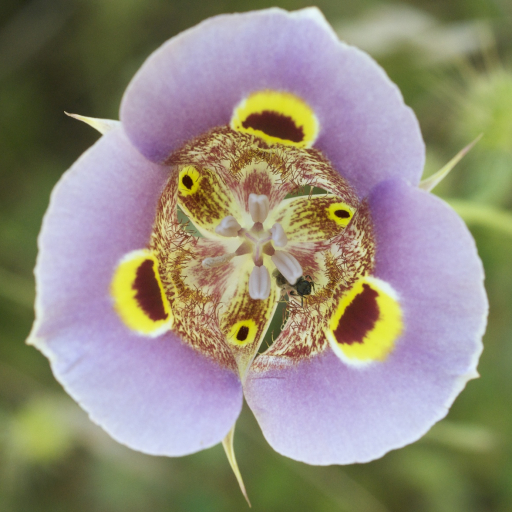
Plant Overview
Often called the Superb Mariposa Lily, this stunning wildflower is a true icon of California's rolling hills and open woodlands. Its name literally translates from Greek and Latin as "superb beautiful grass," referring to its delicate, blade-like leaves and show-stopping blooms that look like they were hand-painted by an artist. They are beloved by hikers for their "butterfly" appearance (Mariposa is Spanish for butterfly).
🔍 How to Identify
- 🌸 The Petals: Three large, wedge-shaped petals that form an elegant cup. Colors range from creamy white to pale lavender.
- 🎯 The Eye Spot: A distinctive dark mahogany or purple "U" shaped blotch at the base of each petal, usually framed by a bright yellow halo and fine hairs.
- 🌿 The Foliage: Sparse, grass-like leaves that often begin to wither just as the flower reaches its peak, a survival tactic to save water for the bloom.
🏡 In Your Garden
- 🏜️ Drainage is King: These lilies are adapted to rocky slopes and meadows. They absolutely detest "wet feet" and require gritty, well-draining soil to prevent the bulb from rotting during the wet season.
- 💤 The Summer Sleep: This plant is a geophyte, meaning it survives underground. After the flower fades, the plant goes completely dormant. Do not be tempted to water it during the hot summer months; it needs a dry "baking" period to thrive the following year.
⚠️ Safety & Toxicity
- ✅ Generally Safe: The Superb Mariposa Lily is not considered toxic to humans or livestock.
- 🐾 Pet Caution: While not listed as poisonous, the bulbs contain concentrated starches that can cause mild digestive upset in curious dogs or cats if excavated and eaten in large quantities.
✨ Fun Fact
🍴 Ancient Snack: Many California Indigenous tribes historically harvested the small, starchy bulbs (corms) of Mariposa Lilies. They were eaten raw or roasted in earth ovens, with many describing the taste as being similar to a sweet potato or a chestnut.

Detailed Care Instructions
To grow Calochortus superbus, also known as Sego Lily, follow these steps:
- Climate and Soil Requirements:
- Sego lilies grow best in dry climates with well-drained soil.
- They are native to North America and are adapted to arid environments.
- The soil should be sandy or loamy, with a slightly acidic to neutral pH (around 6.5 to 7).
- Sego lilies grow best in dry climates with well-drained soil.
- Planting Time and Method:
- Sow the seeds in the fall, as this gives them time to experience the winter cold and break dormancy.
- Alternatively, you can also plant seeds in late winter or early spring, as these plants can tolerate light frosts.
- The seeds are best planted at a depth of about 1 inch (2.5 cm).
- Sow the seeds in the fall, as this gives them time to experience the winter cold and break dormancy.
- Seed Treatment:
- Calochortus superbus seeds have a hard seed coat, so you may want to scarify them before planting.
- You can do this by gently rubbing the seeds with sandpaper or nicking them with a knife to help moisture penetrate and speed up germination.
- Calochortus superbus seeds have a hard seed coat, so you may want to scarify them before planting.
- Watering:
- During the growing season, provide enough water to ensure the soil remains slightly moist but never waterlogged.
- Once established, these plants are quite drought-tolerant and prefer drier conditions.
- During the growing season, provide enough water to ensure the soil remains slightly moist but never waterlogged.
- Sunlight:
- Sego lilies require full sunlight to flourish.
- Choose a location that receives at least 6-8 hours of direct sunlight per day.
- Sego lilies require full sunlight to flourish.
- Maintenance:
- Remove any weeds or competing vegetation from the planting area.
- Apply a layer of organic mulch around the plants to conserve moisture and suppress weed growth.
- Generally, Calochortus superbus does not require fertilizer. However, if the soil is poor in nutrients, you can apply a balanced, slow-release fertilizer during the growing season.
- Remove any weeds or competing vegetation from the planting area.
- Flowering and Harvesting:
- Sego lilies generally start flowering in late spring or early summer.
- Enjoy the beautiful show of cup-shaped flowers, and if you desire, you can cut some for floral arrangements.
- Leave some flowers on the plant to produce seeds for future growth.
Remember to check the specific growing conditions for your region and adjust accordingly. Good luck with growing your Calochortus superbus plant!
- Sego lilies generally start flowering in late spring or early summer.

Place in a bright room that is sun drenched almost all day. Or directly in a south-facing window.

Calochortus Superbus is a plant that requires regular watering to thrive. To water it, you should first check the soil to ensure that it is dry to the touch before you water it. When watering, you should be sure to water the entire root system and not just the surface of the soil. The best way to water is to use a watering can or a low-pressure hose to avoid over-watering. It is important to avoid letting the soil become too waterlogged, as this can lead to root rot and other issues. To keep the plant healthy, you should also ensure that it has access to plenty of sunlight and is grown in well-draining soil.
To properly fertilize this plant, apply a slow-release balanced fertilizer in the early spring before new growth appears. Mix the fertilizer into the top few inches of soil around the plant's base, being careful not to disturb the roots. Water thoroughly after fertilizing, and then again lightly every two to three weeks during the growing season. Avoid over-fertilizing as it can damage the plant.
Calochortus superbus is a plant that belongs to the family of Liliaceae. The soil type for this plant should be well-draining and rich in organic matter. The soil's pH should be slightly acidic to neutral, ranging from 6.0 to 7.0. Sandy loam and loam soils are ideal for this plant as they provide adequate drainage and water retention. The soil should also be free from any contaminants or pollutants that can damage the plant's growth and development. A balanced fertilizer with an equal ratio of nitrogen, phosphorus, and potassium can be applied to the soil during the growing season. Proper soil preparation and maintenance are crucial for ensuring the plant's health and longevity.
To propagate this plant, one needs to wait until the plant has stopped flowering and the seed pods have matured. Once the pods have turned brown and are dry, remove them from the plant and collect the seeds. The seeds can then be planted in well-draining soil in a location that receives partial to full sunlight. It is important to keep the soil consistently moist during the germination process. The plant can also be propagated through division by carefully separating the bulbs without damaging them and planting them in a new location.








