Plant Overview
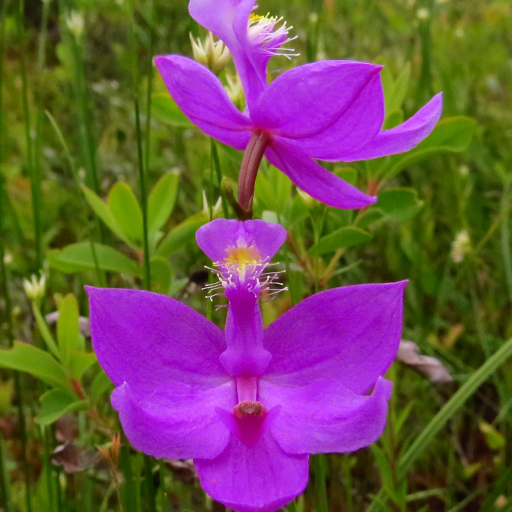
Often called the Grass Pink Orchid, Calopogon tuberosus is a show-stopping native of North American wetlands that breaks all the traditional "orchid rules." While most orchids twist their flowers to face downward, this rebel keeps its lip at the top, looking like a tiny, fringed sunburst. It is a favorite among bog-garden enthusiasts for its neon-pink hue and its clever, albeit slightly deceptive, personality.
🔍 How to Identify
- 🌸 Non-Resupinate Blooms: Unlike 99% of orchids, these flowers are "upside down," meaning the fringed lip (labellum) points toward the sky rather than the ground.
- 🧔 The Golden Beard: The top petal is decorated with a brilliant crest of yellow and white fleshy hairs that look remarkably like a cluster of pollen-rich stamens.
- 🌿 Single Linear Leaf: Each plant typically produces only one long, ribbed, grass-like leaf that emerges from a small underground bulb-like structure called a corm.
🏡 In Your Garden
- 💧 The Bog Life: This is not a standard garden plant; it is a dedicated wetland species. It requires "wet feet" and thrives in acidic, peat-based substrates that mimic its natural fen or bog habitat.
- ☀️ Sun Seeker: While many woodland orchids crave deep shade, the Grass Pink loves the spotlight. It needs full to partial sun to produce its tall, multi-flowered spikes, which can hold up to 10 blossoms at once.
⚠️ Safety & Toxicity
- ✅ Safe for All: Calopogon tuberosus is considered non-toxic to humans, cats, and dogs. It is a safe addition to a residential water feature or bog garden.
- 🛡️ Conservation Status: Because it is so beautiful and sensitive to habitat changes, it is endangered in several regions. Always purchase from reputable nurseries rather than "wild-harvesting," as the plant rarely survives the shock of being moved from its native soil.
✨ Fun Fact
This orchid is a master of deception. The yellow "beard" on the lip mimics pollen to attract bees, but the flower actually produces no nectar at all. When a bee lands on those yellow hairs, the lip hinges downward like a trapdoor, physically dumping the bee onto the plant’s reproductive organs to ensure pollination!

Detailed Care Instructions

Place in a bright room that is sun drenched almost all day. Or directly in a south-facing window.

Calopogon Tuberosus is a plant that requires regular watering in order to thrive. When watering this plant, it is important to avoid watering too frequently, as this can lead to root rot and other issues.
Instead, water Calopogon Tuberosus every seven to ten days, depending on the climate and soil conditions. This will ensure that the plant has enough moisture to grow properly, without getting waterlogged.
When watering Calopogon Tuberosus, it is important to water deeply, so that the water reaches the plant's roots. This can be achieved by using a watering can or hose with a slow trickle, or by placing the plant in a tray of water for a short time.
It is also important to avoid getting the plant's leaves wet when watering, as this can lead to fungal growth and other diseases. Instead, aim to water the soil around the base of the plant.
In addition to regular watering, Calopogon Tuberosus also benefits from fertilization during the growing season. This can be achieved by applying a balanced fertilizer every four to six weeks.
Calopogon tuberosus plants grow best in a well-draining soil that is rich in organic matter. The soil should be moist but never waterlogged, as too much moisture can cause root rot. A pH level between 6.0 and 7.0 is preferred. The soil should be slightly acidic to neutral. A mixture of peat moss, sand, and perlite or vermiculite is ideal for cultivating healthy plants. When planting Calopogon tuberosus, avoid compacting the soil and instead lightly press the soil around the bulb without burying it too deeply.








