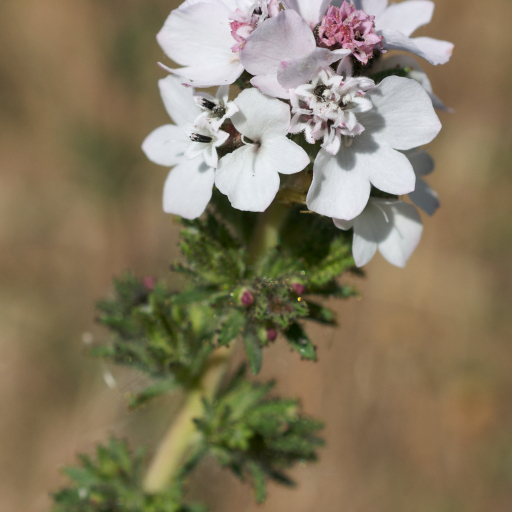
Plant Overview
Known as the Sticky Western Rosinweed, this California native is a true summer survivor. Often found dancing in the golden hills of the West Coast, it looks like a delicate yellow sparkler amidst the dry grass of the chaparral. Its botanical name, multiglandulosa, tells the story of its most famous trait: an abundance of tiny resin glands that make the entire plant feel tacky to the touch.
🔍 How to Identify
- 🌼 Pitchfork Petals: Look closely at the outer yellow (or sometimes white) petals; they are deeply divided into three distinct lobes, giving them a unique "forked" or "crowned" appearance.
- 💎 Resinous Beads: The stems and flower heads are covered in microscopic stalks topped with tiny, glistening resin beads that sparkle in the sunlight.
- 🍃 Slender Profile: This is a tall, wiry annual that grows upright with very narrow, needle-like leaves that cling closely to the stem, minimizing its surface area to save water.
🏡 In Your Garden
- 🏜️ The Serpentine Specialist: In the wild, this plant thrives in poor, rocky, or serpentine soils where other plants might wither. It is an excellent choice for a "wildflower meadow" or a native rock garden that receives very little supplemental water.
- 🦋 Late-Season Lifeline: While many spring wildflowers fade by June, the Sticky Western Rosinweed blooms well into the summer heat, providing a critical nectar source for native bees and butterflies when other food is scarce.
⚠️ Safety & Toxicity
- 🧴 Contact Sensitivity: While not technically poisonous, the heavy resin can be incredibly sticky and difficult to wash off. Some people with sensitive skin may experience mild redness or irritation after handling the plant.
- 🐾 Pet Safety: It is generally considered non-toxic to dogs and cats. Its bitter, resinous taste and "tacky" texture usually act as a natural deterrent, making it very unlikely that a pet would try to eat it.
✨ Fun Fact
🧪 Biological Sunscreen: The sticky resin that gives the plant its name isn't just to catch bugs; it acts as a sophisticated "sunscreen" and a sealant, reflecting UV rays and trapping moisture inside the stems to help the plant survive 100°F temperatures!

Detailed Care Instructions
To grow Calycadenia Multiglandulosa plants, here are the steps you can follow:
- Soil: Choose a well-draining soil mixture for planting. It should be sandy and loamy with good drainage capabilities.
- Sunlight: Find a location for planting where the plant can receive full sunlight for a significant part of the day. Calycadenia Multiglandulosa plants thrive in direct sunlight.
- Sowing Seeds: You can sow the calycadenia seeds directly into the soil in early spring or late fall. Gently press the seeds into the soil, but do not bury them too deep as they require light for germination.
- Watering: Water the seeds lightly after planting, using a misting spray or a gentle watering can. Keep the soil consistently moist but not waterlogged. Once the plants are established, they are generally drought-tolerant and do not require frequent watering.
- Germination: It usually takes 1-2 weeks for the seeds to germinate. During this time, make sure to keep the soil moist. Once the seedlings have emerged, thin them out if necessary, leaving the strongest plants with a space of about 8-12 inches apart.
- Maintenance: Calycadenia Multiglandulosa plants are relatively low maintenance. However, you should regularly weed the area around the plants to prevent competition for nutrients and water.
- Pruning: In late summer or early fall, consider pruning the plant to promote a bushier growth habit. This can be done by cutting back the stems by about one-third of their length.
- Pests and Diseases: Calycadenia Multiglandulosa plants are generally resistant to pests and diseases. However, if you notice any signs of pest infestation or disease, treat the plants accordingly using appropriate, environmentally friendly methods.
- Propagation: If desired, you can propagate Calycadenia Multiglandulosa plants by collecting seeds from mature plants or by dividing the clumps of the plant.
Remember to check your local climate and growing conditions to ensure they are suitable for growing Calycadenia Multiglandulosa plants.

Place in a bright room that is sun drenched almost all day. Or directly in a south-facing window.

When watering this plant, it is important to water deeply but infrequently to encourage deep root growth. Allow the soil to dry out slightly between waterings, as the plant is susceptible to root rot if overwatered. To check if the plant needs water, insert a finger into the soil to a depth of about 2 inches; if it feels dry, it is time to water. When watering, pour water slowly and evenly over the soil until it drips out the bottom of the pot or drains away from the plant. Avoid getting water on the leaves, as this can encourage fungal diseases. During winter months, reduce watering to once every two to three weeks, as the plant requires less water during this time.
To fertilize this plant, use a balanced fertilizer with a nitrogen-phosphorus-potassium (N-P-K) ratio of 10-10-10 or 20-20-20. Apply the fertilizer to the soil around the base of the plant, being careful not to let it touch the leaves or stems. Water the plant after fertilizing to help the nutrients reach the roots. Fertilize every month during the growing season (spring and summer), and reduce fertilization in fall and winter. Avoid over-fertilizing, as this can lead to excessive foliage growth at the expense of blooms.
Calycadenia Multiglandulosa is a plant that is native to California and needs a well-drained soil with good fertility. The soil should be sandy or loamy with a slightly acidic pH. It is best to avoid heavy, clayey soils, as they can trap water and suffocate the roots. The plant prefers a sunny location and needs to be watered regularly, but overwatering should be avoided. In general, a mix of organic matter and sand or a commercial cactus mix is a good choice for this plant. It is also recommended to fertilize the plant with a controlled-release fertilizer a few times a year.
The propagation of this plant can be done through seeds or cuttings. To propagate through seeds, collect the ripe seeds and sow them in a well-draining seed mix. The seeds should be lightly covered with the mix and kept moist until they germinate. Once the seedlings have developed a few leaves, they can be transplanted to individual pots or directly to the garden.
To propagate through cuttings, take stem cuttings from healthy plants, making sure they are about 3-4 inches long. Remove the leaves from the bottom half of the stem and dip the cut end in rooting hormone. Place the cutting in a pot with well-draining soil mix and keep it consistently moist. Once the roots have developed, the cutting can be transplanted to individual pots or directly to the garden.








