Plant Overview
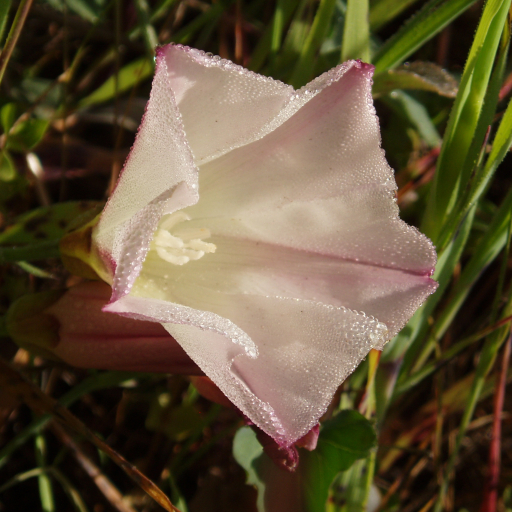
Commonly known as the Pacific False Bindweed, this coastal native is the wild, purple-veined cousin of the common morning glory. Often found draping gracefully over dunes and chaparral, it serves as a crucial component of Western North America’s coastal ecosystems. While it looks delicate, it is a resilient survivor, thriving in the face of salty winds and rocky soils.
🔍 How to Identify
- 🌸 The Blooms: Large, trumpet-shaped flowers that range from creamy white to pale lavender, often featuring striking deep purple or reddish streaks that "drain" toward the center.
- 🍃 Arrowhead Foliage: The leaves are leathery and distinctly shaped like broad arrowheads (deltoid-hastate), growing on stems that often have a subtle reddish tint.
- ➰ The Twine: This is a climbing or trailing perennial that uses its entire stem to spiral around nearby shrubs or fences rather than using tiny tendrils.
🏡 In Your Garden
- 🧗 Natural Climber: If you have this in your landscape, provide a trellis or a sturdy shrub for it to scale. It is a vigorous grower and can easily overwhelm smaller, delicate plants if left to sprawl.
- 🌊 Coastal Specialist: Because it evolved along the Pacific coastline, it is remarkably salt-tolerant. It prefers well-draining soil and mimics the "fog drip" cycle, meaning it appreciates consistent humidity but hates sitting in stagnant, soggy roots.
⚠️ Safety & Toxicity
- 🐾 Mildly Toxic: Like many members of the Convolvulaceae family, the seeds and foliage contain alkaloids that can cause digestive upset if ingested by curious pets or children.
- 🌿 Dermatitis Risk: While not traditionally considered a "rash" plant, the milky sap inside the stems can cause mild skin irritation for those with sensitive skin. It is wise to wear gloves when pruning its long vines.
✨ Fun Fact
The Pacific False Bindweed is a master of the "morning shift." Its flowers are highly synchronized with the sun; they unfurl at dawn to greet native bees and typically begin to shrivel and close by mid-afternoon, earning them the nickname "the coastal clock."

Detailed Care Instructions
| Humidity | Normal |
| Lighting | Full Sun |
| Difficulty | Easy |
| Hibernation | Cold Period |
| Hardiness Zones | 8 - 10 |
To grow Calystegia purpurata, also known as Engelmann's morning glory, follow the steps below:
- Choose an appropriate location: Morning glories thrive in full sun, so select a spot that receives at least six hours of direct sunlight each day. The soil should be well-draining and rich in organic matter.
- Prepare the soil: Amend the soil with compost or well-rotted manure to enrich its nutrient content. Ensure proper drainage by loosening the soil and removing any large rocks or debris.
- Sow the seeds: Morning glory seeds can be sown directly into the prepared soil after the last frost has passed. Space the seeds about 6-12 inches apart and plant them 1/2 inch deep. Alternatively, you can start seeds indoors about 4-6 weeks before the last frost. Transplant seedlings outdoors once the weather is suitable.
- Watering: Water the seeds or seedlings thoroughly after planting. Keep the soil consistently moist but not waterlogged. During dry spells, provide additional water to prevent the soil from drying out completely.
- Support: Calystegia purpurata is a climbing vine, so it requires support structures such as trellises, fences, or stakes. Install these in the garden before the vine starts to grow.
- Pruning: Prune the vine regularly to promote branching and a bushier growth habit. Pinch off the tips of the stems to encourage lateral growth and more abundant flowering.
- Fertilizing: Apply a balanced, slow-release fertilizer to the soil once or twice during the growing season to provide the plant with essential nutrients.
- Mulching: Apply a layer of organic mulch around the base of the plant to help retain moisture in the soil, inhibit weed growth, and keep the roots cool during hot summer days.
- Pests and diseases: Morning glories are generally not prone to many pests or diseases. However, keep an eye out for aphids, spider mites, or fungal diseases like powdery mildew. If necessary, use appropriate organic pest control methods or consult a garden center for recommendations.
- Harvesting seeds: Once the flowers have faded, seed pods will form. Allow these pods to dry on the vine and open naturally. Harvest the seeds for future planting.
Remember that Calystegia purpurata can be an aggressive grower, so contain or prune the vine as necessary to prevent it from becoming invasive.

Place in a bright room that is sun drenched almost all day. Or directly in a south-facing window.

Calystegia Purpurata is a plant that requires regular watering to stay healthy and thrive. To water the plant properly, you should start by checking the soil around it. If the soil feels dry to the touch, it is time to water the plant.
When watering, take care not to over-water the plant. This can lead to root rot and other problems. Instead, water the plant slowly and evenly, ensuring that the soil absorbs the water properly.
You can water the plant either by hand or using a watering can or hose with a gentle spray nozzle. When using a watering can or hose, make sure to direct the water onto the soil and not the leaves or flowers. Directing water onto the leaves can cause them to become damaged or diseased.
In general, Calystegia Purpurata should be watered deeply once or twice a week during the growing season, depending on the climate and weather conditions. During dry or hot weather, you may need to water more frequently.
Overall, proper watering is essential for the health and vitality of Calystegia Purpurata. By following these tips, you can ensure your plant stays healthy and beautiful throughout the growing season.
To fertilize this plant, it is recommended to use a balanced fertilizer with equal amounts of nitrogen, phosphorus, and potassium. Choose a slow-release fertilizer and apply it to the soil around the base of the plant. Be sure to follow the instructions on the package for the recommended amount of fertilizer to use. Avoid over-fertilizing as this can damage the roots of the plant. Additionally, it is recommended to fertilize this plant during its active growth periods, usually in the spring and summer months.
Calystegia Purpurata plant prefers a well-draining soil that is rich in organic matter. It requires soil that is slightly acidic and has a pH range of 5.5 to 6.5. The soil should be crumbly and not heavy, with good water retention but at the same time allowing for proper drainage. An ideal soil mix would include a good quality potting mix or garden soil mixed with peat moss and perlite or vermiculite. It is also important to add organic fertilizers or slow-release fertilizers to the soil to provide necessary nutrients for the plant's growth. Additionally, it is recommended to add a layer of mulch on top of the soil to help retain moisture and prevent weed growth around the plant.
Calystegia Purpurata is a flowering plant that can be propagated through several methods. One common method is through stem cuttings. To do this, select a healthy stem with no flowers or buds and cut it at a 45-degree angle, just below a node, using sharp and sterilized pruning shears. The cutting should be at least 6 inches long and you should remove the leaves from the bottom half of the stem.
Dip the cut end of the stem in rooting hormone powder and plant it in a pot filled with a mixture of perlite and peat moss. Keep the soil moist and place the pot in a bright, but not direct, sunlight. You can cover the pot with a plastic bag to create a humid environment for the cutting.
Another method is through division. This is best done in the spring when new growth appears. Dig up the plant and carefully separate the root system into smaller sections with a sterilized knife or garden shears. Each section should have at least one rooted stem and a healthy amount of roots. Plant each section in a pot filled with potting soil and water thoroughly.
It is also possible to propagate Calystegia Purpurata through layering. This involves bending a stem down to the ground and covering it with soil. Allow the stem to grow roots over several weeks before cutting it off from the parent plant and transplanting it to a new location.
No matter which method you choose, it is important to keep the newly propagated plant in a warm, humid environment with consistent watering until it becomes established.








