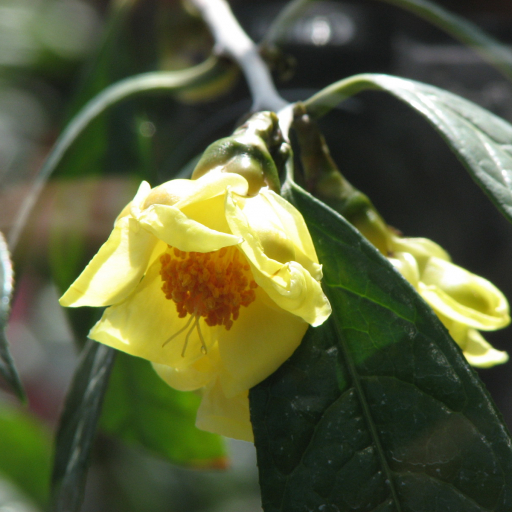
Plant Overview
Often hailed as the "Queen of Camellias," the Camellia petelotii was a mythic legend to botanists for centuries before its official discovery. Unlike the common red or white varieties, this rare treasure from the misty forests of Vietnam and Southern China boasts waxy, butter-yellow blooms that look as if they were sculpted from solid gold. It is highly prized not only for its striking beauty but also for its legendary status in traditional herbal tea culture.
🔍 How to Identify
- 🌼 Golden Blooms: The standout feature is its cup-shaped, waxy flowers that display a vibrant, saturated lemon-to-golden yellow hue, often appearing in late winter or early spring.
- 🍃 Quilted Foliage: The leaves are large, leathery, and dark green with deeply impressed veins, giving them a distinct "quilted" or "pleated" texture that remains beautiful year-round.
- 🌳 Upright Growth: It grows as a slow-moving, evergreen shrub or small tree, maintaining a graceful, narrow stature that reflects its origins in the forest understory.
🏡 In Your Garden
- ☁️ Humidity Enthusiast: Because it originates from tropical and subtropical limestone forests, this plant craves high humidity. It struggles in dry, arid air and performs best in sheltered spots where moisture lingers.
- 🧪 Acidic Foundations: Like most Camellias, it is a strict acid-lover. It requires well-draining, organic-rich soil; if the soil is too alkaline, the plant will struggle to "breathe" and its leaves will turn a sickly pale yellow.
- 🛡️ Dappled Shade: This is not a plant for the harsh, direct sun. It prefers "filtered" light, mimicking the way sunlight trickles through a forest canopy. Direct afternoon sun can easily scorch its precious, waxy petals.
⚠️ Safety & Toxicity
- ✅ Generally Non-Toxic: Camellia petelotii is considered safe for humans. In its native regions, the flowers and leaves are often dried and brewed into an expensive, antioxidant-rich tea.
- 🐾 Pet Safety: While not specifically listed as toxic to cats or dogs, it is always best to discourage pets from chewing on ornamental plants to avoid minor digestive upset.
✨ Fun Fact
For a long time, the "Yellow Camellia" was the "Holy Grail" for plant hunters. When it was finally shared with the world, it caused a botanical sensation. In China, it is so highly regarded for its health benefits and rarity that it is often referred to as "Plant Gold" or the "Giant Panda of the Plant World."

Detailed Care Instructions
| Humidity | Normal |
| Lighting | Part Sun |
| Difficulty | Medium |
| Hardiness Zones | 8 - 10 |
To grow Camellia Petelotii plants, follow these steps:
- Choose the right location: Camellias prefer partial shade, so find a spot in your garden that receives morning sunlight and afternoon shade. They also thrive in acidic soil, so check the pH level of your soil and make sure it is between 5.0 and 6.5.
- Prepare the planting hole: Dig a hole that is twice as wide and deep as the root ball of the Camellia plant. Make sure the hole has good drainage.
- Amend the soil: Mix some organic matter, such as compost or peat moss, into the bottom of the hole to improve the soil's drainage and acidity.
- Plant the Camellia: Place the Camellia plant into the hole, making sure the root ball is level with or slightly above the ground. Backfill the hole with soil and gently tamp it down to remove any air pockets.
- Mulch the plant: Apply a layer of organic mulch, such as wood chips or bark, around the base of the Camellia plant. This will help conserve moisture and suppress weeds.
- Water regularly: Camellias require regular watering, especially during dry periods. Keep the soil consistently moist, but not soggy. Water deeply at the base of the plant and avoid getting the leaves wet to prevent disease.
- Fertilize: Feed your Camellia Petelotii plant with a balanced, acid-loving fertilizer, such as one formulated for azaleas or rhododendrons, in early spring and again in late summer. Follow the package instructions for the correct dosage.
- Prune if needed: Camellias generally require minimal pruning, but you can shape them or remove dead or diseased branches as necessary. Prune after the plant finishes blooming.
- Protect from frost: If you live in an area with frost, cover your Camellia Petelotii plant with a frost cloth or blanket during cold spells to protect it from freezing temperatures.
By following these guidelines, you can successfully grow a Camellia Petelotii plant and enjoy its beautiful blooms.

Place in a bright room that is sun drenched almost all day. Or directly in a south-facing window.

Camellia Petelotii plant requires consistent watering to thrive, especially during the first few years after planting. You should avoid allowing the soil to dry out completely, as this can cause stress to the plant. However, overwatering can also be detrimental, as it can lead to root rot.
To water your Camellia Petelotii plant, start by checking the soil moisture level. Stick your finger about an inch into the soil near the base of the plant. If it feels dry, it's time to water. If it's still moist, hold off for a day or two.
When watering, aim to moisten the entire root zone, which extends out from the base of the plant to about the middle of the dripline (the area under the outermost branches). Water slowly and deeply, using a watering can or hose set to a low flow rate. Avoid getting water on the leaves, as this can encourage fungal growth.
During periods of hot, dry weather, you may need to water your Camellia Petelotii plant more frequently, up to once a week. In cooler weather, you can reduce the frequency of watering to every 10-14 days.
Overall, it's important to strike a balance when watering your Camellia Petelotii plant. You want to provide enough moisture for healthy growth, but not so much that you cause waterlogging or other issues. With a little attention and care, your Camellia Petelotii should thrive and produce beautiful blooms year after year.
For optimal growth and health, feed your Camellia Petelotii plant with a balanced fertilizer at the start of the growing season and again in midsummer. Use a slow-release fertilizer, following the manufacturer's instructions for application rates. Water the plant thoroughly after fertilizing, and avoid getting fertilizer on the foliage to prevent burns. For best results, apply a layer of organic compost around the base of the plant annually.
The soil best suited for Camellia Petelotii plant is a well-draining, acidic soil with a pH range between 5.0 and 6.0. The soil should be rich in organic matter, and should have good water retention properties while allowing excess water to drain away. A mix of peat moss, compost, and sand can be used to create the ideal soil blend for this plant. The soil should also be loamy and moist, but not waterlogged, as this can cause root rot. It is important to avoid using heavy clay soils or soils that are high in alkalinity, as this can cause harm to the plant and limit its growth potential. Proper soil conditions are important for Camellia Petelotii plant to thrive and produce healthy blooms.
One way to propagate this plant is through seed germination. Collect mature seeds from the plant and soak them in water overnight before planting them in a well-draining soil mix. Keep the soil moist and warm, with temperatures between 65-75°F, until the seeds germinate.
Another method is through stem cuttings. Take stem cuttings in the spring or early summer, making sure they are about 3-4 inches long and have at least two leaf nodes. Remove the bottom set of leaves and dip the cut end in rooting hormone before planting it in a well-draining soil mix. Keep the soil moist and warm, with temperatures between 65-75°F, until the cutting establishes roots.
Division is also possible, although it may be tricky due to the shallow root system of the plant. Carefully dig up the plant and separate the individual sections, making sure each one has a portion of the root system. Replant each section in a well-draining soil mix and keep the soil moist until the plants establish themselves.








