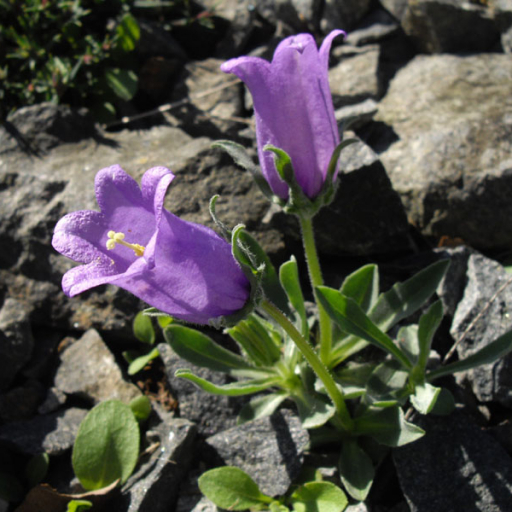
Plant Overview
Often called "Allioni’s Bellflower," this tiny high-altitude specialist is a true jewel of the Southwestern Alps. Unlike its tall, floppy garden cousins, this plant stays hunkered down against mountain winds, surprising hikers with solitary flowers that seem far too large for such a petite frame. It is the quintessential "alpine treasure," prized by rock garden enthusiasts for its dramatic proportions and rugged survival skills.
🔍 How to Identify
- 🌸 The Oversized Bell: It produces single, violet-blue, bell-shaped flowers that can reach up to 2 inches long—stunningly large considering the entire plant rarely exceeds 3 inches in height.
- 🍃 Silvery Rosettes: The leaves are narrow, spatula-shaped, and grow in tight clusters. They are often covered in fine, greyish hairs which act as a natural "sunscreen" against intense mountain UV rays.
- 🌱 Creeping Habit: Instead of a single clump, it spreads slowly via underground runners (stolons), eventually forming a small colony that peeks out from between cracks in stones.
🏡 In Your Garden
- 🏔️ The Scree Specialist: This plant is biologically programmed for "moving" ground. In a garden, it demands extreme drainage. It thrives in a "scree bed" or alpine trough filled with grit and stone rather than standard rich potting soil.
- 💧 The Winter Paradox: While it enjoys consistent moisture during the heat of summer, it is highly sensitive to "wet feet" during the winter. Stagnant water around the crown is the most common cause of failure, leading to rapid root rot.
- 🧊 Cool Root Run: It loves having its foliage in the sun but its roots tucked deep into cool, moist crevices behind large rocks to mimic its native glacial moraines.
⚠️ Safety & Toxicity
- ✅ Safe Status: Campanula alpestris is considered non-toxic to humans and common household pets, including cats and dogs.
- 🐾 Pet Friendly: While it is not a forage plant, you don't need to worry if a curious pet takes a nibble. Its fuzzy, slightly tough leaves usually make it unappealing to most grazers anyway.
✨ Fun Fact
If a human had the same proportions as Allioni's Bellflower, our "hat" (the flower) would be nearly four feet wide! The plant puts almost all its biological energy into one massive bloom to ensure it catches the attention of rare high-altitude pollinators during its very short growing season.

Detailed Care Instructions
To grow Campanula Alpestris, also known as the alpine bellflower, follow these steps:
- Select a suitable location: Choose a sunny or partially shaded spot in your garden. The plant thrives in well-draining soil, so ensure the area doesn't retain excessive moisture.
- Soil preparation: Before planting, prepare the soil by removing any weeds or debris and loosening it to a depth of about 6-8 inches. Consider adding organic matter like compost or aged manure to improve soil fertility and drainage.
- Start from seeds or young plants: Campanula Alpestris can be grown from seeds or nursery-bought plants. If starting from seeds, sow them in a seed tray or small pots filled with seed-starting mix. Lightly press the seeds into the soil or cover them with a thin layer of soil. Keep the soil moist and place the tray in a warm location or use a heating mat to aid germination.
- Transplanting: Once the seedlings have grown to a suitable size (typically 2-3 inches tall), transplant them into the prepared garden bed. If planting from potted plants, dig a hole slightly larger than the root ball and place the plant in the hole, ensuring it is at the same depth as it was in the pot. Backfill the hole, gently firming the soil around the plant.
- Watering: Campanula Alpestris prefers moderate levels of moisture. Water the plant regularly, keeping the soil evenly moist, but not waterlogged. Provide enough water during dry spells or periods of prolonged heat.
- Mulching: Apply a layer of organic mulch, such as shredded bark or dry leaves, around the base of the plant. Mulching helps to conserve moisture, suppress weed growth, and protect the plant's shallow roots during winter.
- Fertilization: Campanula Alpestris doesn't typically require heavy fertilization. However, you can apply a balanced, slow-release fertilizer in early spring to promote healthy growth. Follow the instructions on the fertilizer packaging for appropriate application rates.
- Pruning: After the flowering season, you can deadhead spent blooms by cutting them back to encourage further blooming. Additionally, cutting back the plant to about half its height in late autumn will help maintain its compact shape and promote new growth in the following season.
- Winter care: Most alpine bellflowers are hardy perennials. However, it is advisable to provide some winter protection, such as covering the plant with a layer of mulch or straw, especially in colder regions. This will help insulate the root system and protect it during frosty weather.
By following these steps, you should be able to successfully grow Campanula Alpestris and enjoy its beautiful bell-shaped flowers in your garden.

Place in a bright room that is sun drenched almost all day. Or directly in a south-facing window.

To water this plant, you should first ensure that the soil is dry to the touch before watering. Fill a watering can with room temperature water and pour the water gently into the soil, taking care not to pour directly onto the leaves or stem of the plant. Water thoroughly, but do not let the soil become waterlogged. It is important to water consistently, usually every 7-10 days, especially during the plant's growing season. Avoid watering in the evening, as this can lead to fungal growth. Instead, water in the morning or midday, giving the plant time to dry before nightfall. If the plant is in a container, be sure that the pot has sufficient drainage holes to allow excess water to escape.
To fertilize this plant, apply a slow-release granular fertilizer in early spring before new growth emerges. Use a balanced fertilizer with equal amounts of nitrogen, phosphorus, and potassium. Follow the package instructions for application rates based on the size of your plant. Additionally, you can top dress the soil around the plant with compost or organic matter in the fall to replenish nutrients. Avoid over-fertilizing, as this can lead to excessive foliage growth and decreased flower production.
Campanula Alpestris plant thrives well in soil that is well-draining and has good fertility. The plant prefers a slightly acidic to neutral soil pH range between 6.0 to 7.0. A good soil mix for this plant should be rich in organic matter, such as compost and aged manure, to improve soil structure, soil aeration, and soil fertility. The soil should also have good water retention capacity to keep the root zone moist but not waterlogged. Adding perlite or coarse sand to the soil mix can help improve drainage and air circulation around the roots. Avoid using heavy clay soils or highly compacted soils as they can impede root growth and drainage. A good rule of thumb is to use a soil mix that is loose, friable, and crumbly to the touch, similar to garden loam. It's recommended to periodically amend the soil with organic matter and fertilizers to maintain soil health and plant vigor.
The propagation of this plant can be achieved through various methods. The first method is through seed germination. The seeds should be sown in a well-draining soil mix and kept moist until they germinate. The second method is through stem cuttings. The stems should be cut from the parent plant and placed in a rooting hormone solution before planting them in a well-draining soil mix. The third method is by dividing the root clumps of the parent plant. This should be done in the early spring or fall when the plant is dormant. Each division should have at least one rooted shoot. The propagated plants should be planted in well-draining soil and should be kept moist until they establish themselves.








