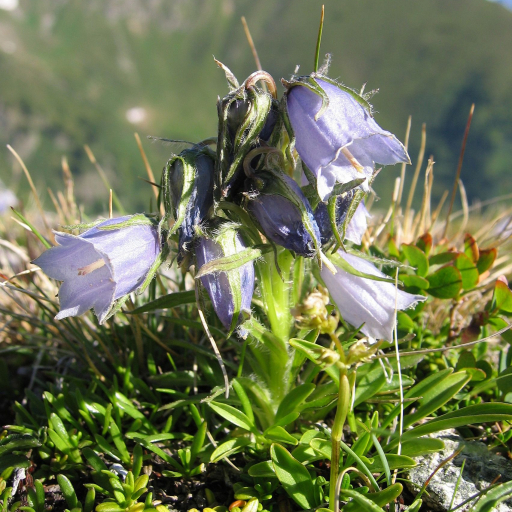
Plant Overview
Known as the Alpine Bellflower, this resilient little gem is the crown jewel of the high-altitude Eastern Alps and Carpathians. Unlike its taller garden cousins, this plant has adapted to survive the harshest mountain winds by staying low to the ground, forming a fuzzy, protective cushion. Its deep violet bells look like tiny sapphire droplets scattered across rocky ridges and limestone cliffs.
🔍 How to Identify
- 🔔 The Flowers: Large, nodding bell-shaped blooms that are a deep, saturated violet or sky blue. They often hang downward to protect their delicate pollen from mountain rain and snow.
- 🍃 The Foliage: A dense basal rosette of narrow, lance-shaped leaves. The leaves are distinctively hairy or "woolly," a clever evolutionary trick to trap heat and reduce moisture loss.
- 📏 The Stature: Extremely compact, rarely growing taller than 5 to 10 centimeters. It looks like a miniature version of a standard Bellflower that has been shrunk to fit between stones.
🏡 In Your Garden
- 🪨 The Rock Star: This plant is a specialist for rock gardens or "scree" beds. It requires exceptionally sharp drainage; if its roots sit in soggy soil for even a few days, it will likely perish.
- ❄️ Cold Lover: Unlike many garden plants, Campanula alpina thrives on a long, cold winter. It uses the freezing temperatures as a signal to prepare for its summer bloom. Avoid planting it in humid, tropical, or overly hot lowlands where the nights stay warm.
- 🏔️ Substrate Preference: It prefers slightly acidic to neutral rocky soil. To mimic its natural home, mix plenty of grit, perlite, or crushed volcanic rock into its planting hole.
⚠️ Safety & Toxicity
- ✅ Safe Status: Campanula alpina is considered non-toxic to humans and common household pets.
- 🐾 Pet Friendly: While it’s safe if a curious dog or cat takes a nibble, the plant is quite delicate and won't survive much trampling or heavy grazing. It is best kept in an elevated rockery out of the "zoomie" zone.
✨ Fun Fact
Because it grows in such nutrient-poor, rocky crevices, Campanula alpina grows very slowly. A tiny cluster of flowers that fits in the palm of your hand might actually be several years old, having survived multiple seasons of being buried under heavy mountain snow.

Detailed Care Instructions
To grow Campanula Alpina, also known as Alpina Bellflower, you can follow these steps:
- Choose the right location: Campanula Alpina prefers full sun to partial shade. Choose a location in your garden that receives at least 6 hours of direct sunlight per day. The soil should be well-draining and rich in organic matter.
- Prepare the soil: Before planting, prepare the soil by loosening it with a garden fork or tiller. Remove any weeds or stones from the area.
- Plant the seedlings: Campanula Alpina can be grown from seeds or purchased as seedlings. If you are starting from seeds, sow them in early spring. If using seedlings, plant them in spring or early fall. Dig a hole slightly larger than the root ball of the plant and place the plant in it. Gently firm the soil around the roots.
- Watering: Keep the soil evenly moist, especially during the first growing season. Water regularly but avoid overwatering, as it can lead to root rot. Water at the base of the plant, avoiding wetting the leaves.
- Mulching: Apply a layer of organic mulch around the base of the plant to help retain moisture, suppress weeds, and regulate soil temperature. Mulch also helps prevent diseases by reducing splashing of soil onto the leaves.
- Fertilizing: Campanula Alpina does not require heavy fertilization. However, you can apply a balanced, slow-release fertilizer in early spring to promote healthy growth. Follow the manufacturer's instructions for dosage.
- Pruning: After the blooming season, you can deadhead the flowers by removing faded blooms to encourage further flowering. Additionally, pruning in early spring can help shape the plant and remove any dead or damaged stems.
- Winter care: Campanula Alpina is a hardy perennial that can tolerate cold temperatures. However, if you live in an area with harsh winters, you can provide some protection by applying a layer of mulch around the base of the plant in late fall.
By following these steps, you should be able to successfully grow Campanula Alpina in your garden. Enjoy the beautiful bell-shaped flowers that this plant produces!

Place in a bright room that is sun drenched almost all day. Or directly in a south-facing window.

1. Determine the soil type: The first step in watering Campanula Alpina is to understand the soil type. It is a plant that thrives in well-drained, slightly alkaline soil. This means that the soil should not hold too much water, nor should it be too dry.
2. Test the moisture level: The second step is to test the moisture level of the soil. The plant prefers soil that is moist but not waterlogged. You can check the moisture level by inserting a finger into the soil. If the soil feels dry, then it is time to water.
3. Watering frequency: The frequency of watering Campanula Alpina depends on the environmental conditions. If the plant is placed in a location that receives full sunlight, it may need to be watered more frequently. On the other hand, if it is placed in a shady area, it may require less water. As a general rule, water the plant once a week during the growing season and reduce watering during the dormant period.
4. Watering amount: When watering Campanula Alpina, it is important to water it deeply. This means that the water should penetrate the soil to a depth of at least 6 inches. The amount of water needed will depend on the size of the container or the plant's location in the garden.
5. Watering method: The best way to water Campanula Alpina is by using a watering can or a garden hose with a gentle showerhead. Avoid using sprinklers, as they can cause damage to the plant.
6. Mulching: Finally, consider mulching around the base of the plant to help retain moisture in the soil. This can be done using organic material such as compost, bark, or grass clippings.
- Choose a well-draining soil mixture that is rich in organic matter.
- Before planting, mix in a slow-release fertilizer.
- Water the plant thoroughly after planting and continue to keep the soil moist but not waterlogged.
- After the first flush of blooms, apply a balanced fertilizer at half strength.
- Repeat this feeding every 4-6 weeks throughout the growing season.
- In the fall, stop fertilizing and allow the plant to go dormant.
Campanula Alpina is a plant species that is best grown in well-draining soil that has a balanced pH level. The soil should be rich in humus, organic matter, and nutrients, and should not be compacted, as it can suffocate the roots. Recommended soil types for Campanula Alpina are sandy loam or loamy soils.
When planting Campanula Alpina, it is important to amend the soil before planting with compost, peat moss, or other organic materials to improve its quality. The plant also prefers moist but well-draining soil, so adding perlite or other materials can help improve drainage while retaining moisture.
It is recommended to test the soil for pH levels and adjust it accordingly to ensure that it is within the optimal range of 6.0-7.5. Adding lime can help raise the soil pH, while sulfur can help lower it.
Overall, Campanula Alpina requires a nutrient-rich, well-draining soil that is not too compacted, and with a balanced pH level. With the right soil conditions and proper care, this plant can thrive and produce beautiful flowers.
Campanula Alpina is a perennial plant that belongs to the family Campanulaceae. It is commonly propagated through seeds, division, or cuttings.
To propagate Campanula Alpina using seeds, begin by collecting the seeds from the plant after they have ripened. Sow the seeds in a mixture of sand and peat at a depth of about 1/8 inch. Keep the soil moist and place the container in a warm, bright location. The seeds will germinate in about 2-3 weeks.
To propagate Campanula Alpina using division, wait until the plant has become mature and has formed multiple stems. Gently lift the entire plant from the soil and use a sharp knife to cut the plant into smaller sections. Each section should have a healthy root system and several stems, then replant each section in a new location.
To propagate Campanula Alpina using cuttings, take a cutting from the stem of the plant with four to six leaves. Dip the cutting in rooting hormone and plant it in a well-draining soil mixture. Keep the soil moist and place the container in a warm, bright location. Roots should begin to form in two to three weeks.
Once the new plants have grown, care for them by providing ample sunlight, watering them regularly but not allowing the soil to become waterlogged, and fertilizing them once a month during the growing season.








