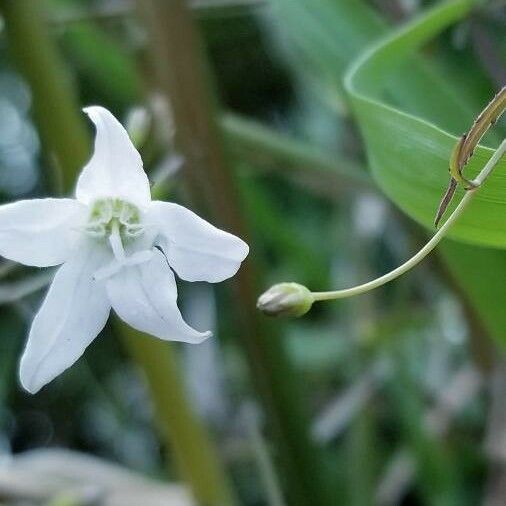
Plant Overview
Known as the Marsh Bellflower, this delicate native of North American wetlands is a master of the "lean-on-me" strategy. It is often nicknamed the "Bedstraw Bellflower" because of its uncanny resemblance to Bedstraw (Galium), using tiny, hooked bristles to scramble over neighboring grasses for support. While it looks like a fragile, ethereal lantern, it is a hardy survivor of the soggiest fens and wet meadows.
🔍 How to Identify
- 📏 The Scrambling Stems: The stems are exceptionally thin, weak, and three-angled. They are covered in tiny, downward-pointing prickles that allow the plant to "climb" by hooking onto other vegetation.
- 🔔 The Flowers: Look for small, five-lobed bells that range from stark white to a faint, misty lavender-blue. They typically hang solo or in very small clusters at the ends of the wiry branches.
- 🌿 The Foliage: The leaves are long, narrow, and alternate along the stem. Much like the stems, the leaf margins feel rough to the touch—almost like fine sandpaper or Velcro.
🏡 In Your Garden
- 💧 Soggy Needs: This isn't your typical garden border plant; it craves "wet feet." In a home landscape, it thrives best on the muddy edges of a pond or in a dedicated rain garden where the soil remains consistently moist.
- 🧗 Natural Support: Because its stems are so slender, the Marsh Bellflower doesn't stand up on its own. It prefers to weave itself through taller sedges and grasses. If planted in a bare spot, it will likely collapse into a tangled mat.
- 🌱 Root Sensitivity: Like many members of the Campanula family, it has a delicate root system that hates being moved. It is best to sow it from seed in its "forever home" rather than attempting to transplant established clumps.
⚠️ Safety & Toxicity
- ✅ Safe Status: Campanula aparinoides is generally considered non-toxic to humans, cats, and dogs. It is not known to contain any harmful alkaloids.
- 🧤 Skin Sensitivity: While not poisonous, the tiny hooked bristles on the stems can be mildly irritating to very sensitive skin if handled frequently. It’s a "look but don't touch" beauty for most enthusiasts.
✨ Fun Fact
The scientific name aparinoides literally translates to "resembling Aparine" (the common weed known as Cleavers). It’s a rare case of a bellflower evolving to mimic a completely different family of plants just to take advantage of the same "hitchhiking" climbing mechanics!

Detailed Care Instructions
To grow Campanula aparinoides (Dalmatian bellflower) successfully, follow these steps:
- Select the proper location: Choose a spot that receives full sun to partial shade. The plant prefers well-draining soil and can tolerate a range of soil types.
- Prepare the soil: Loosen the soil and remove any weeds or grass. If the soil is heavy or clay-like, add organic matter like compost or well-rotted manure to improve drainage.
- Sow the seeds: Sow the Campanula aparinoides seeds directly outdoors in spring or early summer after the danger of frost has passed. Scatter the seeds over the prepared soil and gently rake them in. Keep the soil moist until germination occurs, which usually takes two to three weeks.
- Thin the seedlings: Once the seedlings have grown a bit, thin them to provide proper spacing. Maintain a distance of about 8-10 inches between each plant.
- Watering: Water the plants regularly, especially during dry periods or in hot weather. Avoid overwatering, as it can lead to root rot. Allow the top inch of soil to dry out between waterings.
- Fertilization: Campanula aparinoides does not require heavy fertilization. However, you can apply a balanced slow-release fertilizer once in spring to promote healthy growth.
- Mulching: Apply a layer of organic mulch around the plants to help retain moisture, regulate soil temperature, and suppress weed growth.
- Pruning: Cut back the flowering stems once the blooms have faded to encourage repeat blooming and maintain a tidy appearance. This also prevents self-seeding, as Campanula aparinoides can be invasive in some regions.
- Pests and diseases: Monitor the plants for pests like slugs, snails, or aphids. Treat any infestations promptly using organic pest control methods. While generally disease-resistant, watch for signs of fungal diseases like powdery mildew and treat accordingly.
- Division: Every few years, divide the Campanula aparinoides plants to rejuvenate them. Dig up the clumps in spring or fall, and gently separate the roots. Replant the divisions in prepared soil, spacing them appropriately.
With proper care and the right growing conditions, Campanula aparinoides will reward you with bright, bell-shaped flowers throughout the growing season.

Place in a bright room that is sun drenched almost all day. Or directly in a south-facing window.

Campanula Aparinoides is a perennial plant that requires regular watering to thrive. To water this particular plant, it is important to ensure that the soil is moist but not waterlogged.
Firstly, check the soil moisture level by inserting your finger about an inch into the soil near the roots. If it feels dry, it is time to water the plant.
When watering, use a watering can or a hose with a gentle spray nozzle to avoid damaging the plant. Slowly and evenly water the soil around the roots, making sure to water deeply enough to reach all roots but not so much that the water runs off and causes erosion.
The frequency of watering campanula apariniodes will depend on factors such as the temperature and humidity levels in your area, as well as the plant's size and age. In hot, dry weather, the plant may require more frequent watering, while in cooler and more humid conditions, it may need less frequent watering.
It is important to avoid overwatering the plant, which can lead to root rot and other diseases. It is better to water the plant deeply and less often than to water it frequently with shallow watering.
In summary, to water Campanula Aparinoides, check the soil moisture level, use a gentle watering method, water deeply but not too frequently, and avoid overwatering.
To fertilize this plant, apply a balanced fertilizer in spring, just before new growth begins. Water the plant thoroughly after fertilizing to ensure the nutrients are distributed evenly in the soil. Repeat this every four to six weeks during the growing season, but avoid fertilizing during dormancy. Be sure to follow the manufacturer's instructions for proper application rates.
The ideal soil for the Campanula Aparinoides plant should be well-draining and rich in organic matter. It should have a pH between 6.0 and 7.0, and be slightly acidic to neutral. The plant prefers moist but not overly wet soil, so it is important to ensure adequate drainage.
A mixture of peat moss, perlite, and vermiculite is a good soil mix for Campanula Aparinoides. This will provide good drainage and aeration, allowing the roots to breathe and preventing the soil from becoming waterlogged. Adding some compost or aged manure will also provide the necessary nutrients for healthy growth.
It is important to avoid using soil that is heavy and clay-like, as this can cause root rot and other issues. Also, avoid using soil that is too sandy, as it will not retain enough moisture.
Overall, the soil for Campanula Aparinoides should be well-draining, rich in organic matter, slightly acidic to neutral, and moist but not overly wet. A soil mix of peat moss, perlite, vermiculite, and compost or aged manure is a good choice for this plant.
Campanula aparionides is a herbaceous perennial plant that belongs to the Campanulaceae family. It is often grown for its beautiful blue and white flowers that bloom during the summer months, making it a popular choice among gardeners and landscapers.
The propagation process for Campanula aparionides can be done through various methods such as stem cuttings, division, and rooting of offsets. Here are some details about each method:
- Stem Cutting Propagation: Take a cutting of the stem of the current season's growth and make sure it is around 8-10 cm long. Remove the lower leaves from the cutting and dip the stem in rooting hormone powder. Plant the stem in a well-draining potting mix and keep it in a shaded area. Make sure to keep the soil moist and water the plant frequently. After a few weeks, the cutting should start developing roots, and new growth will appear.
- Division: Divide an existing plant into two or more parts during the early spring. Dig out the plant carefully and separate the roots into two parts. Ensure that each part has some shoots and leaves. Plant the divided parts in well-drained soil and keep them well-watered. Place them in the shade for a few days and then gradually move them to a sunny spot.
- Rooting of Offsets: Campanula aparionides often produces small offsets on the parent plant. These offsets can be cut off and planted in a small pot with good quality, well-draining soil. Make sure to keep the soil moist and provide the plant with sufficient light.
Propagation of Campanula aparionides is relatively easy, and the plant can be grown in pots or in the ground. It requires well-drained soil and regular watering to thrive. With proper care, it can produce beautiful flowers that will add color to any garden or landscape.








