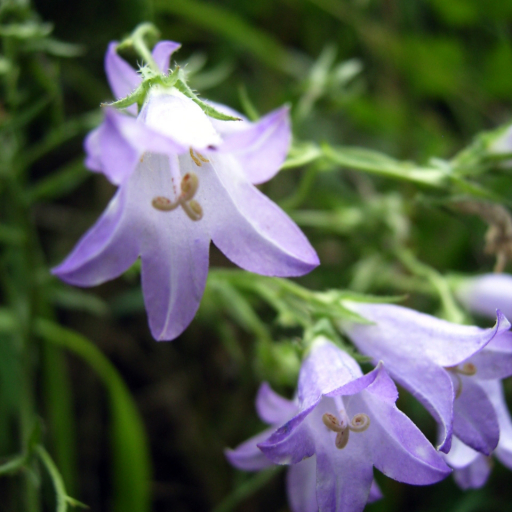
Plant Overview
The Siberian Bellflower (Campanula sibirica) is a rugged beauty that hails from the dry steppes and rocky slopes of Eastern Europe and Central Asia. Often called the "Ice Queen" of the bellflower family, it is a biennial plant that spends its first year quietly forming a lush rosette of leaves before exploding into a fountain of nodding, violet bells in its second year. It is highly prized by rock garden enthusiasts for its ability to thrive where more delicate flowers might wither.
🔍 How to Identify
- 🔔 The Flowers: Large, drooping, bell-shaped blossoms that usually range from a deep lavender to a striking sky blue. They typically hang in loose clusters along the upper half of the stem.
- 🖌️ Hairy Texture: One of its most defining traits is its "hispid" nature—the stems and leaves are covered in fine, stiff hairs that give the plant a slightly rough, silvery-green appearance.
- 🍃 Foliage Shape: The leaves at the base are long and spoon-shaped with wavy edges, while the leaves further up the stem become much narrower and clasp directly to the stalk.
🏡 In Your Garden
- 🌱 The Waiting Game: Because this is a biennial, it requires patience. It focuses all its energy on root development in year one, so if you don't see flowers immediately, don't fret! It is simply preparing for a spectacular show the following summer.
- ☀️ Drought Warrior: Unlike its thirstier cousins, the Siberian Bellflower loves well-drained, even rocky or sandy soil. It is an excellent choice for xeriscaping or "neglected" corners of the garden that get plenty of sun.
- 🐝 Pollinator Magnet: Its deep bells are perfectly shaped for bumblebees, who will often crawl entirely inside the flower to reach the nectar, vibrating their wings to release the pollen.
⚠️ Safety & Toxicity
- ✅ Non-Toxic: Campanula sibirica is generally considered safe and non-toxic for humans, cats, and dogs.
- 🧤 Skin Sensitivity: While not poisonous, the stiff hairs on the stems can sometimes cause mild mechanical irritation or a "scratchy" feeling on sensitive skin. Wearing gloves while pruning is a good idea if you have sensitive hands.
✨ Fun Fact
The name Campanula is Latin for "little bell." In ancient folklore, bellflowers were often associated with magic; it was believed that if you could ring a bellflower without it breaking, you would be granted the ability to see fairies!

Detailed Care Instructions
To grow Campanula Sibirica plant, also known as Siberian Bellflower, you can follow these steps:
- Choose a suitable location: Campanula Sibirica prefers full sun to partial shade. It can tolerate a variety of soil types as long as it is well-draining.
- Prepare the soil: Before planting, loosen the soil and remove any weeds or large stones. Adding organic matter like compost can improve the soil quality.
- Sow seeds or plant seedlings: If you have seeds, start them indoors about 10-12 weeks before the last frost date. Sow them in moist seed-starting soil and lightly cover with a thin layer of soil. Keep the soil consistently moist until the seeds germinate. Once the seedlings are large enough, transplant them into the prepared outdoor soil.
If you have seedlings, dig a hole slightly larger than the root ball and place the plant in it, ensuring the top of the root ball is level with the soil surface. Backfill the hole and gently firm the soil around the plant.
- Watering: Keep the soil consistently moist, but avoid overwatering as this can cause root rot. Water deeply and regularly, especially during dry periods.
- Mulching: Apply a layer of organic mulch around the plants to help retain moisture, suppress weed growth, and regulate soil temperature.
- Pruning: After flowering, you can deadhead the spent flowers to encourage new blooms. Additionally, trim back the plant in early spring to promote compact growth.
- Fertilizing: Campanula Sibirica generally does not require frequent fertilization. However, you can apply a balanced, slow-release fertilizer in early spring to provide some nutrients.
- Pests and diseases: Campanula Sibirica is generally resistant to pests and diseases. However, slugs and snails may sometimes feed on the leaves. Use organic pest control methods or handpick them off the plants.
By following these steps, you can successfully grow Campanula Sibirica and enjoy its beautiful bell-shaped flowers.

Place in a bright room that is sun drenched almost all day. Or directly in a south-facing window.

1. Check the soil moisture level: Before watering the Campanula Sibirica plant, check the soil moisture level by sticking your finger into the soil up to about 2 inches deep. If the soil feels dry, it's time to water the plant.
2. Use room temperature water: Always use room temperature water to water the plant as cold water can shock the roots and harm the plant.
3. Water at the base: Water the Campanula Sibirica plant at the base of the stem, avoid watering the leaves or flowers as this can cause them to rot. Use a watering can or a hose with a gentle spray nozzle.
4. Water thoroughly but avoid waterlogging: Water the plant until the soil is evenly moist but avoid overwatering or waterlogging the soil as it can cause root rot.
5. Water regularly: The Campanula Sibirica plant prefers consistent moisture in the soil, so water it regularly to keep the soil damp but not soggy.
6. Adjust watering schedule according to the season: During hot and dry weather, the plant may require more frequent watering, while during the winter months, it may need less water.
7. Monitor the plant's response: Monitor the plant's response to watering and adjust the frequency and amount of water accordingly. If the leaves turn yellow or brown, it may indicate overwatering, while wilting leaves could be a sign of under watering.
For best results, apply a balanced fertilizer which contains equal amounts of nitrogen, phosphorus, and potassium. Fertilize once every 2-4 weeks during the growing season, diluting the fertilizer to half strength before application. Avoid fertilizing during the winter months or when the plant is dormant. There is no need to fertilize newly planted campanula sibirica until it has established itself in the soil.
Campanula Sibirica plants require well-draining soil that is moist but not waterlogged. It prefers a soil pH between 5.5 and 6.5, which is slightly acidic. A rich, loamy soil is ideal, but it can tolerate a variety of soils as long as it is well-draining. It grows best in full sun to partial shade. Add organic matter such as compost or aged manure to improve soil fertility. Avoid heavy clay soils or soils with high amounts of sand, as these tend to dry out too quickly or become compacted.
To propagate this plant, you will need to take stem cuttings. Start by selecting a healthy stem that is at least 4-6 inches long. Make a clean cut just below a node on the stem.
Remove the lower leaves from the stem, leaving only 2-3 leaves towards the top. Dip the cut end of the stem in rooting hormone to encourage healthy roots.
Prepare a pot filled with well-draining soil and poke a hole in the center of the soil using a stick or pencil. Insert the stem cutting into the hole and gently pack the soil around the stem.
Water the cutting well and keep the soil moist but not too wet. Place the pot in a warm, bright spot but avoid direct sunlight. It should take 2-4 weeks for the roots to develop.
Once the cutting has developed a good root system, you can transplant it to a larger pot or in the ground outside. You can repeat this process to propagate additional plants.








