Plant Overview
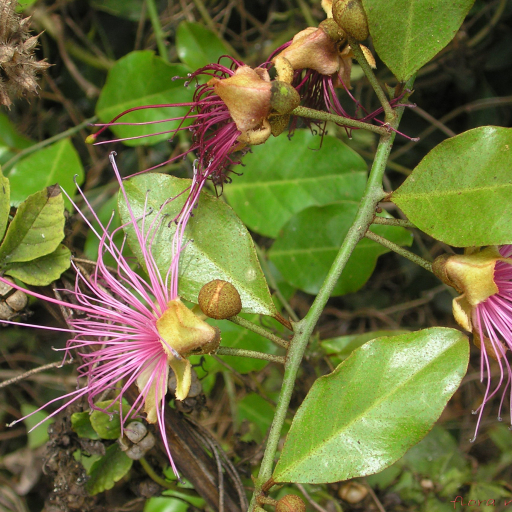
Often called the Ceylon Caper or Ardanda, this hardy, woody climber is a master of the dry landscape across South and Southeast Asia. Its flowers are the true showstoppers, featuring a dramatic burst of long, hair-like stamens that look like a firework frozen in time. In traditional landscapes, it is often used as a formidable "living fence" due to its scrambling growth and defensive spines.
🔍 How to Identify
- 🌸 Fireworks Flowers: The blossoms feature four white petals and dozens of incredibly long, delicate filaments (stamens) that start white and "blush" into a deep purple or pink as they age.
- 🌿 Glossy Foliage: The leaves are oval-shaped, leathery, and have a polished shine that helps the plant reflect intense tropical sunlight.
- ⚓ Hooked Spines: Look closely at the base of the leaves; the stems are armed with short, sharp, recurved thorns that allow the plant to "hook" onto neighboring trees to climb toward the sun.
🏡 In Your Garden
- 🌞 Thrives on Neglect: This is a "set it and forget it" plant for hot, arid climates. It prefers well-drained, rocky soil and actually performs better when the soil is allowed to dry out completely between waterings.
- 🦋 Pollinator Paradise: It is a vital host plant for various butterfly species, particularly the Belenois and Cepora families. Planting one will almost certainly invite colorful "Gull" and "Pioneer" butterflies to your yard.
- 🏗️ Structure Required: Because it is a scrambling shrub, it needs a sturdy trellis, wall, or a sacrificial tree to grow on, otherwise, it will form a dense, tangled mound on the ground.
⚠️ Safety & Toxicity
- 🩹 Mechanical Hazard: The primary danger of the Ceylon Caper is its thorns. They are small but very sharp and hooked, making pruning a task that requires thick gardening gloves.
- 🐾 Pet & Child Safety: While the plant is not considered toxic to touch or consume in small amounts (the fruits are sometimes used in traditional pickles), the thorns pose a significant risk of scratches or skin irritation.
✨ Fun Fact
The flowers of the Ceylon Caper are "time-sensitive" communicators; they change from white to purple specifically to tell pollinators which flowers have already been drained of nectar, helping bees and butterflies forage more efficiently!

Detailed Care Instructions
To grow Capparis Zeylanica, also known as Wild Caper, follow these steps:
- Obtaining Seeds or Plants: You can either acquire seeds from a reputable seed supplier or purchase young plants from a nursery.
- Germination: If starting from seeds, soak them in warm water for 24 hours. After soaking, plant the seeds in a well-draining potting mix. Cover the seeds with a thin layer of soil and keep them in a warm location, such as a greenhouse or a sunny indoor spot.
- Light and Temperature: Capparis Zeylanica requires plenty of sunlight. Place the pot or container in a location that receives full sun, preferably with at least 6 hours of direct sunlight each day. The plant also prefers warm temperatures between 70-85°F (21-29°C).
- Watering: Ensure that the soil is evenly moist but not waterlogged. Water the plant thoroughly and allow excess water to drain out. The plant can tolerate short dry periods but prefers consistent moisture.
- Soil and Fertilizer: Capparis Zeylanica thrives in well-draining, sandy loamy soil. Ensure the soil is rich in organic matter. Fertilize the plant with a balanced, slow-release fertilizer during the growing season, following the instructions on the fertilizer packaging.
- Pruning: Regular pruning helps maintain the shape of the plant and promotes branching. Prune back any dead or damaged stems, along with any excessive growth.
- Pests and Diseases: Capparis Zeylanica is generally resistant to pests and diseases. However, occasional inspections are necessary to address any issues promptly. If pest infestations occur, treat them with an appropriate insecticidal soap or pesticide.
- Transplanting: If the plant has outgrown its container, transplant it into a slightly larger pot with fresh potting soil. Take care while handling the plant to avoid disturbing the roots excessively.
- Harvesting: Capparis Zeylanica produces edible flower buds, often used as a substitute for capers. Harvest the flower buds when they are still closed and before they open. This is typically done in the morning when the buds are firm and have a good flavor.
By following these steps, you should be able to successfully grow Capparis Zeylanica. However, remember to research any specific details or considerations related to your location or climate conditions.

Place in a bright room that is sun drenched almost all day. Or directly in a south-facing window.

To water this plant, ensure that the soil is dry to a depth of at least 2 inches before watering. Use room temperature water and water the soil around the base of the plant until the soil is moist but not waterlogged. Do not allow the plant to sit in standing water, as this can cause root rot. Adjust the watering frequency depending on the temperature and humidity in the plant's environment.
For best results, fertilize this plant with a balanced, slow-release fertilizer during the growing season. Apply the fertilizer around the base of the plant and water it in thoroughly. Avoid over-fertilizing, as this can lead to excessive vegetative growth and reduced flowering. It is also important to monitor the soil pH, as this plant prefers a slightly acidic soil. If the pH is too high, consider amending the soil with sulfur or acidifying fertilizers.
It is recommended to use a well-draining soil with a pH range of 6.5 to 7.5 for this plant. The soil should also be rich in nutrients and organic matter to promote healthy growth. It is best to avoid heavy, clay soils that can retain too much water and cause root rot. Adding sand or perlite to the soil mixture can also improve drainage.
Capparis Zeylanica is a plant that can be propagated through various methods such as seed propagation, vegetative propagation, and cutting propagation. The process of propagating this plant involves patience and proper care to ensure the success of the propagation.
One way to propagate Capparis Zeylanica is through seed propagation. The seeds need to be collected from the mature fruits of the plant. After being collected, the seeds should be cleaned and prepared for planting. Once the seeds are ready, they can be planted in well-drained soil that is enriched with organic matter. The soil should be kept moist, and the seedlings should be carefully monitored to ensure healthy growth.
Vegetative propagation is another method that can be used to propagate Capparis Zeylanica. This method involves taking a cutting or a piece of the plant, such as a stem or a leaf, and planting it in soil or water. The cutting should be taken from a mature, healthy plant that is free from diseases and pests. The cutting should be planted in well-drained soil or in water and kept in a warm, humid place. The cutting will begin to develop roots and shoots, and once it has grown enough, it can be transplanted into a larger pot or directly into the ground.
Cutting propagation can also be used to propagate Capparis Zeylanica. This method involves taking a cutting from a mature plant and planting it in soil. The cutting should be taken from a healthy, disease-free plant and should be planted in well-drained soil that is enriched with organic matter. The cutting should be kept in a warm, humid place and watered regularly. Once the cutting has grown enough, it can be transplanted into a larger pot or directly into the ground.
Overall, propagation of Capparis Zeylanica requires patience, care, and the use of proper techniques. Seed propagation, vegetative propagation, and cutting propagation are all viable methods that can be used to successfully propagate this species.








