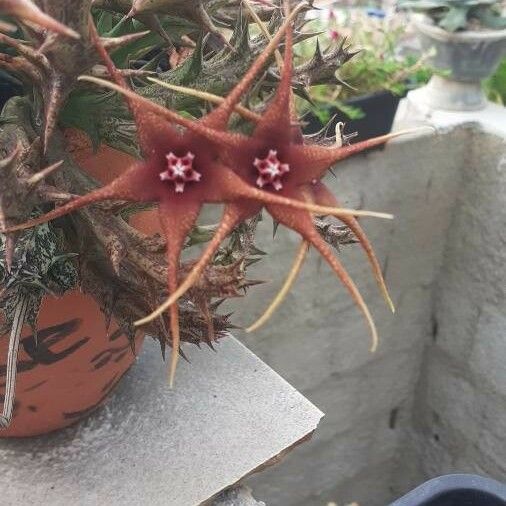
Plant Overview
Known as the Tail-flowered Caralluma, this striking succulent is a master of mimicry and survival. Hailing from the arid regions of Southern and Eastern Africa, it is often nicknamed the "Carrion Flower" or "Starfish Plant" due to its otherworldly blooms that look—and sometimes smell—like something from a sci-fi novel. It is a prized specimen for collectors who appreciate the strange and beautiful side of the desert.
🔍 How to Identify
- 🌵 The Stems: Thick, fleshy, and four-angled with prominent "teeth" along the ridges. They are typically a dusty grey-green, often marbled with darker purple or brown splotches when exposed to bright sun.
- ⭐ The Bloom: The star of the show. The flowers are five-pointed stars with extremely long, slender lobes (the "tails") that give the plant its name. They are usually yellowish-green with dense maroon or chocolate-colored spots.
- 🪶 Fine Details: If you look closely, the edges of the flower petals are often fringed with tiny, vibrating purple hairs meant to catch the eye of passing insects.
🏡 In Your Garden
- 🏜️ Drainage is Key: This plant has a very sensitive root system that is prone to "black rot" if left in damp soil. It requires a very gritty, cactus-heavy mix and a pot with plenty of drainage holes.
- ☀️ Light Needs: To achieve those beautiful purple stem markings and encourage flowering, it needs bright, indirect light. However, be cautious of harsh afternoon sun in mid-summer, which can scorch its fleshy skin.
- 💧 The "Sip and Dry" Method: Only water when the soil is completely bone-dry. During the winter months, the plant enters a dormant phase and needs almost no water at all.
⚠️ Safety & Toxicity
- 🐾 Mildly Toxic: Like many members of the Apocynaceae family, the milky sap can be an irritant to skin and eyes. It is best kept out of reach of curious cats, dogs, and toddlers.
- 👅 Bitter Defense: The plant contains compounds that make it extremely bitter, which usually prevents pets from eating enough to cause serious harm, but it may cause stomach upset if ingested.
✨ Fun Fact
The Caralluma caudata doesn't rely on bees or butterflies for pollination. Instead, it emits a faint scent of decaying organic matter to attract carrion flies. The tiny hairs on the flower petals wiggle in the slightest breeze, mimicking the movement of larvae to trick flies into landing and moving pollen from one "star" to the next!

Detailed Care Instructions

Place in a bright room that is sun drenched almost all day. Or directly in a south-facing window.

When the top few inches of soil dry out, water your plants. If the top few inches of soil are still moist, do not water your plant. Wait a few days, then poke your finger into the soil to see if anything has changed. Overwatering poses a disease risk, such as the development of fungal diseases in the roots. These plants have adaptations in there leaves that allow them to survive in low water supply.
These plants can thrive without taking help from any fertilizer. However, if the medium of growth is something other than soil for instance sand then you may need to add little fertilizer. The best way to know if your plants need fertilizer or not is to check for yellowing of leaves. If the leaves start to turn yellow it’s fertilizing time.








