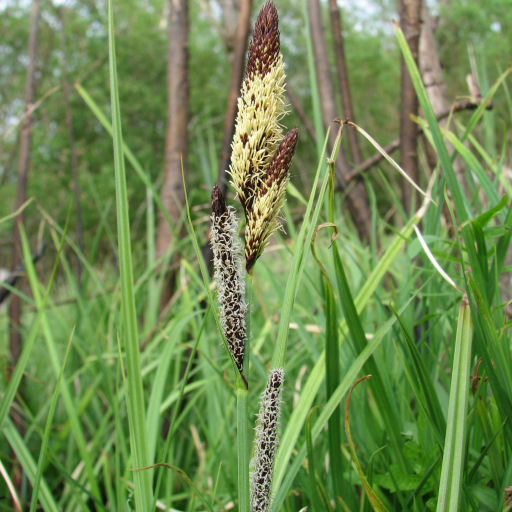
Plant Overview
Often called the Lesser Pond Sedge, this plant is an architectural powerhouse of the wetlands. It is a master of the marsh, frequently seen framing the edges of slow-moving rivers or garden ponds with its tall, elegant, blue-green plumes. While it looks like a grass at first glance, it belongs to the ancient and sturdy Sedge family, known for their "edgy" personalities and love for the water’s edge.
🔍 How to Identify
- 📐 Triangular Stems: Like most sedges, it follows the rule "Sedges have edges." If you roll the stem between your fingers, you will feel three distinct corners.
- 🗡️ Glaucous Leaves: The foliage is a striking grey-green (glaucous), long and tapering to a very fine, sharp point. They often arch gracefully toward the water.
- 🌾 Contrasting Spikes: In late spring, it produces dark, almost black-brown flower spikes. The male spikes sit at the very top, while the fatter female spikes hang just below them.
🏡 In Your Garden
- 💧 The Water Filter: This plant is a natural purifier. It is frequently used in "living ponds" because its root system is incredibly efficient at absorbing excess nutrients and heavy metals, helping to keep the water clear and healthy.
- 🚧 Space Management: Be aware that the Lesser Pond Sedge spreads via underground runners called rhizomes. In a small garden pond, it’s best planted in a submerged basket to prevent it from stage-managed "taking over" the entire shoreline.
- 🏗️ Erosion Control: Because of its dense, matted root system, it is a hero for gardeners dealing with crumbling banks or soggy soil that refuses to hold its shape.
⚠️ Safety & Toxicity
- 🌿 Non-Toxic: Carex acutiformis is generally considered non-toxic to humans, dogs, cats, and horses. It is a safe choice for family wildlife ponds.
- ✂️ Physical Risk: The primary danger is in its name (acutiformis means "sharply formed"). The edges of the leaves are lined with microscopic silica teeth that can cause small, irritating "paper cuts" if you slide your hand quickly along the blade. Wear gloves when pruning!
✨ Fun Fact
The Lesser Pond Sedge is a champion of phytoremediation. Scientists have used this specific plant to help "clean" land contaminated with industrial runoff, as it can store high levels of metals like copper and nickel in its tissues without dying.

Detailed Care Instructions
To grow Carex acutiformis, also known as lesser pond sedge or lesser pond-dwelling sedge, follow these steps:
- Find the right location: Carex acutiformis prefers moist to wet soil conditions and can tolerate full sun to partial shade. Choose a location that receives at least 4-6 hours of sunlight per day.
- Prepare the soil: The soil should be moist and rich in organic matter. Add compost or well-rotted manure to improve the soil's fertility and drainage.
- Planting: Carefully transplant the Carex acutiformis plants into the prepared soil. Dig a hole slightly larger than the root ball and place the plant in it. Backfill the hole with soil and firm it gently around the plant.
- Watering: Keep the soil consistently moist, especially during the establishment period. Water deeply to encourage the roots to grow downward.
- Mulching: Apply a layer of mulch around the plants to help retain moisture in the soil and suppress weeds. Avoid covering the base of the plant to prevent rotting.
- Maintenance: Ensure the plants receive adequate water throughout the growing season. However, avoid over-watering, as this can lead to root rot. Regularly check the soil moisture level and adjust your watering schedule accordingly.
- Fertilization: Apply a slow-release, balanced fertilizer in early spring to promote healthy growth. Follow the instructions provided on the fertilizer packaging for application rates.
- Division: Every 2-3 years, Carex acutiformis can be divided to prevent overcrowding and promote vigorous growth. Dig up the clumps and carefully separate them into smaller sections. Replant these divisions in the desired location.
- Pest and disease control: Carex acutiformis is generally resistant to pests and diseases. However, monitor the plants for any signs of damage or infestation. If necessary, use organic pest control methods or consult a professional for assistance.
- Winter care: Carex acutiformis is cold-tolerant and can usually survive the winter without protection. However, in extremely cold regions, you can apply a layer of mulch around the plants to provide insulation.
By following these steps and providing proper care, your Carex acutiformis plants should thrive and grow successfully.

Place in a bright room that is sun drenched almost all day. Or directly in a south-facing window.

To water this plant, it is important to keep the soil consistently moist but not waterlogged. It is recommended to water deeply once every week during the growing season, and less frequently during the dormant period. The plant should be watered at the base and not overhead to prevent any water from accumulating on its foliage. Always check the soil moisture level before watering, as over-watering may cause root rot and damage the plant. It is also advised to avoid using tap water as the plant may be sensitive to chemicals and minerals present in it. Instead, rainwater or distilled water is preferred for watering.
To properly fertilize Carex Acutiformis, you will need to follow these instructions:
- Choose a balanced fertilizer: Look for a slow-release, balanced fertilizer with equal amounts of nitrogen (N), phosphorus (P), and potassium (K). A ratio of 10-10-10 or 20-20-20 is suitable.
- Determine the appropriate time: Apply fertilizer to Carex Acutiformis in early spring or late winter before new growth begins. This ensures that the plant receives proper nutrients during its active growth phase.
- Dilute the fertilizer: Follow the instructions on the fertilizer package to dilute it properly. Mix the fertilizer with water according to the recommended ratio. This helps prevent fertilizer burn and excess nutrient uptake.
- Apply the fertilizer: Carefully pour the diluted fertilizer around the base of the Carex Acutiformis plant. Avoid direct contact with the foliage to prevent burning.
- Water the plant: After applying the fertilizer, water the plant thoroughly. This helps to distribute the nutrients evenly and avoid potential root damage.
- Repeat application: For best results, fertilize Carex Acutiformis every 4-6 weeks during the active growing season. However, be cautious not to over-fertilize, as this can lead to excessive growth or nutrient imbalances.
Remember, it is always recommended to read and follow the specific instructions provided by the fertilizer manufacturer to ensure appropriate and safe application.
The ideal soil for the plant in question should be a mixture of organic matter and well-draining soil. Avoid using heavy soils that retain too much moisture as they can lead to root rot. A pH value of 5.5 to 7 is good for the plant's growth, therefore the soil should be tested for the right pH value. The soil should also be fertile, with enough nutrients to support the growth of the plant. Adding a slow-release fertilizer to the soil is a good way to ensure that the plant gets the necessary nutrients. However, excessive fertilization should be avoided as it can damage the plant.
Carex acutiformis, commonly known as the lesser pond sedge, can be propagated through various methods. Here is a detailed description of how to propagate this plant:
- Division: The most common method of propagating Carex acutiformis is through division. This can be done by following these steps:
a. Select a mature, healthy plant for division.
b. Dig around the plant to carefully remove the clump from the ground, ensuring minimal damage to the root system.
c. Gently separate the clump into smaller sections, ensuring that each section has a portion of the root system and some above-ground growth.
d. Replant the divided sections in desired areas, ensuring they receive appropriate sunlight, water, and soil conditions.
- Seed Propagation: Carex acutiformis also reproduces through seed propagation. However, this method requires more time and effort. Here is a step-by-step guide for propagating from seeds:
a. Collect ripe seeds from mature plants in late summer or early autumn.
b. Clean the seeds by removing any debris or non-viable seeds.
c. Stratify the seeds, which is mimicking natural winter conditions, by placing them in a moist medium in the refrigerator for about 6-8 weeks. This breaks the dormant stage of the seeds.
d. After stratification, sow the seeds in a seed tray or pots filled with a sterile, well-draining soil mix.
e. Cover the seeds lightly with a thin layer of soil and gently press them down.
f. Place the tray or pots in a warm location with indirect sunlight.
g. Keep the soil consistently moist but not waterlogged.
h. Germination should occur within a few weeks to a few months, depending on the conditions provided.
i. Once the seedlings have grown a few inches tall and have developed a good root system, they can be transplanted into individual pots or directly into the ground.
- Rhizome Cuttings: Carex acutiformis can also be propagated through rhizome cuttings, although this method is less commonly used. Here's how to do it:
a. Select a healthy, mature plant with established rhizomes.
b. Dig around the plant to carefully expose the rhizomes.
c. Cut off a section of the rhizome, ensuring it has several nodes and some foliage attached.
d. Plant the cutting in a pot or directly in the ground, ensuring it is placed horizontally with the nodes covered by a layer of soil.
e. Water the cutting regularly to keep the soil moist, but avoid over-watering.
f. After a few weeks, new growth should appear, indicating successful propagation.
Remember, Carex acutiformis prefers moist to wet soil conditions, and its propagation success may vary depending on the specific growing conditions and region.








