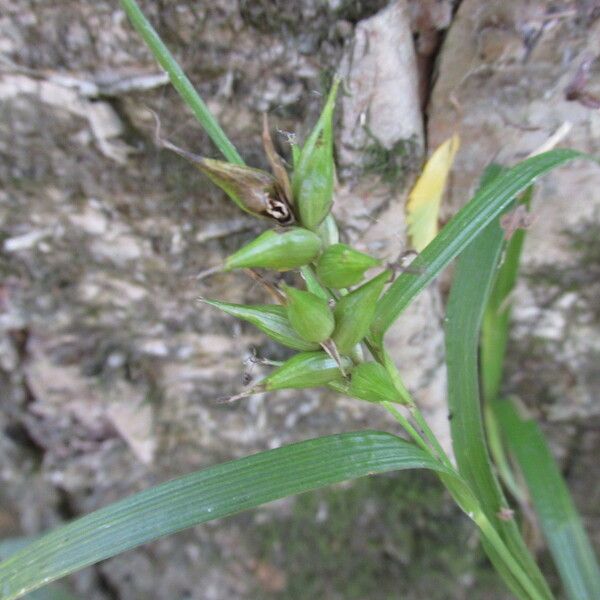
Plant Overview
The Northern Long Sedge, scientifically known as Carex folliculata, is a standout member of the sedge family that looks more like a collection of tiny green medieval morning stars than a typical blade of grass. Often found gracing the edges of mystical woodland swamps and damp meadows across Eastern North America, this perennial brings a structural, architectural elegance to the "wet feet" areas of a landscape. Its bright, yellowish-green hue provides a luminous quality to shaded garden corners.
🔍 How to Identify
- 🌾 The Seed Pods: Its most striking feature is the clusters of "perigynia"—the seed-bearing pouches—which are long, inflated, and taper to a sharp point, resembling tiny green bottles or stars.
- 🍃 Leaf Structure: The leaves are relatively wide for a sedge (up to 12mm) and have a distinct yellowish-green tint that makes them pop against darker forest foliage.
- 📏 Growth Habit: It grows in tidy, fountain-like clumps (cespitose), reaching heights of about 2 to 3 feet, ensuring it doesn't spread aggressively like some of its "creeping" cousins.
🏡 In Your Garden
- 💧 Thirst for Moisture: Unlike standard lawn grass, this sedge thrives in "mucky" conditions. It is a perfect choice for rain gardens or the edges of a backyard pond where the soil stays consistently damp.
- 🌲 Acidic Preferences: It is a specialist of acidic soils. If your garden has peat or sits under the needle-drop of pine trees, this plant will feel right at home while other plants might struggle with the pH.
- 🌥️ Light Play: While it enjoys dappled sunlight, it is remarkably resilient in deep shade, using its pale foliage to reflect what little light reaches the forest floor.
⚠️ Safety & Toxicity
- ✅ Pet & Human Safe: Carex folliculata is generally considered non-toxic to dogs, cats, and humans. It is a safe, "worry-free" addition to family gardens.
- ✂️ Mechanical Irritation: Like many sedges, the edges of the leaves can be slightly "saw-toothed." While not dangerous, they can cause minor paper-cut-like scratches if handled roughly or if a pet runs through a dense patch.
✨ Fun Fact
The specific epithet folliculata comes from the Latin word for "small bag" or "pouch," referring to those iconic, air-filled seed sacs that allow the seeds to float and disperse via water during heavy rains!

Detailed Care Instructions
To grow Carex folliculata (Scop) Holmboe plant, follow these steps:
- Choose the right planting location: Carex folliculata prefers moist to wet soil conditions. Select a location in your garden that receives partial shade to full sun.
- Prepare the soil: Carex folliculata prefers fertile soil with good drainage. Remove any weeds or debris from the planting area and loosen the soil with a garden fork or tiller. You can also add organic matter, such as compost or well-rotted manure, to improve the soil's fertility.
- Plant the Carex folliculata: Dig a hole in the prepared soil that is slightly larger than the plant's root ball. Gently place the plant in the hole, ensuring that the top of the root ball sits level with the soil surface. Fill the hole with soil, lightly firming it around the roots.
- Water the plant: After planting, water the Carex folliculata thoroughly to help it establish itself. Keep the soil consistently moist but avoid waterlogging.
- Mulch the area: Apply a layer of organic mulch, such as straw or wood chips, around the base of the plant. This helps conserve moisture, keep the soil cool, and suppress weed growth.
- Maintain proper care: Carex folliculata requires regular watering to keep the soil moist. However, ensure that the plant doesn't sit in stagnant water. Watering 1-2 times per week, depending on rainfall and soil moisture, is usually sufficient.
- Fertilize as needed: While Carex folliculata does not usually require regular fertilization, you can apply a slow-release, balanced fertilizer once a year, preferably in early spring.
- Remove weeds: Regularly check the planting area for weed growth and promptly remove any weeds to prevent competition for nutrients and water.
- Division and propagation: Carex folliculata can be divided every few years to maintain healthy growth. Dig up the plant, separate the clumps, and replant them in the desired location.
- Prune as needed: Trim back any dead or damaged leaves to maintain the plant's appearance. Pruning can be done in early spring or fall.
By following these steps, you can successfully grow Carex folliculata in your garden or landscape.

Place in a bright room that is sun drenched almost all day. Or directly in a south-facing window.

When watering this particular plant, it is important to keep in mind its preference for consistently moist soil. Watering should be done thoroughly, ensuring that water penetrates deep into the soil to reach the roots. However, it is important not to over-water and cause waterlogging, which can lead to root rot. Therefore, it is recommended to check the moisture level of the soil before watering. This can be done by inserting a finger into the soil to gauge if it feels damp or dry. Watering should be reduced during cooler months when the plant requires less moisture. It is also recommended to use a watering can or gentle sprinkler to avoid damaging the delicate foliage.
For optimal growth and health of this plant, you should fertilize it with a balanced, slow-release fertilizer during the growing season. Apply the fertilizer according to the manufacturer's instructions, taking care not to overfertilize as this can damage the plant. Additionally, it is important to provide adequate water to the plant during dry periods, as this will help it absorb nutrients and thrive. If the plant shows signs of nutrient deficiency, such as yellowing leaves or stunted growth, fertilize more frequently or with a higher dosage.
Carex Folliculata requires well-draining soil that is nutrient-rich and moist. It prefers soil that is slightly acidic and has a pH level of 5.5 to 6.5. The ideal soil for this plant is composed of a mixture of peat moss, loam, and sand. The peat moss provides moisture retention, the loam provides nutrients, and the sand ensures good drainage. Avoid using heavy clay or sandy soils as they can retain too much or too little moisture, respectively. It is also recommended to use soil that is free from pests and diseases to prevent infecting the plant.
Carex folliculata is a plant that can be propagated by division. The process involves separating the clump of roots and shoots into smaller segments, which are then replanted in new locations or pots. To propagate Carex folliculata, the following steps should be taken:
- Choose a healthy plant: Look for a mature and robust plant with no signs of diseases or pests.
- Select the right time: The best time to divide Carex Folliculata is in the early spring or late fall when the plant is dormant.
- Dig out the clump: Use a shovel to dig out the entire clump of Carex folliculata. Be careful not to damage the roots and shoots.
- Separate the clump: Using a sharp knife or scissors, divide the clump of roots and shoots into smaller sections. Each section should have at least one healthy shoot and a few roots attached to it.
- Replant the divisions: Plant each division in a new location or pot. The soil should be moist and well-drained. Ensure that the plant is planted at the same depth as before.
- Water the plants: Water the newly planted divisions and keep the soil moist until they are established.
- Provide care: Give the newly planted divisions plenty of sunlight and regular watering to encourage healthy growth.
By following these steps, you can successfully propagate Carex folliculata plants.








