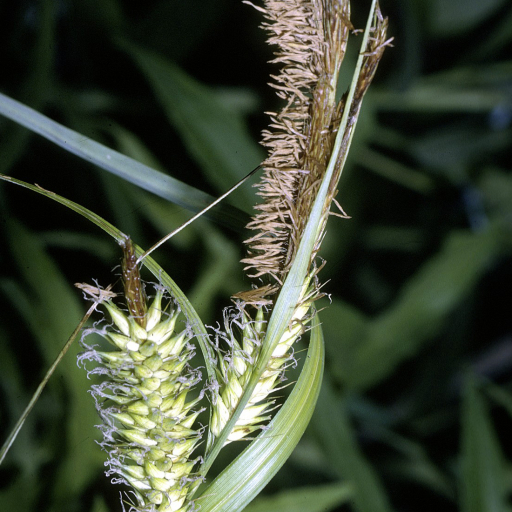
Plant Overview
Often called the Lake Sedge, Carex lacustris is a true powerhouse of North American wetlands. With its impressive height and striking bluish-green foliage, it often looks like a shimmering sea of tall grass swaying in the marsh. It is a vital "ecosystem engineer," holding shorelines together with a hidden, complex network of underground roots that prevent erosion.
🔍 How to Identify
- 📐 Triangular Stems: True to the old botanist's rhyme—"Sedges have edges"—the stems of this plant are distinctly three-sided and feel sharp to the touch when rotated between your fingers.
- 🍃 Wide Blue-Green Leaves: Unlike many spindly grasses, Lake Sedge has broad leaves (up to half an inch wide) that feature a prominent "M" or "W" shape in cross-section and a beautiful glaucous (waxy) blue-green hue.
- 🎨 Purple Bases: If you look closely at the very bottom of the plant near the soil line, the leaf sheaths are typically tinted a deep, royal purple or wine-red color.
🏡 In Your Garden
- 💧 The Muck Factor: This plant is a "hydrophile," meaning it loves water. It is best used in rain gardens, pond edges, or low-lying areas of your yard where water tends to pool. It thrives where other plants might "drown."
- 🏃 Space to Roam: Because it spreads via vigorous underground runners (rhizomes), it is excellent for filling large, difficult spaces quickly. However, avoid planting it in small, decorative containers or tight borders where it might crowd out delicate neighbors.
⚠️ Safety & Toxicity
- ✅ Non-Toxic: Carex lacustris is generally considered safe and non-toxic for both humans and household pets like cats and dogs.
- ✂️ Paper-Cut Warning: The leaf margins are lined with tiny, microscopic teeth made of silica. While not poisonous, the leaves can be quite sharp—always wear gardening gloves when pruning or transplanting to avoid "grass cuts."
✨ Fun Fact
Lake Sedge provides a specialized habitat for the rare Sedge Wren. These tiny birds rely on the dense, sturdy stalks of Carex lacustris to weave their intricate, globe-shaped nests just inches above the water line.

Detailed Care Instructions
To grow Carex lacustris, or lake sedge, you can follow these steps:
- Choose the right location: Carex lacustris prefers growing in wet or boggy areas, such as marshes, wetlands, or along the edges of ponds. Make sure the spot you select has consistently moist soil.
- Prepare the soil: Carex lacustris thrives in nutrient-rich soil, so you can enrich your planting area by adding organic matter like compost or aged manure. This will help improve water retention and provide essential nutrients.
- Planting: Dig a hole that is deep enough to accommodate the plant's root ball. Place the Carex lacustris in the hole and backfill with soil, gently firming it around the roots. Ensure the crown of the plant is at or slightly above the soil level.
- Watering: Water the plant thoroughly after planting to settle the soil. Carex lacustris requires consistently moist soil, so regularly check the soil moisture level and provide enough water to keep it consistently damp. Avoid overwatering, as it may lead to root rot.
- Mulching: Apply a layer of organic mulch like wood chips or straw around the plant to help retain moisture, keep the soil cool, and suppress weeds. Leave a small gap around the stem to prevent excess moisture from getting trapped.
- Fertilizing: Carex lacustris generally doesn't require additional fertilization, especially if you have prepared the soil with organic matter beforehand. However, if the plant shows signs of nutrient deficiency, you can opt for a slow-release, balanced fertilizer.
- Pruning: This plant doesn't require regular pruning, but you can trim any dead or damaged leaves or stems as needed.
- Winter care: Carex lacustris is hardy and can tolerate freezing temperatures. However, if you are expecting severe winter conditions, you can apply a layer of mulch around the base of the plant to provide extra insulation.
By following these guidelines, you should be able to successfully grow Carex lacustris. Remember to monitor the soil moisture levels and provide the plant with the conditions it needs to thrive.

Place in a bright room that is sun drenched almost all day. Or directly in a south-facing window.

Carex Lacustris is a plant that requires regular watering to grow and thrive. It is important to water the plant regularly, especially during the growing season when the plant is actively growing and producing new leaves and flowers.
When watering Carex Lacustris, it is important to water deeply and thoroughly to ensure that the roots receive plenty of moisture. This can be done by watering the plant slowly with a hose or watering can, allowing the water to soak into the soil and reach the roots.
It is also important to avoid over-watering the plant, as this can lead to root rot and other problems. To avoid over-watering, it is best to wait until the soil is dry to the touch before watering again.
In addition to regular watering, Carex Lacustris also benefits from a regular fertilization schedule. This can be done using a slow-release fertilizer or by adding a liquid fertilizer to the watering can.
Overall, providing Carex Lacustris with consistent and regular watering and fertilization will help to ensure that it grows and thrives in your garden or landscape.
To fertilize this plant, first, ensure that the soil is moist. Apply a slow-release fertilizer in early spring, avoiding direct contact with the foliage. Use a balanced 10-10-10 or 20-20-20 fertilizer, applying at a rate of 1/2 pound per 100 square feet of planting area. Follow the manufacturer's instructions for application. Avoid over-fertilization, as this can lead to burning and damage to the plant. Water thoroughly after fertilizing to help activate the nutrients and prevent root damage.
The ideal soil for sustaining the growth of this species of plant should possess a relatively high content of organic matter, and be similarly rich in iron, nitrogen, and phosphorus. A neutral pH range between 6.0 and 7.5 is optimal for the cultivation of this plant, owing to the fact that it does not thrive in overly acidic or basic mediums. In addition, the soil must be able to retain sufficient moisture while also allowing for adequate drainage to control waterlogged conditions. Mixing in sand, peat moss, or vermiculite can assist with improving drainage and retaining moisture levels in the soil.
To propagate this plant, you will need to obtain healthy and mature plant specimens with intact roots. Using a clean and sharp gardening tool, carefully divide the root system into several smaller sections, ensuring that each division has a sufficient amount of roots and healthy foliage.
Prepare the planting location by selecting a site that receives adequate light and moisture levels, and has well-draining soil. Dig holes with a trowel or spade at least several inches deep and wide enough to accommodate each of the divided plants.
Plant each section in the hole, filling in with soil to secure the plant in place. Water the newly planted sections to help settle the soil, and keep the soil moist during the initial establishment period.
Monitor the plants regularly for signs of growth and development, and provide adequate water and nutrients as needed. With proper care, the divided sections should grow into healthy and mature plants that can be further divided for continued propagation.








