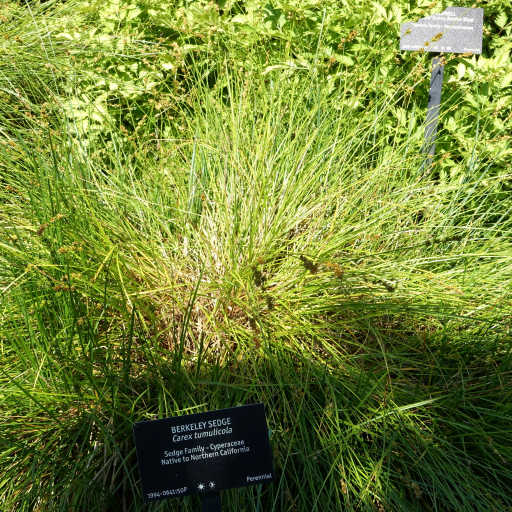
Plant Overview
Often called the Berkeley Sedge, this graceful evergreen is a superstar of meadow-style gardening and "no-mow" landscapes. Native to the western coast of North America, it offers a soft, fountain-like texture that ripples beautifully in the wind. It is the go-to problem solver for those awkward, dry shady spots where traditional turf grass refuses to grow.
🔍 How to Identify
- 🌿 Growth Habit: It forms dense, arching clumps of narrow, bright green blades that spill outward like a botanical fountain.
- 🌾 Inflorescence: In late spring, look for tiny, inconspicuous brownish flower spikes tucked subtly among the foliage rather than towering over it.
- 📏 The Silhouette: Unlike many spreading grasses, it stays in a tidy, mounded shape, typically reaching about 1 to 2 feet in height and width.
🏡 In Your Garden
- 💧 Watering Wisdom: While it appreciates regular moisture to get established, this sedge is surprisingly drought-tolerant once its roots are deep, making it a "set it and forget it" favorite for sustainable yards.
- 🌍 Soil & Erosion: It isn't picky about dirt; whether you have heavy clay or sandy coastal soil, it digs in and holds its ground, making it excellent for stabilizing slopes or edges.
- ✂️ Low Maintenance: You don't need to mow it! If it looks a bit shaggy after winter, a simple "haircut" in early spring (cutting it back by one-third) will stimulate fresh, vibrant growth.
⚠️ Safety & Toxicity
- 🐾 Pet Friendly: This plant is generally considered non-toxic to dogs, cats, and horses, making it a safe choice for busy family backyards and play areas.
- 🧤 Skin Protection: While not poisonous, the leaf edges can be slightly sharp. It is wise to wear gardening gloves when pruning a large patch to avoid minor "grass cuts."
✨ Fun Fact
Berkeley Sedge is a master of disguise! For decades, many plants sold in nurseries under the name Carex tumulicola were actually a look-alike European species called Carex divulsa. It took a group of eagle-eyed botanists to finally sort out the true California native from its overseas twin!

Detailed Care Instructions
To grow Carex Tumulicola, or Berkeley sedge, you can follow these steps:
- Find the right location: Carex Tumulicola is a versatile plant that thrives in various conditions. It prefers partial shade and moist soil but can also tolerate full sun and drier conditions.
- Prepare the soil: The soil should be well-draining and rich in organic matter. If your soil is heavy clay, add some compost or sand to improve drainage.
- Planting: Dig a hole slightly larger than the root ball of the Carex Tumulicola. Place the plant in the hole, ensuring that the crown is level with or slightly above the soil surface. Gently backfill the hole with soil and pat it down to eliminate any air pockets.
- Watering: Water the newly planted Carex Tumulicola thoroughly to help establish its roots. Afterward, water it regularly, especially during drought periods, to keep the soil moist but not waterlogged.
- Mulching: Apply a layer of organic mulch around the base of the plant, such as wood chips or straw. Mulching helps retain moisture, suppress weeds, and regulate soil temperature.
- Fertilizing: Carex Tumulicola doesn't have high fertilization needs, but you can apply a slow-release, balanced fertilizer in spring to promote healthy growth. Follow the instructions on the fertilizer packaging for application rates.
- Pruning: Berkeley sedge generally requires minimal pruning. However, if the plant becomes untidy or overgrown, you can trim it back in late winter or early spring before new growth emerges.
- Division: Over time, Carex Tumulicola may clump and become crowded. To rejuvenate the plant and maintain its health, you can divide it every few years. Dig up the clump and separate it into smaller sections, ensuring each section has a good portion of roots. Replant the divisions in desired locations and water them well.
By following these guidelines, you should be able to successfully grow Carex Tumulicola.

Place in a window with dappled sun or a spot in the middle of a room. Or directly in a window facing west or east.

Carex Tumulicola plant requires regular watering to keep the soil moist but not waterlogged. The frequency of watering depends on factors like the temperature and humidity of the environment, the size of the plant, and the type of soil. Ideally, it is best to water the plant when the top inch of soil is dry to the touch. When watering, make sure to water deeply, allowing the water to penetrate the roots of the plant. It is essential to avoid getting water on the foliage, as this can cause fungal diseases. It is recommended to water in the morning to allow the plant to dry before nightfall. If the soil is prone to drying out quickly, it may be necessary to mulch around the plant to retain moisture. Overwatering can lead to root rot, so it is crucial to maintain a careful balance between keeping the soil moist and not overwatering.
- Choose a fertilizer with a balanced ratio of nitrogen, phosphorus, and potassium.
- Apply the fertilizer in the early spring before new growth appears.
- Follow the instructions on the fertilizer package for application rates and methods.
- Water the plant immediately after fertilizing to help distribute the nutrients.
- Repeat fertilization once a year in the early spring for optimal growth.
Carex Tumulicola is a perennial ornamental grass that is native to North America. When selecting soil for this plant, it is important to consider its natural habitat. Carex Tumulicola grows in moist areas such as stream banks, meadows, and wetlands. Therefore, it thrives in soils that are rich in organic matter and retain moisture well.
A suitable soil for Carex Tumulicola should be well-draining, but also retain enough moisture to keep the plant hydrated. The ideal pH range for this plant is between 5.5 and 7.5, which is slightly acidic to neutral.
When planting Carex Tumulicola, it is recommended to amend the soil with compost or other organic matter to improve fertility and moisture retention. A mix of topsoil, compost, and peat moss is an excellent option. Avoid using heavy clay soils, which can retain too much water and cause root rot.
In summary, a suitable soil for Carex Tumulicola should be well-draining, rich in organic matter, and retain moisture well. It should also have a slightly acidic to neutral pH range.
To propagate this plant, you will need to carefully remove the mature plant from its pot or garden bed and divide the rhizomes into several sections. These sections should each have a few healthy shoots and roots.
Then, prepare small pots with well-draining potting soil and plant each section of the divided rhizomes in its own pot. Water the newly planted sections thoroughly and place them in an area with filtered light, keeping the soil consistently moist.
After a few weeks, new growth should start to emerge from the section you planted. At this point, you can gradually introduce the plant to more sunlight until it is able to handle full sun exposure.
Continue to care for the young plant by keeping the soil consistently moist and fertilizing it with a balanced fertilizer every few weeks. As the plant grows, you may need to transplant it into a larger pot or garden bed to accommodate its size.








